


Introduction
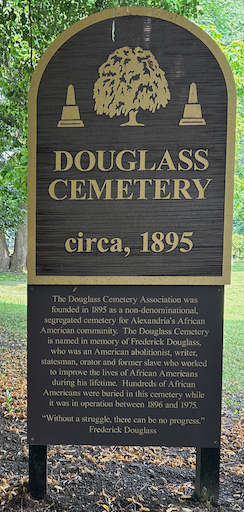
Douglass Memorial Cemetery, at 1421 Wilkes Street in Alexandria, Virginia, was established in 1895 as a segregated, nondenominational African American burial ground and named in memory of Frederick Douglass, who had died that February. It received burials for eighty years, until 1975, and is one of the thirteen burial grounds that make up the Wilkes Street Cemetery Complex. Records suggest more than 2,000 people lie here. Fewer than 700 markers remain visible. This page gathers what the deeds, the newspapers, the interment records, and two recent archaeological studies tell us about the ground and the people who created it.
Founding a Cemetery in Frederick Douglass’s Name
The land was once part of Spring Garden Farm and later belonged to William Burton Richards, who is buried across the complex in St. Paul’s Cemetery. The parcel Richards’s successors sold measured roughly 147 by 355 feet, just north of Wilkes Street at its junction with the extension of West Street.
On July 3, 1895, Jesse H. Graham of Washington, D.C., together with David J. Howell and Mary M. Howell of Alexandria, conveyed the tract to Rufus H. Porter, Henry H. Waring, Fields Cook, Freeman H. M. Murray, and William B. Dulaney as Trustees of the Douglass Cemetery Association. The deed came with conditions. A ten-foot right of way from Wilkes Street was reserved down the center of the tract. The trustees were to lay out, enclose, and subdivide the ground into lots and sell them, while the grantor would mow and maintain the property until the Association’s monthly payments reached the purchase price of $2,400.
Work began at once. In October 1895 the Alexandria Gazette reported that “a force of workmen is employed in opening the walks, grading the ground and grading an entrance at the new Douglass Memorial cemetery for colored people, on the western outskirts of the city,” and that the owners were “preparing to erect a monument in the center of the cemetery to the memory of Fred. Douglass.” The following February the paper announced that the board of trustees — the Reverends Porter and Waring, Fields Cook, W. B. Dulaney, and M. B. T. Murray, “all colored” — would control the land and intended to make the cemetery “a very handsome one.”
The oldest burial Wesley Pippenger located when he transcribed the stones was that of Alexander Harden, who died March 22, 1896, at the age of fifty-one.
L. Peyton Chauncey and the Loan
A persistent story holds that L. Peyton Chauncey, the Alexandria memorial stone carver, owned the land before it became a cemetery. He did not. The Association’s purchase was financed, and the ground itself stood as collateral. A couple of years after the cemetery opened, the loan went into default. Chauncey paid it off and took over management of Douglass, running the cemetery alongside his stone business, which supplied markers to burial grounds across Alexandria.
James Click, longtime proprietor of the neighboring Bethel Cemetery, told Pippenger how Chauncey ran the place: he sold the plot and the headstone together as one package. That practice explains why so many stones in the later, eastern section look alike — and why so many people bought the plot but never the stone.
Chauncey is buried in the Union Cemetery of the Washington Street United Methodist Church, also part of the Wilkes Street complex. Other members of his family lie in the abandoned Methodist Protestant Cemetery across Wilkes Street, beside the Alexandria National Cemetery.
How the Ground Was Used
A lane running north from Wilkes Street divides the cemetery into two sections that were used in very different ways.
The western section, about two-thirds of the ground, was used first. It was sold as family lots, and relatives were buried together. The stones vary in age, style, and placement, and the 2019 ground-penetrating radar survey found that headstones here generally sit over real graves — but also found many graves with no stone at all.
The eastern section was opened in 1928 and filled in strict rows, west to east, in the order people died, with standardized stones that give it the look of a military cemetery. The oldest graves lie in its southwest corner and the most recent in its northeast. Radar showed that stone and grave line up well in the first rows but drift apart farther east, with clusters of stones over no detectable burial and clusters of burials with no stones.
The last known burial at Douglass took place in 1975.
More Than 2,000 Burials, Fewer Than 700 Stones
The Douglass Cemetery Association’s interment records, which survive for 1896 to 1959 and were published by City Historian T. Michael Miller in 2004, together with Virginia death certificates after 1912, suggest that more than 2,000 people were buried here. Pippenger’s transcription recorded roughly 670 marked graves.
The gap is not carelessness. In October 2019, Rhea Engineers and Consultants surveyed the cemetery with ground-penetrating radar for Alexandria Archaeology and identified about 780 probable graves — a low count, since infant graves are easily missed and in some areas burials are packed too closely to separate. Only about 11 percent of those graves showed the clear outline of a vault or an intact coffin. The rest are grave shafts with nothing detectable inside: bodies buried in a pine box or in no container at all. Many burials were marked only with a wooden marker that has long since rotted, or with nothing. The survey is a map of a community that buried its dead with what it could afford.
Water
Water has shaped this ground from the beginning. The 1862 Coast Survey map shows the block empty except for one house, with a stream cutting across it from southeast to northwest — probably the reason the land stayed undeveloped until the Association bought it. By 1865 the stream had been straightened into a channel running parallel to the city grid, and in September 1902 the Gazette noted sewer pipe being laid along Bethel Cemetery’s northern edge to carry water across Wilkes Street “into the sewer running through the Douglass cemetery.” A 1973 topographic map still shows the open channel. A corrugated metal pipe was laid into that old ditch beneath the central footpath around 1976, after the last burial, and served — badly — for fifty years until the City replaced it in 2026.
The old pipe never kept up. For decades, heavy rain left standing water over graves in the low eastern section, and flooding was the cemetery’s most serious preservation threat.
The Building to the North
Many people believe that the low-rise condominium along the cemetery’s present northern boundary was built over graves. The evidence points the other way.
A low earthen berm marks the north edge of the cemetery and separates it from an open drainage ditch that runs between the burial ground and the building. In January and February 2024, archaeologists from Gray & Pape cut a trench across that berm ahead of the drainage project. They found three layers of fill over subsoil, no buried ground surface, no artifacts, and no grave-related features — evidence that the strip had been graded before the berm was built. Combined with the historic maps, which put the stream and later the drainage channel along the north side of the block, the archaeology supports the view now held by most people who have studied the site: the building stands north of the burial ground, not on top of it.
Neglect, and a Long Road Back
By the 1960s the Association had faded and the cemetery with it. A columnist who walked the ground in April 1967 found it desolate and bare. Douglass eventually passed into the care of the City of Alexandria as an abandoned cemetery, and neighbors — including the residents of Old Town Village — took up mowing and trash removal.
The turn came in the last decade. In 2019 a local Boy Scout organized a restoration effort that drew national press, the City installed a historic interpretation sign, and Alexandria Archaeology commissioned the geophysical survey. In 2022 the Virginia General Assembly funded cemetery preservation with the support of Senator Adam Ebbin and Delegate Elizabeth Bennett-Parker, and conservator Howard Wellman surveyed every visible stone and produced a preservation plan.
In 2023, a Douglass Cemetery Descendant Advisory Group formed, and the City accepted a quitclaim deed that gave it a one-quarter ownership interest in the property so preservation work could proceed. Since 2022, the Alexandria Oral History Center has been recording interviews with descendants.
Gravestone conservation began in the fall of 2024, when Wellman and Devlin McDonald treated 18 stones on the west side, and continued in the fall of 2025 with 26 more, funded by the Virginia Department of Historic Resources’ African American Cemetery and Graves Fund. Descendants and City staff have been trained in cleaning and resetting stones. A further round is planned for fall 2026.
The stormwater project that had been discussed for decades is now complete. Jacobs Engineering designed a replacement for the failed pipe beneath the footpath and a channel through the northern berm to let the ponded eastern section drain. The 2024 archaeological testing established a corridor along the path where the work could proceed without disturbing burials, and archaeologists monitored every excavation. The Department of Historic Resources approved the City’s burial-recovery permit in December 2025, Flippo Construction broke ground in early 2026, and the work was finished in 2026. For the first time since the cemetery opened, the low ground no longer holds water after a storm.
Throughout, the Friends of Douglass Cemetery and the Social Responsibility Group have kept the cemetery in the public eye. For the City’s current updates, meeting presentations, and the Friends’ newsletters, see the City of Alexandria’s Douglass Memorial Cemetery page.
People to Know
Fields Cook (1820 – 1897)
An original trustee of the Douglass Cemetery Association, Fields Cook was a minister, a former enslaved man, and one of the most consequential Black leaders in postwar Virginia — he sat on the Richmond grand jury that indicted Jefferson Davis for treason. He is buried in Bethel Cemetery, directly across Wilkes Street. Read his full story here.
The Trustees of 1895
Rufus H. Porter and Henry H. Waring were ministers; Freeman H. M. Murray, William B. Dulaney, and Fields Cook were laymen. Together they bought the land, laid out the walks, and planned a monument to Douglass at the center of the ground.
L. Peyton Chauncey
Stone carver, lender of last resort, and for years the man who ran Douglass Cemetery. See above.
Part of a Larger Complex
Douglass, established in 1895, is one of the thirteen burial grounds in the Wilkes Street Cemetery Complex. The complex’s grounds date from 1796 to 1933 — Agudas Achim being the youngest — and together hold more than 35,000 burials. The complex includes Protestant, Jewish, municipal, military, and burial-association grounds, and two historically African American cemeteries: Douglass and the Black Baptist Cemetery (1885) on Holland Lane. Walking from one to the next, you can trace the changing burial customs, memorial styles, and demographics of Alexandria across two centuries.
Learn more about the complex or join a Wilkes Street Cemetery Complex tour.
Visiting and Further Information
Douglass Memorial Cemetery is at 1421 Wilkes Street, Alexandria, VA 22314, on the north side of Wilkes Street opposite Bethel Cemetery. It is open ground; please stay on the paths, as unmarked burials lie throughout.
Related sites:
- Alexandria Black History Museum and the Watson Reading Room, 902 Wythe Street
- Alexandria African American Heritage Park, 600 Holland Lane, across Hooff’s Run to the west of the complex
- Freedom House Museum, 315 Duke Street
- Contrabands and Freedmen Cemetery Memorial, 1001 S. Washington Street
- African American Heritage Trail, City of Alexandria
Sources of Information
Alexandria Gazette, “Local Brevities,” October 18, 1895, p. 3; Alexandria Gazette and Virginia Advertiser, February 26, 1896, p. 3; Alexandria Gazette, “Local Brevities,” September 30, 1902.
City of Alexandria, Office of Historic Alexandria. Douglass Memorial Cemetery. https://www.alexandriava.gov/historic-sites/douglass-memorial-cemetery
Fairfax County Deed Book W No. 5, pp. 32-34 (July 3, 1895).
Gray & Pape, Inc. (2024). Management Summary: Archaeological Testing for Proposed Drainage Improvements at the Douglass Cemetery, Alexandria, Virginia. Prepared for Jacobs Engineering Group. https://media.alexandriava.gov/content/oha/reports/DouglassCemeteryMgmtSummary2024.pdf
Greenly, M. D. (1996). Those Upon Whom the Curtain Has Fallen: Past and Present Cemeteries of Old Town Alexandria, Virginia. Alexandria Archaeology Publications No. 88.
Johnson, N. E., and W. J. Johnson (2019). Non-Invasive Geophysical Surveys, Douglass Memorial and Penny Hill Cemeteries, Alexandria, Virginia. Rhea Engineers and Consultants, Inc., for Alexandria Archaeology. https://media.alexandriava.gov/docs-archives/historic/info/archaeology/sitereportjohnsongeophysicalsurveysdouglassandpennyhill.pdf
Miller, T. M. (2004). Douglass Cemetery Association, Fairfax County, Virginia: Interment Records, 1896-1959. Alexandria Library, Local History/Special Collections.
Pippenger, W. E. (1992). Tombstone Inscriptions of Alexandria, Virginia, Volume 3. Family Line Publications, Westminster, MD.
Pippenger, W. E. (2005). Tombstone Inscriptions of Alexandria, Virginia, Volume 5. Family Line Publications, Westminster, MD.
Wellman Conservation, LLC (2022). Douglass Memorial Cemetery Preservation Plan. https://media.alexandriava.gov/content/oha/reports/DouglassCemeteryPreservationPlanWellmanAX140.pdf
Find A Grave. Douglass Cemetery. https://www.findagrave.com/cemetery/2151092/douglass-cemetery