

Born on April 6, 1820, Major George Duffey was a third-generation silversmith in Alexandria and lived until July 10, 1896. He lies at rest in The Methodist Protestant Cemetery.
His grandfather, John Duffey, was responsible for crafting the silver trowel used by President George Washington on September 18, 1793, to lay the cornerstone of the United States Capitol building. This same tool was employed in constructing prominent structures like the Smithsonian, United States Supreme Court, National Cathedral, Library of Congress, and Jefferson Memorial.
Today, this treasured artifact can be found at the George Washington Masonic National Memorial.
George Duffey’s father, George Hurd Duffey, who lived between September 11, 1801, and February 2, 1852, owned a tavern on Royal Street. Known as an adept “mechanic,” he worked with materials like steel, brass, silver, and gold in his North Royal Street shop. He is also buried in the Methodist Protestant Cemetery.
The Mechanical Artillery
In 1850, a group known as the Mechanical Artillery was initiated by Duffey in Alexandria, housing four bronze cannons at the Gun House on Columbus Street. Six years later, in 1856, the organization was renamed the Alexandria Artillery.
As he was then known, Major Duffey was ordered on November 17, 1859, to proceed to Charles Town, Virginia, to safeguard the jail where the abolitionist John Brown was detained. Brown had received a death sentence by hanging for his role in instigating a raid on Harpers Ferry’s armory, intending to spark a slave uprising. Charles Town later became a part of the State of West Virginia, which was carved out from Virginia’s western counties and became a part of the United States on June 20, 1863.
John Brown met his end by hanging on December 2nd, 1859, and the Alexandria Artillery remained in Charles Town until December 23rd. During the Civil War, the Alexandria Artillery was designated Company E of the 18th Virginia heavy artillery under the leadership of [David Lowe Smoot].


How Major George Duffey Saved Alexandria’s Historic Documents
At the onset of the Civil War, Duffey took it upon himself to preserve significant historical documents of Alexandria. Among these papers was a map of Alexandria, crafted by George Washington during the town’s planning in 1748-1749. These invaluable records were concealed at Wise’s Tavern, a location imbued with history. At Wise’s Tavern, George Washington bid farewell to his friends and neighbors in Alexandria on April 16, 1789, before embarking on his journey to New York to assume the presidency. On this memorable occasion, Alexandria’s Mayor, Dennis Ramsay, greeted Washington with the title “The President of the United States” for the very first time. This historical tavern can be found at 217 Cameron Street in the Old Town district.


On July 1, 1845, Duffey tied the knot with Sarah Catherine Steele. Tragically, she succumbed to Tuberculosis and passed away on September 22, 1890. Together, the couple had fifteen children, of whom eleven survived to adulthood.
A. N. V. Reserve Ordnance Train Command
Once Virginia seceded from the Union, Major Duffy enlisted in the Confederate army, rising to the rank of Lieutenant Colonel. Initially, he served under the command of Edward Porter Alexander, who orchestrated the substantial Confederate artillery assault against the Union forces on Gettysburg’s third day. Later, from 1863 to 1865, Duffy took charge of the reserve ordnance train for the Army of Northern Virginia. An interesting note to this historical account is that Duffy’s brother, Edward Samuel Duffy, held the position of Ordinance Sergeant. He is known to have fired the concluding shot of the battle at Gettysburg while serving with Parker’s Virginia Light Artillery.
George Duffey’s Postwar Life
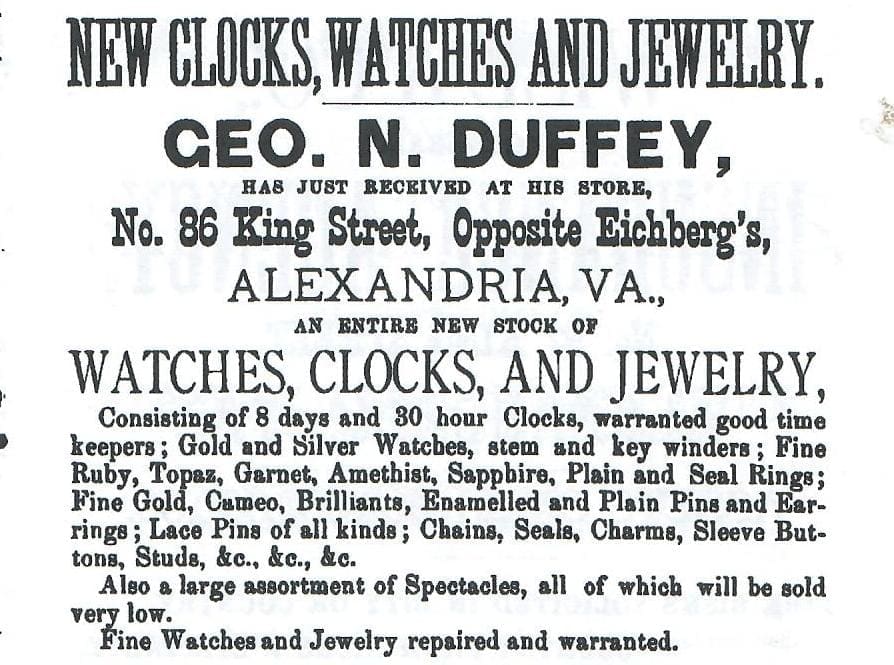
After the war, Duffey resumed his role in the family’s jewelry enterprise. He was honored with the position of Chief Marshall during Alexandria’s Centennial parade on March 9, 1880, and served as Commissioner of the Revenue for the City.


Duffey’s involvement extended to various organizations including the Andrew Jackson Masonic Lodge, the Oriental Lodge, and the R. E. Lee Camp of Confederate Veterans. Upon his death on July 10, 1896, an announcement was published in the Alexandria Gazette, calling members of those fraternal organizations to attend his funeral. The service was held on July 12, 1896, at 3:00 p.m., after which he was interred in the Methodist Protestant Cemetery.


Following the service, Duffey was interred in the Methodist Protestant Cemetery, specifically in plot E116.


| C.S.A. GEORGE DUFFEY Major of Artillery died July 10, 1896. |
Several of Duffey’s children were interred in the Wilkes Street Complex, including Marie Rosalie Duffy, who was born on May 17, 1847, and passed away on March 17, 1873; Kate Duffey, born in 1852, who lived until 1930; and Annie R. Duffey, born on February 11, 1872, who departed on August 11, 1899. All these family members were laid to rest in the Methodist Protestant Cemetery.
George Nelson Duffey, another of Duffey’s children, born on January 8, 1850, was buried in Trinity United Methodist Cemetery, specifically in plot G:22. Like his father, he also served in the Civil War and was a member of the Columbia Fire House. In addition, he continued his family’s legacy in the watch and jewelry business.

Charles Wills Duffey, born on February 28, 1854, passed away peacefully on May 5, 1932. A thirty-six-year member of the Columbia Fire House, Charles also crafted ammunition for the Confederate Army during the war, working as a civilian. His wife, Josephine Diamond Hugh, whom he wed on November 29, 1882, was the first woman to register to vote and serve on a jury in Alexandria (as noted on the genealogy website Descendants of John Duffey). Another family member, Ella Louise Duffey Palmer, born on October 5, 1866, was interred on March 31, 1923, in The Presbyterian Cemetery, specifically in section 18, plot 17.
Sources of Information
Alexandria Association. (1956). Our town, 1749–1865 [Exhibition catalog, Gadsby’s Tavern, Alexandria, Virginia, April 12–May 12, 1956]. Dietz Printing.
Brockett, F. L., & Rock, G. W. (1883). A concise history of the city of Alexandria, Va., from 1669 to 1883, with a directory of reliable business houses in the city. Gazette Book and Job Office.
Dahmann, D. C. (2022). Roster of historic congregational members of the Old Presbyterian Meeting House [Unpublished manuscript]. Old Presbyterian Meeting House.
Descendants of John Duffey. (n.d.). http://www.geocities.ws/server2/homestead/heartland/valley/1909/JohnDuffey.html
Hakenson, D. C. (2011). This forgotten land: Vol. 2. Biographical sketches of Confederate veterans buried in Alexandria, Virginia.
Pippenger, W. E. (1992). Tombstone inscriptions of Alexandria, Virginia (Vol. 1). Family Line Publications; Heritage Books.
Pippenger, W. E. (2008). Tombstone inscriptions of Alexandria, Virginia (Vol. 2). Heritage Books.