


Introduction
The Old Presbyterian Meeting House burial ground 1 in Alexandria, Virginia, holds the founding generation of the town. This sacred space serves as the final resting place for many notable figures who shaped Alexandria’s early days and played significant roles in the nation’s founding. From the earliest grave, dating back to 1761, to the last interment in 1876, the burial ground offers a fascinating glimpse into the lives and legacies of Alexandria’s early Presbyterians.
The Early Days
The churchyard burial ground, located north and west of the Presbyterian Meeting House, was the primary burial site for Alexandria’s Presbyterians from the town’s founding until 1809. The oldest grave in the burial ground belongs to Sarah Fairfax Carlyle, who died in 1761, predating the establishment of the formal Presbyterian congregation in 1772 and the completion of the original meeting house in 1775.
The ground itself came to the congregation in three steps across three years. By 1762 the town’s original lots were “all built upon,” and the legislature expanded Alexandria a block to the north, west, and south. The new lots were sold in 1763, when George Johnston purchased Lots 90 and 91 — the ground of the future churchyard — for £15 sterling. Then, on July 12, 1773, Richard and Eleanor Arell deeded the northern half of the property to Rev. William Thom “for the purpose of a Presbyterian Church.” The deed was witnessed by John Carlyle and William Ramsay — the same two men who, in May 1775, would place the newspaper advertisement seeking bids to build the Meeting House itself.
This sequence presents an obvious puzzle: how could Sarah Carlyle be buried in 1761 on ground that was not sold as town lots until 1763, and not deeded for a church until 1773? The answer lies in how congregations of that era actually formed. An unpublished manuscript history of the Meeting House states the practice plainly: burying the dead on properties prior to their use for a place of worship “occurred fairly frequently during this early period of American history.” 2 The graveyard often came first, and the church followed. When Sarah died, this ground lay just beyond the town’s edge, with Alexandria’s expansion — which would soon plat it as Lots 90 and 91 — already under discussion, and the community had evidently set this corner apart for its dead: the congregation’s own brochure dates the burial ground as active from 1760, the year before Sarah’s death. 3 Every owner the ground passed through — George Johnston, then Richard and Eleanor Arell — was a Presbyterian, and the burials continued unbroken: Sarah Carlyle in 1761, Archibald Thompson in August 1772, in the very months the congregation formally organized. The Arells’ 1773 deed did not create the burial ground; it recognized one that already existed.
The First Four Ministers
The congregation’s first half-century in the pulpit ran through four men. Rev. William Thom came from Philadelphia in 1772, the year the congregation organized, received the Arells’ deed to the churchyard ground in July 1773, and died of yellow fever that August at twenty-two, three days after his mother. For the next seven years there was no installed pastor. Rev. Amos Thompson, a Princeton graduate settled in Loudoun County, supplied the pulpit, and he was almost certainly the preacher whom the loyalist diarist Nicholas Cresswell heard in November 1774. “Went to a Presbyterian meeting,” Cresswell wrote on Sunday the 6th. “These are a set of rebellious scoundrels, nothing but political discourses instead of Religious Lectures.” Cresswell names no minister, but no one else is recorded in the Alexandria pulpit during those years. Thompson is said to have served as a chaplain to Colonel Hugh Stephenson’s Maryland and Virginia Rifle Regiment in 1776, though that service has not yet been confirmed in the military records. Rev. Isaac Stockton Keith took the charge in 1780 and served eight years, through the end of the war and the debates over religious freedom in Virginia, before accepting a call to Charleston in 1788. Rev. James Muir arrived in 1789 and held the pulpit for thirty-one years, burying Washington’s mourners, marrying the town’s merchants, and joining the peace delegation that met the British in 1814. Of the four, only Thom and Muir lie here: Thom in the churchyard he was deeded, Muir beneath the aisle of the sanctuary he preached in.
Shift to a New Site
In 1809, the Alexandria Common Council passed an ordinance prohibiting further burials within the city limits. In response, the Presbyterian congregation established a new burial ground, the Presbyterian Cemetery on Hamilton Avenue, which remains in use today.
Although the churchyard ceased to serve as the congregation’s primary burial site after 1809, interments continued there on an occasional basis for decades. Margaret Janney was laid to rest by special exception in 1810, and the last person known to be interred in the burial ground was Elizabeth Love Muir, daughter of the Reverend Dr. James Muir and his wife Elizabeth, in 1876 — more than sixty years after the Presbyterian Cemetery opened on Hamilton Avenue, and well over a century after the earliest recorded graves.
Notable Figures and Resting Places
Church records reveal that approximately 396 individuals from Alexandria’s colonial and early national periods were laid to rest in the Meeting House burial ground during its roughly fifty years of use. Many of these graves are unmarked, but among the interred are members of prominent founding families such as the Alexanders, Carlyles, and Ramsays, as well as Rev. William Thom, the congregation’s first minister, and his mother, Mary Thom.
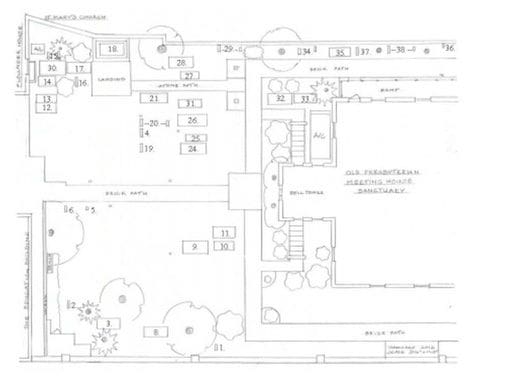
The map below locates the gravestones that survive; the numbered markers correspond to the entries throughout this page — Sarah Fairfax Carlyle at No. 10, John Carlyle at No. 11, the Tomb of the Unknown Soldier at No. 18. For a printable version with the complete numbered key, download the Churchyard Burial Ground brochure (PDF).

Honoring Heroes
The burial ground is the final resting place for veterans of the French and Indian War and the American Revolutionary War. One of the most notable monuments is the Tomb of an Unknown Soldier of the American Revolution, dedicated to an unidentified patriot who was originally buried in the churchyard’s lost northern ground and whose remains were uncovered during the construction of St. Mary’s Catholic Church in 1826, then reinterred at the present grave. Other significant figures include Dr. Robert Creighton, who fought in the French and Indian War, and Dr. James Craik, a close friend of George Washington and one of the attending physicians at his deathbed. Research by Meeting House archivist Donald Dahmann has documented 87 members of this congregation as Revolutionary War patriots; together, the Meeting House Burial Ground and the Presbyterian Cemetery on Hamilton Avenue hold more than forty patriot graves — believed to be the most of any burial site in Virginia.
Two memorial plaques stand in the northeast corner of the burial ground. The first, honoring the Revolutionary War patriots interred here, was placed in 2006 by the George Washington Chapter, Virginia Society Sons of the American Revolution, together with the St. Andrew’s Society of Washington, D.C. The second, dedicated to all who were laid to rest in the burial ground, was erected by the congregation in 2009.
To explore the broader story of Alexandria’s documented Revolutionary War burials, visit our Alexandria Revolutionary War Patriots page.
Challenges and Preservation
Over time, the expansion and reconstruction of the Meeting House during the 1830s and 1840s led to the loss or concealment of some burial sites. The northern property line originally ran about fifty feet further north than it does today — out into what is now the Basilica of Saint Mary’s S. Fairfax Street parking lot. The error was baked into the churchyard’s founding: the 1763 town-expansion survey drew the line north of the true property boundary, and when the line was contested and resurveyed from the 1820s onward, the churchyard surrendered a northern strip of roughly 6,900 square feet that once held burials. The boundary was adjusted several times before the brick wall that has defined it since 1932 was erected.
What became of the northern strip’s dead is an uncomfortable question without a tidy answer. Only one relocation is documented: the unknown Revolutionary War soldier, whose remains were reinterred within the surviving yard. Nineteenth-century reports record that when a townhouse basement was excavated hard against the new line, workers encountered graves — and the bones were apparently discarded. For the rest, no record of removal exists. In all likelihood, burials from the lost ground were never moved at all, and they remain where they were laid, beneath the ground just north of the wall.

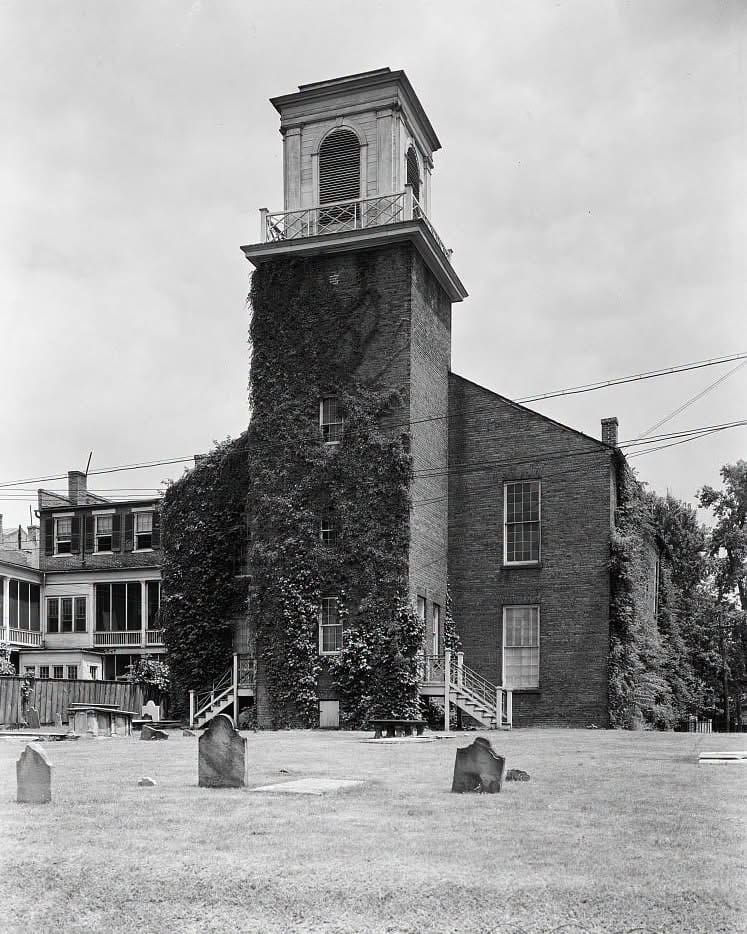
Today, approximately 40 gravestones remain visible — a small fraction of the hundreds actually interred here. Many burials were of infants who died within a year of birth and were laid to rest before being formally named, so their graves were never marked; and the plain, unembellished stones favored by the congregation’s Calvinist founders were often disregarded by later generations and left to deteriorate without repair or replacement.
Preservation of the burial ground continued into the modern era. In 2008, the Meeting House congregation established a standing committee to oversee the churchyard. The committee surveyed the grounds and assessed the condition of every gravestone and fragment, and in 2011 it prepared an accurate new site map that became the basis for a new visitor brochure. That assessment shaped a comprehensive three-phase conservation plan. In the spring of 2015, the Meeting House received a grant from the Historic Alexandria Foundation toward the work; combined with a grant from the Presbyterian Cemetery Board and funds already in hand, it allowed the committee to address the most pressing needs. In September 2015, conservators from Manassas Granite and Marble, specialists in the repair of historic grave markers using approved methods, completed the Phase I conservation work.
The Tomb of the Unknown Soldier of the American Revolution
The National Society of the Children of the American Revolution, under its president, Mrs. Josiah A. Van Orsdel, erected the Tomb of the Unknown Soldier of the American Revolution within the Old Presbyterian Meeting House’s 18th-century burial ground, dedicating it on Lexington-Concord Day, April 19, 1929. A temporary wooden marker had been placed the year before, on Washington’s Birthday, February 22, 1928, by Alexandria’s American Legion Post No. 24. The monument pays tribute to an unidentified patriot originally interred in the northern portion of the churchyard — ground later lost when the boundary shifted. His remains were uncovered in 1826 during construction at St. Mary’s Catholic Church, now known as the Basilica of Saint Mary, and moved to the present site (No. 18 on the map). He is the one burial we know was relocated when the churchyard shrank.
The Basilica of Saint Mary, situated adjacent to the Meeting House, provides valuable insights into the historical context of the era. Its proximity to the burial ground and the discovery of the unknown soldier’s remains underscore the interconnected nature of Alexandria’s early history and the sacrifices made by those who fought for American independence. For additional information about The Basilica of Saint Mary, you can explore this link.


| Here lies a soldier of the revolution whose identity is known but to God He was an idealism that recognized a supreme being that planted religious liberty on our shores that overthrew despotism that established a peoples government that wrote a constitution setting metes and bounds of delegated authority that fixed a standard of value upon men above gold and lifted high the touch of civil liberty along the pathway of mankind. In ourselves his soul exists as part of ours his memory’s mansion. |


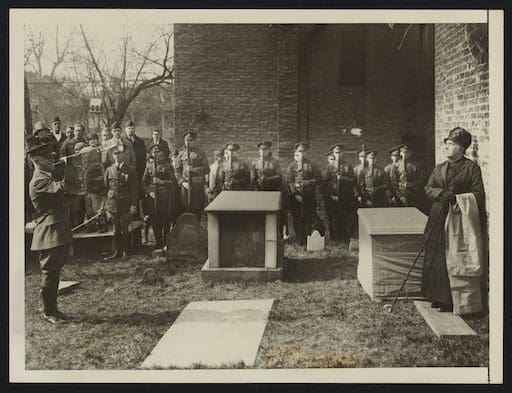
In the early 20th century—likely around 1930—Eleanor Washington Howard, a descendant of George Washington and the last child born at Mount Vernon in 1856, visited the tomb. A rare postcard shows her standing quietly beside the grave, offering a poignant visual bridge between the Founding Era and modern remembrance. The back of the postcard identifies it as published by Shenandoah Publishing House, Inc. of Strasburg, Virginia, suggesting it was part of a regional series of commemorative or tourist images from the period. Eleanor lived until 1937 and was buried at Zion Episcopal Churchyard in Charles Town, West Virginia.
A separate postcard—featuring the piazza at Mount Vernon and signed by Eleanor S. Washington Howard—is preserved in the collections of the Mount Vernon Ladies’ Association Archives and dates to approximately the same period. The image of her at the tomb may have originated from a similar regional printing series.
Mary Gregory Craufurd Powell
Mary Gregory Craufurd Powell (1847-1928) left a lasting mark on the history of the Old Presbyterian Meeting House, though she is not buried in its 18th-century burial ground. A devoted member of the Mount Vernon Chapter of the Daughters of the American Revolution (DAR), she played a key role in establishing the memorial at the Tomb of the Unknown Soldier of the American Revolution in the burial ground.

Powell is buried in the Presbyterian Cemetery, one mile west of the Meeting House, near her father, William Gregory III.
Read more about the Presbyterian Cemetery at this link.
Discovering the Stories of the Past
Church records show that about 396 people were buried in the Meeting House burial ground, most of them in graves that are no longer marked. The entries below tell the stories of those we can still name, from Sarah Fairfax Carlyle, whose 1761 stone is the oldest here, to Dr. James Craik, who may not be here at all. New research adds to them every year.
To read more about the details of the burials in the 18th Century Burial Ground of the Meeting House, access the brochure here.
Lives Remembered: Notable Burials in the Old Presbyterian Meeting House Burial Ground
Richard Arell (1719-1796) Donated Land for the 18th Century Presbyterian Meeting House Burial Ground.
Richard Arell, originally from Pennsylvania, became a prominent figure in Alexandria, Virginia’s early history, settling there by 1768. He ran a successful tavern on King Street, a popular spot for notable individuals, including George Washington, who documented his visits starting from 1768, even before the tavern received its official license in the early 1770s. The tavern welcomed distinguished guests like John Carlyle, George Mason, and William Ramsay. Phillip Alexander, who is connected to Alexandria’s founding family, significantly supported Arell’s business endeavors.
As T. Michael Miller, a respected Research Historian at the Alexandria Library, noted, a critical meeting occurred in Arell’s Tavern on July 18, 1774. Led by George Washington, a committee of Fairfax County residents convened there to draft the Fairfax Resolves. These resolutions, largely authored by George Mason, expressed disapproval of the British Parliament’s actions against Boston following the Tea Party. The Fairfax Resolves influenced the Virginia Declaration of Rights and the United States Constitution’s Bill of Rights. The tavern, an integral part of this history, ceased operations by 1811. 4
Arell’s influence extended beyond his business; he owned significant real estate, including properties on Duke and Royal Streets, and his family was deeply integrated into the community, evidenced by his wife’s attendance at George Washington’s final birthday celebration in 1799.
His son David, a Revolutionary War officer, became an Alexandria lawyer, councilman, and mayor. Both father and son were members of the esteemed Alexandria-Washington Masonic Lodge N. 22. Richard’s daughter, Christiana “Kitty” Arell, also played a role in the town’s social circles.
Richard Arell’s enduring impact includes the deed he and his wife Eleanor executed on July 12, 1773, conveying the northern half of the property to Rev. William Thom ‘for the purpose of a Presbyterian Church’ — witnessed by John Carlyle and William Ramsay. On parts of that ground the town’s Presbyterian burial ground was established. The exact location of Arell’s grave within the burial ground has been lost to time and later development.
Sea Captain Robert Allison, Sr. (c. 1745–1801) Alexandria Merchant, Civic Leader, and Revolutionary Patriot
Sea Captain Robert Allison, Sr. (c. 1745–1801) was born in Pennsylvania and settled in Alexandria before 1777, where he became a merchant and respected civic figure. A retailer on King Street, he was active in the city’s early public life, signing the 1785 Memorial and Remonstrance and the 1786 incorporation papers. He also served on the church committee in 1786, was a member of the Sun Fire Company from 1777, belonged to Lodge 22, and was a charter member of the Alexandria Library Company in 1794.
During the Revolutionary era, he served as a justice of Fairfax County, a position that then carried legislative, executive, and judicial responsibilities. Allison is recognized as a Revolutionary War patriot and is listed on the burial ground’s patriot plaque. On June 7, 1784, he married Ann Ramsay, daughter of Alexandria’s founder William Ramsay. Their son, Robert Allison Jr. — a ship’s captain like his father — was killed on September 5, 1814, at the Battle of the White House during the War of 1812; a memorial plaque to the younger Allison hangs on the east interior wall of the sanctuary. Father and son bracket the founding era: one served the cause of independence, the other died preserving it. The elder Allison died of consumption on June 11, 1801, at age 56, and was buried in the Meeting House churchyard.
Judith Bogue (c. 1759–1799) and Her Family
Judith Bogue came to Alexandria from England with her husband, John Bogue, and their family around 1795. She died of dropsy on September 3, 1799, at approximately forty years of age, and was buried in the Meeting House Burial Ground.
Her lengthy gravestone inscription praised her industrious nature, maternal devotion, honesty, and steadfast friendship. Its reference to “the four she bore” indicates that Judith and John had four children; one known son, also named John, was baptized by Rev. James Muir on October 9, 1797.
Her husband was known in Alexandria as a “joiner and cabinet maker,” working in house and ship joinery and the hardware trade — first in partnership with a man named Staples, later with Mungo Dykes. Working from a design by James Wren, Bogue and Dykes constructed the Fairfax County Courthouse between 1799 and 1800. Among Bogue’s known projects were the adjoining houses at 609 and 611 Cameron Street. He built 609 Cameron Street for James Irwin, a Belfast-born ropemaker, civic leader, and longtime elder of the Meeting House congregation who was later buried in the Presbyterian Cemetery.
The house at 611 Cameron Street he built for his own family — and it acquired a second history after the Bogues were gone. When the Lee family moved to Alexandria in 1810, this was their first residence in town, where the young Robert E. Lee briefly lived. It should not be confused with the house at 607 Oronoco Street traditionally known as Robert E. Lee’s Boyhood Home— which stands directly across Oronoco Street from the Lee-Fendall House, home to five generations of Lees.
Bogue was also a member of Brooke Masonic Lodge. When George Washington died in December 1799, he served on the committee that arranged the lodge’s participation in the funeral and attended as one of its representatives — a widower of barely three months, helping to bury the most famous man in America. In 1801, about two years after Judith’s death, Bogue left the town he had helped build and moved to the Goose Creek area of Loudoun County, Virginia.


| To the memory of JUDITH BOGUE, spoufe of JOHN BOGUE of Alexandria who died 3rd September 1799, Aged 40 Years. Her turn induftrious and her maternal care; enhanced to me her worth, and to the four fhe bore. In all her dealings just & in her friendship firm; She died in peace & hope unaw’d by death tho grim. Take warning of your end & live not as the throng Knowing that time is short, eternity how long; Our friend has baid [sic] the debt we owe & all muft pay. Peace guard the hallow’d place where now her afhes lay. M.H. Memento Mori. |
John Carlyle (1720- 1780) Founding Trustee and first Overseer of Alexandria
Born in 1720, John Carlyle was the second son of a British family with strong Scottish connections. He apprenticed with an English merchant firm, and in 1741 he came to Virginia as the agent of William Hicks.

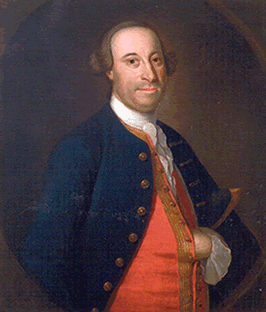
Carlyle built up substantial landholdings in Virginia, including three plantations and an iron foundry in the Shenandoah, and traded with England and the West Indies as one of Alexandria’s leading merchants.
In 1747 he married Sarah Fairfax of the powerful Fairfax family. Sarah, who lies beside her husband in the Meeting House burial ground, bore seven children; their daughter Sarah, the fifth, was the first to survive infancy. Sarah Fairfax Carlyle died on January 22, 1761, shortly after the birth of their seventh child, Ann. Her gravestone is among the oldest in the Meeting House burial ground (see picture above). Her burial here, twelve years before the ground was formally deeded to the church, reflects the era’s common practice of interring the dead on land already set apart — by understanding, if not yet by deed — for a future meeting house.
Subsequently, on October 22, John wedded Sybil West, daughter of Hugh West, who established the village of West, west of Alexandria near Hooff’s Run along Duke Street; the village grew into today’s Carlyle neighborhood and the site of the U.S. Patent and Trademark Office. Sybil and John had four children in their decade of marriage, but only George William survived. After Sybil died in 1769, John Carlyle did not remarry.
In 1775 Carlyle’s daughter Ann married Henry Whiting; she died in childbirth in 1778.
John Carlyle’s name was among the signers of the Fairfax Resolves, adopted on July 18, 1774. Drafted chiefly by George Mason at George Washington’s urging, the Resolves rejected the British Parliament’s authority over the American colonies.
Carlyle served Alexandria in many roles. He was commissary for the Virginia regiment in the French and Indian War, a trustee of Alexandria, a justice of Fairfax County during the Revolutionary War, a founding member of the Sun Fire Company in 1777, and overseer of the construction of the original Meeting House sanctuary at 321 S. Fairfax Street. In May 1775, Carlyle and William Ramsay placed the construction-bid advertisement in the Maryland Gazette seeking builders for the Meeting House — the very advertisement that, when it resurfaced, proved the sanctuary was erected in 1775, not 1774 as a bronze plaque long claimed. Carlyle was also a slaveholder; at his death he held 67 enslaved people.


In 1753 Carlyle built a Georgian stone mansion that still stands at its original location, 121 N. Fairfax Street. In April 1755 it served for three weeks as the headquarters of General Edward Braddock, who planned there his campaign to drive the French from Fort Duquesne, at the junction of the Allegheny and Monongahela Rivers in what is now Pittsburgh, Pennsylvania.
While at the house, Braddock met with five royal governors to settle how the campaign would be paid for. Their decision to tax the colonists to fund the war was an early step in the long quarrel over colonial taxation that would end in the American Revolution.
Braddock was mortally wounded at the Battle of the Monongahela on July 9, 1755. George Washington, serving as his volunteer aide-de-camp, rallied the defeated British and American troops and led them to safety. Of the 1,459 men in the expedition, 977 were killed or wounded, including sixty-three officers. Washington’s conduct that day won him wide acclaim and set him on the path that led, in 1775, to his appointment by the Continental Congress as commander in chief of the Continental Army.


In 1780, John Carlyle passed away, leaving Carlyle House to his son, George William, then fourteen. A year later George William was killed at fifteen at the Battle of Eutaw Springs in South Carolina, on September 8, 1781.


| Here lies the body of Major JOHN CARLYLE son of DR. WILLIAM and RACHEL MURRY CARLYLE born in Dumfriesshire, Scotland, 1720. died in Alexandria, Virginia 1780. One of the first trustees of Alex andria 1748, appointed Commissary of the Virginia Forces, 175 Erected by the Alexandria Chamber of Commerce |
Sarah Fairfax Carlyle (December 31, 1730 – January 22, 1761) The Oldest Gravestone in the Cemetery

Sarah “Sally” Fairfax Carlyle was born around 1730 in Salem, Massachusetts, the daughter of William Fairfax — collector of His Majesty’s customs in South Patowmack and president of the Council of Virginia — and Sarah (Walker) Fairfax. Her cousin was Thomas Fairfax, 6th Lord Fairfax of Cameron.
In 1747, Sarah married John Carlyle, a merchant in Alexandria. Their children included Sarah (Carlyle) Herbert and Anne Fairfax (Carlyle) Whiting; five others — Rachel, Ann, William, George Fairfax, and Hannah — died before their mother.
Sarah died on January 22, 1761, at about 31, of complications following the birth of her seventh child, and was buried in the Meeting House churchyard. Her epitaph, recorded by the Rev. Timothy Alden in 1814, describes her as a “dutiful child, loving wife, affectionate parent, indulgent mistress, faithful friend, [and] sincere Christian.”
| To the memory of Mrs. Sarah Carlyle Wife of Coll John Carlyle, Merch in Alexandria and Daughter of the Hon W Fairfax, Esq. Coll of his Majesty’s Customs on South Potomack President of the Hon Council of Virginia Who died in Child-bed of her seventh Child the 22 of Jan 1761 Aged 30 Years 22 Days She was amiable thru Life as a Dutiful Child Loving wife Affectionate Parent Indulgent Mistrefs Faithful Friend Sincere Christian and is thence justly lamented by All who knew her Our Life is short but to extend that span to vast eternity in virtue’s work —— Nigh her lie Five of her Children Rachel Ann William George-Fairfax and Hanah |
Dr. James Craik (1730 – 1814) Chief Physician and Surgeon of the Continental Army; Close Friend of Washington


Dr. James Craik was born in 1730 in Dumfriesshire, Scotland — though his gravestone says otherwise. The marker reads “Born ….. 1727” and “Died February 4, 1814” — two carved errors introduced when the stone was erected more than a century after his death. He was born in 1730 and died on February 6. Educated at the University of Edinburgh, Craik served as a surgeon in the British Army in the West Indies before settling in the American colonies in 1751.
His lifelong bond with George Washington began in March 1754, when Craik joined Colonel Joshua Fry’s Virginia Regiment as its surgeon and met its 22-year-old lieutenant colonel. When Fry died after a fall from his horse, Washington took sole command, and that July the two men saw their first action together at Fort Necessity. The following year Craik tended the wounded of Braddock’s expedition at the Battle of the Monongahela — including the dying General Braddock himself. In 1770 he rode the Ohio frontier at Washington’s side on the western-lands survey.
In the Revolution, Craik rose to Chief Physician and Surgeon of the Continental Army by 1781. He treated the Marquis de Lafayette after Brandywine and General Hugh Mercer after Princeton, attended Washington’s stepson John “Jack” Custis in his final illness in 1781, and warned Washington of the Conway Cabal. In 1783, at Washington’s urging, Craik moved his family to Alexandria to take over Dr. Rumney’s practice — and to be his friend’s physician. Beyond his practice, he helped establish the Society of the Cincinnati in Maryland and the Bank of Alexandria.
On December 14, 1799, Craik was in the room at Mount Vernon when Washington spoke his last words — “‘Tis well” — and died at 10:20 that night. Washington’s will remembered their forty-five-year friendship with personal bequests: a secretary desk and a circular chair. Craik walked as a Principal Mourner at the interment.
Craik died on February 6, 1814, at Vaucluse, his estate on what is now Seminary Hill, at the age of 84; his wife Mariamne followed him that April. His original gravestone vanished amid the turbulence of the Civil War, and for decades he lay unmarked. The granite marker that stands today was erected in 1928, part of the same wave of commemoration that produced the Tomb of the Unknown Soldier’s marble and the churchyard’s north wall.
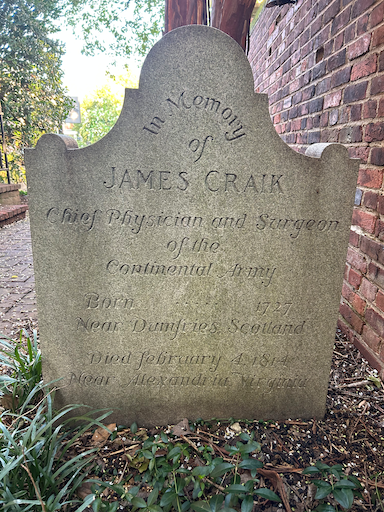
And here the record demands honesty. In 1809 — five years before Craik died — the Common Council banned burials within the city. Exceptions were granted (Margaret Janney received one in 1810), but none is known for Craik, who died at Vaucluse, his own estate beyond the city line, where burial would have required no exception at all. The granite marker, raised more than a century later and long after the original stone had vanished, stands where tradition says he rests: the far east end of the yard, No. 38 on the burial ground map. Tradition places Washington’s oldest friend here. He might not be in this ground at all.
To read more about Dr. Craik, please visit this blog Dr. James Craik: George Washington’s Lifelong Friend and Physician | A Tale of Commitment and Friendship
Joseph Harris: The Man Beside Him
Craik did not serve alone. His enslaved manservant, Joseph Harris, was with him at every encampment and headquarters from 1777 to the war’s end — and appears in none of the official accounts. When Craik brought Harris into Virginia in the 1780s, the state’s 1778 “Act for Preventing the Farther Importation of Slaves” required an owner to swear an oath at the courthouse that the enslaved person was not imported for sale. Craik never did. Under the act, a person so brought into Virginia “shall … become free” — meaning Harris was legally free.
About a decade later, Harris sued for his freedom on that omission in the Alexandria Hustings Court; the case rose to the Virginia Court of Appeals, and Harris won. He lived free in Alexandria for nearly forty years, dying about 1832–34. Craik is marked and remembered here; Harris lies a mile away in Penny Hill Cemetery, in an unmarked grave whose location is unknown. He helped win this country’s freedom before he won his own
| In Memory of JAMES CRAIK Chief Physician and Surgeon of the Continental Army Born ….. 1727 Near Dumfries, Scotland Died February 4, 1814 Near Alexandria, Virginia |
Dr. Robert Creighton: A Life from Scotland to the Americas – Military Physician and Longtime Resident of Jamaica
Dr. Robert Creighton (1734–1801), also known as Robert Crighton, was born in Ayrshire, in the West Lowlands of Scotland. He emigrated to America and served as a medical officer with General Edward Braddock’s expedition against Fort Duquesne, which ended in disaster near what is now Pittsburgh in 1755.
After his military service, Creighton practiced medicine with an office on Cameron Street, likely in Alexandria. He later moved to Jamaica, where he lived for forty years; little is known of his life there.
Suffering from consumption, as tuberculosis was then called, Creighton returned to Alexandria late in life in search of relief. He died on November 18, 1801, at 67, and was buried in the Meeting House churchyard on November 20. The inscription on his gravestone, recorded in the early twentieth century, commemorates his life and his widow’s mourning.
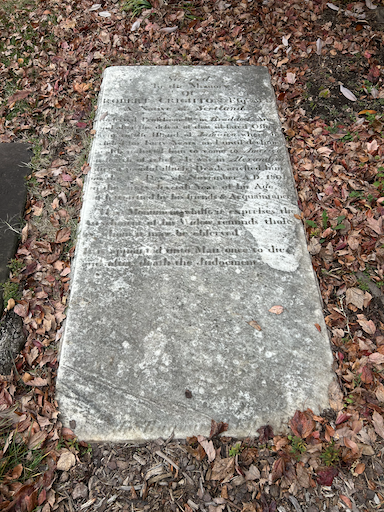
| Sacred to the memory of ROBERT CRIGHTON, Esq. M.D. A Native of Scotland He served Professionally in Braddock’s Army and after the defeat of that ill-fated Officer went to the Island of Jamaica where he resided for Forty Years and until declining health induced him to come to America in search of relief. It was in Alexandria, after a painful illness, Death arrested him on the 18th Day of November A.D. 1801 in the sixty seventh Year of his Age. Much regretted by his friends & Acquaintances. This monument whilst it expresses the attachment of his Widow reminds those by whom it may be observed. He was appointed unto Man once to die/and after death the Judgment. |
Mary Ann Steiner Faw (d. 1805) – Wife of Constitutional Ratifier Abraham Faw
Mary Ann Steiner Faw was the second wife of Abraham Faw, a Swiss-born immigrant who became a prominent merchant, Revolutionary War supporter, Maryland legislator, and later a civic leader in Alexandria. During the American Revolution, Abraham Faw supplied cloth for military uniforms, helped construct facilities to house British prisoners, served on Frederick’s Committee of Observation, and, as a delegate to Maryland’s ratification convention, signed the state’s ratification of the U.S. Constitution.
Mary Ann and Abraham had three children together. She died in January 1805 and was buried on January 20 in the burial ground of the Old Presbyterian Meeting House. Research indicates that she died alone and likely took her own life—an event that would have carried significant social and religious stigma in the early republic. Her gravesite within the burial ground is today unknown.
After her death, Abraham Faw remarried in 1808 to Sarah Moody. He later served Alexandria as a justice of the peace, Hustings Court justice, coroner, and alderman. Abraham and his third wife are buried in the Trinity United Methodist Church Cemetery within the Wilkes Street Cemetery Complex.
Mary Ann’s story is a reminder that this burial ground holds not only civic leaders but also quieter, more fragile lives.
Laura Ann Gilman (Died August 18, 1807)

| LAURA ANN GILMAN Died August 18th, 1807 Aged Nine Months & 18 Days |
Mary Halloday (c.1729-1786)
Mary Halloday is believed to have been born in County Antrim, Northern Ireland, the daughter of Charles and Rosanna Penny McAlister. She died in 1786 at about 57 and was buried in the Meeting House churchyard.

| In Memory of Mary HALLODAY, wife of JAMES who died the fecond of July 1786, Aged 57 years Fhe was a loving wife, a kind mother, mistrefs and neighbor |
Capt. John Harper (1728 – 1804) Built Captain’s Row and Gentry Row on Prince Street
Captain John Harper Sr. (1728-1804) was a sea captain and merchant who helped build Alexandria’s waterfront. Born in Philadelphia to Robert and Margaret Harper, he left his birthplace at the outbreak of the Revolutionary War and joined the Quaker Meeting House. He married Sarah Wells of Pennsylvania, with whom he had 20 children, and later Mary Reynolds of Winchester, Virginia, with whom he had nine more.
Harper began as a mariner, running a schooner in the West Indies trade, and later became a merchant in partnership with William Hartshorne, another Quaker, at Harper’s Wharf at the foot of Prince Street. His enterprise led to the development of Prince Street’s Captain’s Row and Gentry Row.
Though a conscientious objector and no soldier, Harper procured ammunition and other military supplies in 1775 for George Washington’s independent companies in Virginia. He served on Alexandria’s Common Council from its creation in 1780.
Harper signed the 1785 Memorial and Remonstrance, the 1787 petition to establish Overseers of the Poor, and a 1792 petition to the Governor seeking the freedom of an enslaved man named Will, who had been sentenced to death.
He was a member of the Sun Fire Company from 1777, a charter member of the Alexandria Library Company in 1794, and a Mason. Rev. Muir conducted his funeral on May 7, 1804, and he was buried in the Meeting House churchyard, though the location of his grave is unknown. His name appears on the burial ground’s Revolutionary War Patriot plaque.


Agnes Hepburn (1727-1814)
Agnes Hepburn
Agnes Hepburn died on June 7, 1814, “in her eighty seventh year,” as her stone records. Her husband, William, outlived her by three years.
William Hepburn: The Merchant and Community Leader
William Hepburn (1730-1817) was a King Street merchant in business with his son-in-law, John Dundas. In 1777 he and fellow Presbyterian Andrew Wales were arrested as suspected Loyalists. The two were jailed, carted to Williamsburg, and held for two months before being tried and acquitted. Loyalty was contested even in this patriot town — and the town took its accused back.
Hepburn visited George Washington at Mount Vernon in April 1775. In March 1817 he attended a congregational meeting but chose not to become a member of the new Second Presbyterian congregation.
Entrepreneurial Ventures
In 1788 Hepburn and Dundas built a mill near Backlick and Indian Runs, about six miles from Alexandria, and Hepburn owned and managed another mill in Northern Virginia.
He also owned a rope walk that George Washington frequented, and he signed the 1785 Memorial and Remonstrance Against Assessments.
Public Service and Personal Life
Hepburn served on Alexandria’s council in 1783–84 and was a member of the Sun Fire Company from 1777.
Where William Hepburn is buried is unknown: beside Agnes here, or in the Presbyterian Cemetery.
A Complex Personal Life
William fathered four children with Esther David, often called Esther Hepburn, a woman he enslaved; he had purchased her from Benjamin Dulany. In 1816 Esther and her children were sold to her sister, Hannah Jackson, a free Black washerwoman, who freed them eleven days later. William’s will of 1817 provided for Moses’s education and left him land and houses in Alexandria.
Moses Hepburn: A Legacy in His Own Right
That inheritance made Moses Hepburn the wealthiest African American in Alexandria. He became a trustee of the Methodist Church’s Davis Chapel, now known as the Roberts Memorial United Methodist Church, the oldest Black Methodist Church in Alexandria and an active congregation to this day. Though he could not vote, he spoke out against retrocession and its effects on Virginia’s Black community.
In 1853, after Virginia threatened to prosecute him for having his son educated in Pennsylvania, Moses moved his family to West Chester, Pennsylvania. He died there in 1861 and is buried in Longwood Cemetery in Kennett Square.

| Erected in memory of AGNES the late wife of WILLIAM HEPBURN who departed this life 7th June 1814. She was distinguished for simplicity of manner and unfeigned piety. Having lived in the fear of the God she died in peace, in her eighty seventh year. |
William Hunter, Jr. (1731 – 1792) Mayor of Alexandria; Founder of the St. Andrew’s Society
William Hunter was born in Galston, Ayrshire, Scotland, on January 20, 1731, and came to Virginia, where he built an Alexandria trade with London and Liverpool. He served twice as mayor of Alexandria, in 1787–88 and 1790–91. In 1760 he founded the St. Andrew’s Society, later succeeded by the St. Andrew’s Society of Washington, D.C.
Hunter was an elder of the Presbyterian Church and a member of the Alexandria-Washington Masonic Lodge, and he lived at 501 Duke Street. When he died on November 19, 1792, at 61, the St. Andrew’s Society erected a monument in his memory. His gravestone bears the Scottish national motto, ‘Nemo me impune lacessit’ — no one provokes me with impunity — a declaration of Scotland carved on a Virginia grave.

| Relieve the Distressed Nemo me impune lacessit Sacred to the Memory of WILLIAM HUNTER, Jun Born Gafton, Scotland. January 20, 1731 The Characteriftics of his life were Unbounded Benevolence and Friendship. He Died in Alexandria November 19, 1792 Beloved Efteemend and Lamented The ST. ANDREWS SOCIETY OF ALEXANDRIA Whofe Founder he was an Among whom he Rifided Until removed by Death Erect this Monument Af a Tribute of Gratitude and Refpect |
Margaret Janney (Died February 9, 1810)
Margaret Janney died of “bilious cholic” (gallstones) at the age of 49. Her husband, Abel Janney (1755-20 September 1816) was a shipping merchant from Pennsylvania who settled in Alexandria. Margaret, born Margaret Wilkes (1764-9 February 1810), was the daughter of Samuel and Rebecca Wilkes. The couple had nine children: Elizabeth; Samuel, who died at sea; Cosmelia; Rebecca; Cynthia; Maria, who lived only a year; a second Maria; Nancy; and a son, Abel, who died young. Although burials in town had been stopped on May 1, 1809, an exception allowed Margaret to be buried in the Meeting House burial ground. Abel’s burial place is not known.

| In memory of MARGARET JANNEY wife of ABLE JANNEY who departed this life February the 9th, 1810 |
Capt. William Ladd (1736 – 1800): Rhode Island Delegate Who Completed the Union
Rhode Island was the last of the thirteen original states to ratify the United States Constitution — holding out until May 29, 1790, more than a year after the new government had already taken effect. When the Rhode Island State Convention finally convened, William Ladd was among the delegates who cast the votes that completed the union. A delegate from Little Compton, he had already served as a soldier in the Revolution, represented his town in the Rhode Island General Assembly, and helped found the Marine Society of Newport in 1785. He was also a member of the Society of the Cincinnati — the hereditary organization of Continental Army officers founded by George Washington, whose Alexandria chapter counted many of the city’s most prominent citizens among its members.
Ladd did not settle in Alexandria. He came to visit his children, and it was here that he died of pleurisy on December 4, 1800, at the age of sixty-four. Rev. James Muir buried him the next day in the Meeting House churchyard. His flat table marker — recorded by researchers in 1913 and again in 1923 — still carries its inscription in full: “Truth was his guide, integrity his solace.” A soldier, a legislator, a founder, and a father — Alexandria was simply where his journey ended.
Flat table marker with inscription. His name is included on the Sons of the American Revolution memorial plaque placed in 2006.
| In memory of WILLIAM LADD who was born in the town of Little Compton, state of Rhode Island, 30th October 1736, and died on a visit to his children at Alexandria, December 4th 1800 Probity, benvolence, and patriotism characterized his life and gained him the esteem and confidence of society. he volunteered in her cause and therein freely sacrificed the fruits of his honest industry. After being repeatedly elected to the legislature of his native state, he was called to seat in that convention, which ratified the favourite object of his wishes, the federal constitution. Truth was his guide, integrity his solace, and he found the reward of his virtues in the regard of his frieds and the hope of immortality. |
Sarah Gardner Ladd (c. 1734 – 1807)
William Ladd did not rest here alone. His wife, Sarah Gardner Ladd, was the daughter of Capt. Benoni Gardner and Sarah (née Rogers) Gardner of Rhode Island. Born near Kingston — about 1739 by family records, though her epitaph placed her in her seventy-fourth year, suggesting 1734 — she married William Ladd on December 22, 1761, and bore eight children, five of whom she outlived: three died in infancy, one at eight, and her eldest surviving son at twenty-two. She followed her husband to Alexandria and died here on October 30, 1807.
Her table marker is now gone, but evidence of her grave remains beside her husband’s. Her epitaph survives because researchers recorded it while the stone still stood — Rev. Timothy Alden in 1814, later quoted by Wesley Pippenger in Tombstone Inscriptions of Alexandria, Virginia (1992):
In Memory of Sarah Ladd, the amiable consort of William Ladd and daughter of Benoni Gardner, Esq. late of Newport, R.I. She died at Alexandria, 30 Oct 1807, in the 74th year of her age. Exemplary and endearing in all the relations of life, she possessed the respect and esteem of an extensive acquaintance. Her mourning children have erected this monument as a small testimony of their filial duty, reverence, and affection.
Table marker, now lost; grave evidenced beside William Ladd’s. Inscription recorded by Timothy Alden, 1814.
Dr. Joseph Brown Ladd (1764 – 1786): The Poet Who Died in a Charleston Duel
The eldest surviving son of William and Sarah, Joseph Brown Ladd was born in Little Compton, Rhode Island, on July 7, 1764 — a bookish boy who preferred the library to the family farm, raised by a father who believed violence should never settle a dispute. At fifteen he was apprenticed to Dr. Isaac Senter, and by 1783 the newly minted Dr. Ladd had moved to Charleston, South Carolina, on the recommendation of Revolutionary General Nathanael Greene, to begin his practice.
He was also a poet. Writing under the pen name “Arouet” — inspired by Amanda, the young woman he loved but could not marry — Ladd published verse that marks him as one of the more accomplished poets of eighteenth-century America. The Poems of Arouet appeared the year of his death, and one poem, “The Prospect of America,” was dedicated by the author “To the Second Fabius, His Excellency George Washington, Esq.”
In Charleston, Ladd’s friendship with a young attorney named Ralph Isaacs collapsed into a bitter quarrel, fought out in print in the Charleston Morning Post until Isaacs challenged him to a duel. Ladd had been raised to abhor violence and did not want to fight, but in Charleston a refused challenge would have branded him a coward. Early on the morning of October 23, 1786, the two men met in the narrow passage now known as Philadelphia Alley. Ladd took his ten paces, turned, and deliberately fired over Isaacs’s head. Isaacs aimed low, meaning to wound rather than kill, and his ball shattered Ladd’s kneecap. Gangrene set in, and on November 2, 1786, ten days after the duel, Joseph Brown Ladd died at the age of twenty-two.
Twelve years later his brother John Gardner Ladd moved to Alexandria. Their father, the sea captain William Ladd, died in 1800 while visiting John there, and the rest of the family soon followed and prospered in the town. John himself eventually returned to Rhode Island, and when he died in 1819, at forty-seven, he was buried beside his wife, Sarah “Sally” Easton Ladd, in the Easton family lot in Middletown.
Joseph was not forgotten in Alexandria. A long tribute to “Doctor Joseph Brown Ladd, the eldest son of William and Sarah Ladd” was carved on his mother’s gravestone. It praised him as “a favourite of the muses” and closed with verse signed with his own pen name, Arouet: “He liv’d and he was all-belov’d, / He died, and all-lamented fell.” The stone is now lost, and its words survive only in transcription. The tribute began “In memory also of,” wording more often used for a memorial than for a burial, and whether Joseph’s remains were ever brought north from Charleston is unknown. In 1832 his sister Elizabeth Ladd Haskins saw his collected poems and letters published as The Literary Remains of Joseph Brown Ladd, M.D., the family’s final act of remembrance for the young poet.
Dr. James Muir (1757 – 1820), Third minister of the Meeting House; Chaplain of Washington’s Masonic Lodge
Born in Scotland in 1757, the Reverend James Muir, D.D., became the third installed minister of the Meeting House in 1789 and served until his death on August 8, 1820 — a pastorate of “31 years and 3 months,” as his memorial records. Much of the Meeting House’s earliest church records survive thanks to Dr. Muir’s meticulous documentation.
Muir was also chaplain of Washington’s Masonic Lodge, and he led the prayers at the laying of the South Cornerstone of the District of Columbia on April 15, 1791. Washington did not attend, though he had visited the site a month earlier.


Led Local Funeral Services for George Washington
On Wednesday, December 18, 1799, four days after his death, George Washington was buried at Mount Vernon. Many Alexandrians set out early that morning for the nine-mile journey; the interment, arranged by Alexandria’s Masonic Lodge No. 22, lasted from three o’clock until sunset.
No funeral service was held in the Meeting House on the day of the interment. Alexandria mourned Washington here in the weeks that followed: five public memorial services were held in the original Meeting House — on December 27, two on December 29, January 5, and the great National Day of Mourning on February 22, 1800, declared by President John Adams, at which Dr. Muir preached the discourse and Dr. Elisha Cullen Dick delivered the eulogy. That February 22 observance is the seed of today’s George Washington Birthday Parade, which still passes the Meeting House every February.
If you’d like to learn more about these commemorative services, you can explore a dedicated blog post as this link.
Member of the August 1814 Peace Delegation
On August 25, 1814, days after British forces burned Washington during the War of 1812, Muir was part of a “peace” delegation sent to learn on what terms Alexandria might surrender to British Admiral George Cockburn. They found Cockburn sheltering from a violent thunderstorm; some sources call it a derecho that had swept over Washington that afternoon.
As Cockburn talked with the owner of the house, the door swung open and four drenched men entered under a white flag.
Among these individuals were Dr. Elisha Cullen Dick (1762-1825), who had tended to Washington in his final moments, and Rev. William Holland Wilmer, rector of the Episcopal church — an Episcopal rector and a dissenting minister walking out under one white flag, forty years after the establishment had kept this congregation’s doors closed against it. Initially aligned with the Episcopal faith, Dick became a Quaker in 1812. His final resting place lies in Alexandria’s Quaker Burial Ground, which now houses the Kate Barrett Library (you can read more about the Quaker Burial Ground and Dr. Dick at this blog Discover the History of the Quaker Burial Ground in Alexandria, Va: from Sacred Space to Modern Landmark).
They had come to learn the terms on which Alexandria could surrender. Cockburn would not give a firm answer and directed them instead to Commodore James Gordon’s squadron, then sailing up the Potomac toward Alexandria. The town surrendered to Gordon’s Potomac Squadron on August 28, 1814, before any engagement with American militia. To read more about the Potomac Squadron and the surrender of Alexandria, read the blog Battle of the White House.


Buried under the North Aisle of the Meeting House
Muir is buried thirteen feet beneath the north side of the Meeting House sanctuary, near where the original pulpit stood. His memorial plaque on the north wall was moved there during the 1837 reconstruction to bring it close to his grave.
Muir’s grave lies inside the sanctuary, but his family rests in the churchyard. A memorial tablet to Muir (No. 14 on the map) stands among the graves of his wife and several of their children, including Frances Wardlaw Muir (d. 1791) and two daughters named Elizabeth. The last person known to be interred anywhere in the burial ground was his daughter Elizabeth Love Muir, in 1876 — the family that presided over the congregation’s great pulpit era also closed its burial ground. And like several of the congregation’s founders, Muir was a slaveholder: his household included an enslaved woman — a reminder that even the pulpit of this liberty-minded congregation was implicated in the institution.
Lewis Nicola (1717 – August 9, 1807): Author of the Infamous Newburgh Letter and Unsung Hero of the American Revolution
Lewis Nicola was born in Dublin in 1717 into a Huguenot family with deep military roots. He rose from ensign to major, commanded Fort Charles in Ireland, and in 1766 moved to America.
In Philadelphia he turned to civil engineering until the Revolution called him back to military service, where he managed the city’s barracks and proposed new military schemes. In 1782 he wrote to George Washington suggesting that the struggling nation become a monarchy with Washington at its head. Washington’s stern rebuke made the Newburgh Letter infamous.
In 1777 Nicola organized the Invalid Corps, a unit of soldiers no longer fit for combat who could still serve in support roles. The idea returned in the Civil War with the Invalid Corps of 1863, later renamed the Veteran Reserve Corps.
To learn more about how Nicola’s innovation influenced later military practices and to read about Nehemiah Metlock, a soldier who served in the Civil War-era Veteran Reserve Corps, click here.
Nicola spent his last years in Alexandria, where he died in 1807. He was buried in the Old Presbyterian Meeting House burial ground, but the location of his grave has been lost.

Read more at this fascinating blog: The Soldier Who Proposed a Crown: The Life and Legacy of Lewis Nicola
Thomas Porter (1756 – May 1, 1800): From Boston Tea Party to Alexandria Leader
Thomas Porter, born in 1756, was 17 when he took part in the Boston Tea Party at Griffin’s Wharf on December 16, 1773, one of 116 participants (Boston Tea Party Ships & Museum, n.d.). In Alexandria he was an early member and treasurer of the Relief Fire Company and signed the petition to establish the Bank of Alexandria on October 9, 1792. He also signed a 1792 petition to the Governor seeking the freedom of an enslaved man named Will, who had been sentenced to death.
Porter was a merchant and a member of the Common Council, and he lived at 412 South Fairfax Street. He owned property on Cameron Street, where the town’s most popular theater was built in 1797. Records show he held one enslaved person in 1787 and two from 1788 to 1790.
In 1790 Porter joined the Society for the Promotion of Useful Knowledge; in 1794 he became a charter member of the Alexandria Library Company; and he was one of the thirteen original directors of the Marine Insurance Company of Alexandria. In 1800 he was a founding member of the Washington Society of Alexandria.
Porter married Sarah “Sally” Ramsay on August 20, 1794, in a ceremony performed by Reverend Muir. The daughter of William Ramsay, Sarah kept a boardinghouse on Prince Street and held one enslaved person in 1787. The couple had at least one child, James Porter, born in 1798. In 1810 Sarah held five enslaved people and still ran her boardinghouse. She remained a member of the Meeting House until 1817, moved to Washington in September 1819, and died on October 6, 1832; she is buried in Congressional Cemetery in the District of Columbia.
Their son, James Porter, died in 1800 at the age of 2 from hives and is buried in the Meeting House burial ground, plot unknown.
A dedicated Mason and member of Lodge No. 22, Porter died of fever on May 1, 1800, at 44. He was buried with Masonic honors in the Meeting House burial ground, where Lodges No. 22 and No. 47 and Brooke Lodge joined for the ceremony, and members of the Washington Society attended. His name is listed on the burial ground’s Revolutionary War Patriot plaque, but the location of his grave is not known.
Ann Nancy Russell (December 17, 1772 – March 26, 1807)
Ann died of consumption (tuberculosis).

| In Memory of Mrs. ANN RUSSELL born 17th December 1772 died 26th March 1807 Erected by her surviving Husband To re__ of his affection & rest[ect] In her ___ was the law of ___ She looked well to the ways of her household, and ate now the bread of ____ Her children arise up and called her blefsed: her husband also, and he praises her Favor is deceitful and beauty is vain bu at women that dearth the Lord she shall be praised |
Sgt. Thomas Simms — Soldier of Brandywine, Germantown, and Valley Forge
Thomas Simms served as a sergeant in Grayson’s Continental Regiment, one of the “Additional” regiments raised in Virginia for the Continental Army. His service carried him through three of the war’s hardest engagements — Brandywine, Germantown, and Monmouth — and through the winter encampment at Valley Forge, where he was among the many soldiers recorded ill in 1778.
After the war, Simms returned to Alexandria and was laid to rest in the Meeting House burial ground. His grave is unmarked and its location within the churchyard is unknown, but his name is recorded on the burial ground’s Revolutionary War patriot plaque — one of many soldiers here whose service survives in the records even where no stone survives in the ground.
Mary Smith (Died February 1, 1797)

| Erected to the memory of MARY the wife of HUGH SMITH who departed this life Feb. 1st 1797 in the 29th year of her age and to MARY ANN their only child who died Octr 2d 1798 aged 21 months. Near to this place are also interred the remains of THOMAS WILLIAM the eldest son of HUGH & ELIZABETH SMITH who died Octr 21, 1801 aged 3 years and of Mary their daughter who died Aug 11th 1807 aged 1 year.” |
Hugh Smith (1769-1856) was a prominent merchant and civic leader. Born in Knutsford, England, and raised in the Church of England, he attended the congregation of Rev. James Muir, D.D., with his wife despite his reservations about Presbyterian doctrine.
He was a trustee and member of the Church Committee by January 1816. In 1813 he signed the deed purchasing the land for the Presbyterian Cemetery, and in 1819 he gave $200 toward an organ.
During the War of 1812 he served as first sergeant in the First Regiment of the D.C. Militia, and he sat on the City Council. He was an official of the Washington Society of Alexandria, a director of the Alexandria Canal and the Potomac Bank, and president of the Fire Insurance Company of Alexandria.
Smith dealt in imported glass and china from a store at the corner of King and Water streets, or possibly on Ramsay’s Wharf. He was a commissioner of the Domestic Manufacturing Company, later the Mount Vernon Manufacturing Co., and from 1825 to 1841 he operated the Wilkes Street Pottery; Hugh Smith & Co. was known for its earthenware, glass, and china.
He owned 81 acres atop Stump Hill on the road to Leesburg, part of which later became Ivy Hill Cemetery. The 1810 census lists him as holding five enslaved people; he and Hugh C. Smith later manumitted more than twenty-eight people of African descent.
He was also made a member of the Society of the Cincinnati.
Smith and his second wife, Elizabeth Watson Smith, are buried in the Presbyterian Cemetery on Hamilton Avenue in section 41:30.
Rev. William Thom (c. 1750 – August 8, 1773): Alexandria’s First Presbyterian Pastor
Rev. William Thom was the inaugural minister for Alexandria’s Presbyterians, having come from Philadelphia in 1772, the year the congregation formally organized. He was the son of Rev. David Thom and his wife Mary, and had entered the ministry at twenty. His mother, by then a widow, traveled with him to Alexandria.
Thom’s ministry here lasted barely a year, but it produced the document on which the churchyard rests. On July 12, 1773, Richard and Eleanor Arell deeded the northern half of Lots 90 and 91 to him “for the purpose of a Presbyterian Church,” with John Carlyle and William Ramsay as witnesses. Less than a month later, yellow fever swept the town. Mary Thom died on August 5, 1773, at fifty-five. Her son followed her three days later, on August 8, at twenty-two. Mother and son were buried together in the ground he had just received on the congregation’s behalf.
Their gravestone no longer survives. Its inscription does, because the Rev. Timothy Alden recorded it in the fifth volume of his Collection of American Epitaphs and Inscriptions, published in 1814, some forty years after the burials. Alden’s typesetter rendered the family name as “Thorn,” an easy slip for “Thom” in eighteenth-century type, and the error has been copied by nearly everyone who has quoted him since. The church’s own records settle the spelling. With that one correction, the inscription read:
In memory of Mrs. Mary Thom, relict of the Rev. David Thom, who departed this life, 5 August, 1773, in the 56 year of her age; and also of the Rev. William Thom, their son, who was the first Presbyterian pastor in Alexandria. He possessed a clear judgment, lively imagination, and extensive memory. These happy talents were improved by a liberal education. His life was a shining example of filial duty and affection, of sincere friendship, and of every amiable virtue. He entered into the ministry in the 21 year of his age, discovered a becoming zeal for religion in that sacred character, in performing the duties of his office was highly useful and acceptable to his congregation, and, to their inexpressible sorrow, departed this life, 8 August, 1773, in the 23 year of his age.
It is the only surviving description of Thom’s character, written by the people who had sat under his preaching for a single year. Where the stone stood is not recorded; the burial ground map places the Thoms tentatively at B7, but the location is unconfirmed. For the ministers who followed him, see The First Four Ministers above.
Margaret “Peggy” Vowell (1775-1806)
Burial site 33. A native of Alexandria and a daughter of Captain John Harper, Peggy married John Cripps Vowell in 1795. She died of consumption and rests under a tablet stone behind the sanctuary with four of her children who died in infancy. John Cripps Vowell is buried in the Presbyterian Cemetery.

| A monument raised by the afflicted Husband of the departed worth of Mrs. MARGARET VOWELL, daughter of JOHN HARPER, ESQ. Born August 20th A.D. 1775 DIED July 25th A.D. 1806 The same lot contains the dust of four Children who died in infancy the eldest in her fifth year. Her characteristic was an ardent mind which, having received early impressions of the religion of Jesus was zealously bent, by example and precept to promote this glorious interest. Here lies the heir of heavenly bliss, Whose soul was fill’d with conscious peace; A steady faith subdued her fear, She saw the happy Canann near; Her mind was tranquil and serene; No terrors in her look were seen; Her Saviour’s smile dispell’d the gloom And smooth’d her passage to the tomb. Let Faith, like her’s in joys to come, Direct my walk, though dark as night; Till I arrive at heaven, my home Faith be my guide and faith my light. |
Mary Vowell (1772-1805)
Peggy’s elder sister, Mary was born in Philadelphia, a daughter of Captain John Harper. In 1794 she married Thomas Vowell, brother of John Cripps Vowell. She died of consumption at 33, a year before her sister, and lies in a box tomb near Peggy with four infant children who died before her. Thomas Vowell is buried in the Presbyterian Cemetery, within the Wilkes Street Cemetery Complex.

| Under this stone are deposited the rains of Mrs. MARY VOWELL, late wife of THOMAS VOWELL, junior, & daughter of the late Captain JOHN HARPER who was born 28 of February 1772 and died 19 August 1805 aged 33 years, 5 months and 19 days In the same plot are deposited four infant children This Monument is erected by the surviving husband as a tribute of love and afflicting remembrance Her, in the just hope above the stars to rise, The mortal part of MARY VOWELL lies; In whom those beauties of a spotless mind, Faith and good works were happily combin’d. Unblam’d, unequaled in each sphere of life, The tenderest daughter, sister, parent, wife. Sure in the silent sabbath of the grave, She tasted that tranquil peace she always gave. They death, and such, oh reader, wish thine own, Was free from terrots and without groan. Thy spirit to himself th’ Almight drew Mild as the sun exhales th’ ascending dew. |
Andrew Wales — Alexandria’s First Commercial Brewer; Accused Loyalist, Acquitted Patriot
Andrew Wales holds a distinctive place in Alexandria’s history as the town’s first commercial brewer. He also lived through one of the Revolution’s more uncomfortable local episodes: in 1777, Wales and fellow Presbyterian William Hepburn were arrested as suspected Loyalists, jailed, and carted to Williamsburg, where they were held for two months before being tried and acquitted. Both men returned to Alexandria and resumed their places in the community — a reminder that loyalty was contested even in a patriot town, and that the town took its accused back.
Wales went on to provide material aid to the American cause. He was buried in the Meeting House burial ground, and his name appears on the burial ground’s Revolutionary War patriot plaque. His story is intertwined with that of William Hepburn, whose wife Agnes rests here as well.
Elizabeth White (c.1772-1795)

| In Memory of ELIZABETH ANNE WHITE, the wife of JOHN WHITE, of Alexandria, who died the 23d of July, 1795 in the 23d year of her age |
James Wilson (1766/67–1805) – A Merchant and Civic Leader
James Wilson was born in Glasgow in 1766 or 1767 and crossed the Atlantic in 1777, a boy of ten or eleven, bound for Alexandria — the town that would hold the whole of his adult life. He did not come alone: his brother, William Wilson, made the journey as well, and both became fixtures of the town’s merchant community.
Wilson prospered. He lived and traded at 124 South Fairfax Street, in a house built with two entrance doors — one opening into his shop, stocked with fine woolens, women’s shawls, cashmeres, Gloucester cheese, port, and Madeira; the other leading to the family residence on the upper floors. He kept a warehouse on King Street, served as a vendue master, and held land in Fairfax County, including an interest in Bush Hill, the estate associated with Josiah Watson.

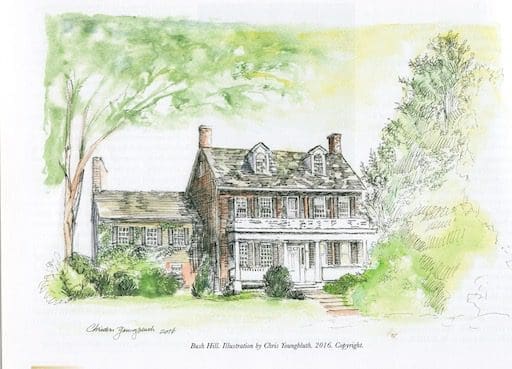
His civic record kept pace with his ledgers: a charter member of the Relief Fire Company in 1788, a supporter of the 1791 lottery to raise the church steeple, and a signer of the October 9, 1792 petition to establish the Bank of Alexandria. He was a Mason in Lodge No. 22. Like many men of his station and era, he was a slaveholder, with two enslaved people recorded in his household in 1790 and four by 1800.
Wilson died of fever on July 9, 1805, at thirty-eight or thirty-nine. Rev. James Muir buried him in the Meeting House churchyard and recorded the burial in his 1805 diary — but no stone survives, and the location of his grave is unknown.
John Wise (c. 1777 – July 3, 1790)

| Here lie the Remains of JOHN WISE Son of John & Elizabeth Wise of Alexandria; who, in the 13th year of his age, was Fuddenly Fummoned, from this world, to an infinitely better on, on the 3rd day of July A. D. 1790. Weep not, found Parents, all you grifts difmifs: I live, inmormortal, in the Realms of bills. |
John Yost — Gunsmith to the Revolution
John Yost armed the Revolution from his workbench. A gunsmith by trade, he produced guns, muskets, cannon, and accoutrements for the Virginia militia and the Continental Line — a patriot whose contribution was measured not in battles fought but in the weapons that fought them.
Yost’s grave is one of the few early burials here for which a marker survives, though not in a place anyone can visit: a small stone bearing the initials “I.Y.” (in 18th-century lettering, the “I” stands for John) sits in a storage area inside the base of the Meeting House bell tower, out of public view. Where in the churchyard it originally stood — and where Yost himself lies — is no longer known. Visitors who pause at the bell tower to find John Carlyle’s grave are closer to the gunsmith than they realize: the town’s founding merchant and the man who armed its fight, a wall apart.

Conclusion
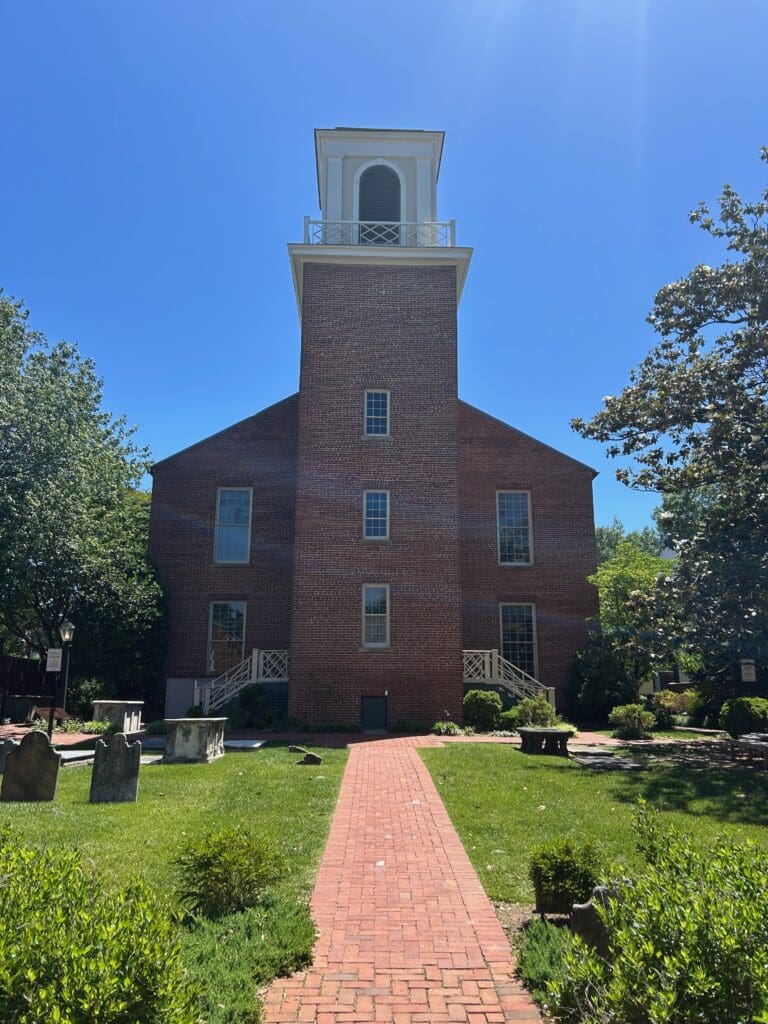
For half a century, from Sarah Fairfax Carlyle’s burial in 1761 until the town banned burials in 1809, Alexandria’s Presbyterians buried their dead here; the last burial, Elizabeth Love Muir’s, came in 1876. Of the roughly 396 people laid in this ground, only a few dozen stones remain. A strip of the yard now lies under a parking lot, and at least one famous name may not be here at all. What survives is enough to tell us who built this town, and how much of their story is still waiting to be found.
Learn more about the individuals buried here through our historical timeline.
Sources and Further Reading
Alden, T. (1814). A collection of American epitaphs and inscriptions, with occasional notes (Vol. 5). S. Marks.
Alexander, J. W. (1872). Princeton College during the eighteenth century. Anson D. F. Randolph & Co.
Alexandria Association. (1956). Our town 1749-1865 at Gadsby’s Tavern Alexandria, Virginia. The Dietz Printing Company.
Boston Tea Party Ships & Museum. (n.d.). Participants in the Boston Tea Party. Retrieved from http://www.boston-tea-party.org/participants/participants.html
Boundary Stones of the District of Columbia. (n.d.). Additional information. Retrieved May 2022, from https://boundarystones.org
Bussel, R. (1998). The most indispensable man in his community. Pennsylvania History.
Carlyle House. (n.d.). John Carlyle. Retrieved October 2022, from https://www.novaparks.com/parks/carlyle-house-historic-park/history
Cresswell, N. (1924). The journal of Nicholas Cresswell, 1774–1777. The Dial Press.
Dahmann, D. C. (2022). The roster of historic congregational members of the Old Presbyterian Meeting House.Unpublished manuscript.
George Washington’s Mount Vernon. (n.d.). Battle of the Monongahela. Retrieved September 2022, from https://www.mountvernon.org/library/digitalhistory/digital-encyclopedia/article/battle-of-the-monongahela/
Howard, M. R. (2023). The fevered fight: Medical history of the American Revolution, 1775-1783. Pen and Sword Books.
Lord, W. (1972). The dawn’s early light. W. W. Norton & Company, Inc.
Lynch, A. M. (Comp.). (2001). A compendium of early African Americans in Alexandria, Virginia, Volume III: Transcriptions of deeds relating to African American churches (Alexandria Archaeology Publications No. 46). Office of Historic Alexandria.
Miller, T. M. (1991). Artisans and merchants of Alexandria, Virginia, 1780-1820: Volume 1. Heritage Books, Inc.
Moore, G. M. (1949). Seaport in Virginia: George Washington’s Alexandria. Garrett and Massie, Incorporated.
National Park Service. (1976, April 30). Register of Historic Places Inventory Form: LaGrange Plantation, Port Tobacco, Maryland. Retrieved from https://apps.mht.maryland.gov/Medusa/PDF/NR_PDFs/NR-400.pdf
Old Presbyterian Meeting House. (n.d.). Old Presbyterian Meeting House’s visitor’s guide to Alexandria’s historic Old Presbyterian Meeting House. Trifold pamphlet.
Old Presbyterian Meeting House Churchyard Burial Ground. (n.d.). Trifold pamphlet.
The Presbyterian Meeting House. (n.d.). Church history. Retrieved May 2022, from https://opmh.org/about/history/
Pippenger, W. E. (1992). Tombstone inscriptions of Alexandria, Virginia: Volume 1. Family Line Publications.
Pippenger, W. E. (2014). Husbands and wives associated with early Alexandria, Virginia (and the surrounding area) (3rd ed., expanded and rev.). Heritage Books.
Powell, M. G. (2000). The history of Old Alexandria, VA, from July 13, 1749 – May 24, 1861. Willow Bend Books.
Wineberger, J. A. (1857). The tomb of Washington at Mount Vernon. T. McGill.
Page last updated: October 26, 2026.
- In colonial Virginia, “Meeting House” described the places of worship of non-Anglican congregations — Presbyterians, Baptists, Quakers, and others. Under the English Toleration Act of 1689, qualifying Protestant dissenters could worship legally, but within limits: a dissenting congregation could not call its building a church, and meeting houses were required to keep their doors and windows open during services, so that worship was conducted in full public view — clandestine religious gatherings remained suspect and unlawful. Compulsory support of the established Anglican church did not end in Virginia until the Virginia Statute for Religious Freedom of 1786. ↩︎
- Unpublished manuscript history of the Old Presbyterian Meeting House, n.d., p. 11; courtesy of Meeting House archivist Don Dahmann. ↩︎
- Old Presbyterian Meeting House trifold brochure, n.d., which dates the ground as “a Burial Ground, active from 1760 – 1809.” ↩︎
- On January 11, 2017, the world learned of the passing of T. Michael Miller, a renowned historian, in November 2016. Miller was a central figure in the study of Alexandria’s history, having written extensively on the topic. His notable contributions include the acclaimed “A Seaport Saga: Portrait of Old Alexandria, Virginia” and the two-part series “Artisans and Merchants of Alexandria, Virginia 1780-1820.” His roles included curatorship at the Lee-Fendall House Museum and positions as a research historian at the Alexandria Library, Lloyd House, and the Office of Historic Alexandria. Miller was an integral part of the Alexandria Historical Society Board for 12 years, serving as its President from 1994 to 1996, and was honored with its annual History Award in 2007. One of his significant accomplishments was the discovery of Freedmen’s Cemetery in 1987, the final resting place for 1,800 freed African American slaves. Well-known historian and former Alexandria resident William Seale acknowledged Miller’s significant contributions, stating that Miller’s work provided a rich legacy to Alexandria and American history. He noted the rarity of a town having as comprehensive a historical record as that created by Miller—source: In Memory of T. Michael Miller, Alexandria Legends. ↩︎