

A Scottish Upbringing Sets the Stage
Born in 1731 in Kilbride, Scotland, Robert Adam was the eldest son of Rev. John Adam and Janet Campbell Adam. His father, a Doctor of Divinity, likely instilled in Robert a spirit of scholarship and civic duty that would guide his future actions. This solid Scottish upbringing planted the early seeds for his eventual influential role in America.
Seeking Opportunity in the New World
In 1753, a bold 22-year-old Adam set sail from his native Scotland, landing in the bustling port of Alexandria, Virginia. This fateful journey marked a new chapter as he sought to establish his fortune in the thriving colonial settlement. Alexandria in the mid-18th century was experiencing rapid growth in both population and prominence. The ambitious young Adam quickly recognized the bountiful opportunities in this energetic community.


Laying Business Foundations
Wasting no time, Adam pursued a variety of entrepreneurial ventures to secure his foothold. He partnered with fellow businessman John Carlyle, focusing first on wheat and flour trading through their firm Carlyle & Adam. Displaying the business diversity that would become his hallmark, Adam also constructed and operated a grist mill along Four Mile Run around 1763, establishing himself as an integral player in Alexandria’s mercantile scene.

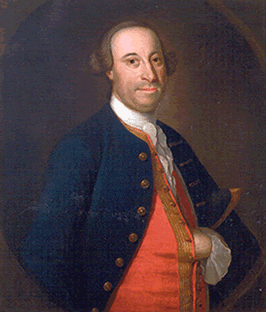
Expanding his business horizon, Adam also entered into a trading partnership in 1770 with Matthew Campbell and James Adam under the firm Robert Adam & Company, though this partnership dissolved in 1776. His business acumen was further displayed through his involvement in various industries, including a tannery and a flour mill.
Beyond his entrepreneurial ventures, Adam’s dealings with George Washington dated back to at least 1760, solidifying a relationship that was both personal and professional. He was a major buyer of flour from Washington’s mill, indicating their close business interactions
Cultivating Bonds with the Washingtons
As a rising community leader, Adam built productive relationships with other power figures like the prominent Washington family. Adam once dwelled in a home originally owned by William Fairfax of Belvoir Plantation. The deed’s transfer to Adam was witnessed by none other than George Washington, illustrating early connections between the two men.
The Adam and Washington families also socialized together frequently. George and other Washington relations were regular guests at Adam’s residence on Fairfax Street, which likely served as a hub for Alexandria’s social and political elites.
The commercial collaboration between Robert Adam and George Washington notably included Adam’s purchase of Washington’s annual fish yield from Posey’s Landing. This venture was incredibly lucrative for Washington, surpassing the earnings from his farming efforts. Washington skillfully managed three commercial fishing areas along the 10-mile shoreline of his estate, showcasing his entrepreneurial acumen. The largest was located about a mile south of the Mansion at Union Farm. The transaction with Adam likely occurred at one key site, Posey’s Ferry, also known as the Fish Landing.
Additionally, Washington operated a fishery near the estate’s wharf, called the Landing, and another approximately a mile above Sheridan Point in the River Farm area. These fisheries significantly contributed to Washington’s economic pursuits. For more information and a detailed map of these locations, visit Washington’s Five Fisheries.
Adam and Washington’s relationship extended beyond business into shared leisure pursuits, notably as hunting companions. Their participation in fox hunts was a source of recreation and a platform for valuable networking with other influential colonial leaders. These activities underscored Adam’s integration into the prominent Virginia social circle and highlighted his close ties with Washington.
Activism and Political Leadership
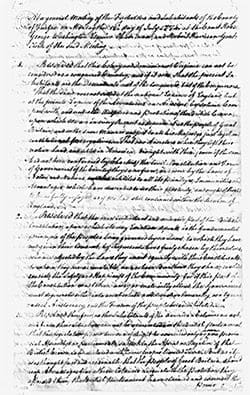
As tensions escalated with Great Britain, Adam joined the ranks of vocal opponents to British tyranny. In 1774, he took the bold step of signing the Fairfax Resolves, demanding colonial self-governance and protesting British aggression against Boston. His involvement in this dramatic early statement of American liberty demonstrated Adam’s convictions and cemented his status as a local patriot leader.
When war finally erupted, Adam utilized his resources to provide supplies and provisions for the colonial war effort. His vessels carried ammunition and weapons to General Washington’s Continental Army.
To read a PDF copy of the Fairfax Resolves, click here: Fairfax Resolves PDF.

In addition to his role as a merchant and community leader, Adam also dedicated himself to public service. He served as the sheriff of Fairfax County and took an active role as a militia officer, furthering his engagement in local governance.
Community Builder
Beyond high-stakes politics, Adam sought to shape the fabric of early Alexandria through civic and business leadership. He held prominent roles in various community organizations including his position as founding Master of Alexandria’s prominent Masonic Lodge.
Adam also invested in projects to provide key local infrastructure and institutions. He helped manage lotteries to finance construction endeavors including a market house and the city’s first schoolhouse.
The enterprising businessman also expanded his commercial reach with interests spanning iron foundries to bakeries to tanneries. The diversity of his business portfolio reflected his capacity for innovation and progress.
Family Life
In addition to his prolific professional life, Robert Adam also enjoyed a loving marriage to his wife Anna and raised a family in their Alexandria home. Anna bore him several children, though their firstborn son John would prove to carry on his father’s legacy most prominently.
John Adam
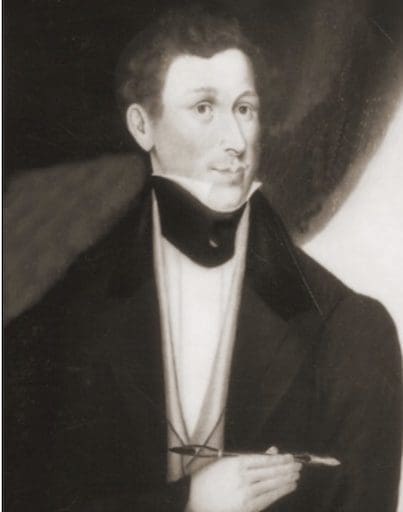
Following in his entrepreneurial father’s footsteps, John Adam became an established businessman, contractor and architect in Alexandria. He too showed versatility in his commercial dealings that included tobacco trading, banking, toll roads and canal systems.
Like his civic-minded father who was a Masonic Lodge founder, John also had deep Masonic ties as a member of Masonic Lodge No. 22 and holding the revered title of Worshipful Master.
John was also associated with the St. Andrew’s Society, a fraternal society for Scots promoting charity and mutual assistance. This nod to his Scottish heritage reflected the influence of his immigrant father Robert.
Like his father, John also invested heavily in community advancement, serving on Alexandria’s Common Council for years. The Council, recognizing his dedication, appointed him as a trustee of the Poor House in 1820.
On September 30th, 1843, John Adam passed away at 62, abruptly cutting short the life of a pillar of the Alexandria community.

The Adam Legacy
Before his abrupt death, John had already established himself as a leading voice in Alexandria, much as his father had done before him. John played his own role in shaping early Alexandria as he honored the family name. Though the Adam family has now faded from memory, during their era the Adam name was once synonymous with Alexandria’s emergence and ascent as a colonial center of industry and influence.
Robert Adam: A Lasting Legacy and a Mysterious Resting Place
Robert Adam, who passed away in 1792, was instrumental in shaping the early development of Alexandria. The mystery of his final resting place adds a layer of intrigue to his story. While Adam does not have a dedicated headstone, his name is commemorated on his son John Adam’s obelisk, honoring his memory. Recent Ground Penetrating Radar (GPR) surveys conducted on the family plot have shed new light on this historical enigma, potentially revealing the location of Robert Adam’s unmarked grave.
Adam’s impact on Alexandria was significant, spanning business, community, and politics, firmly establishing him as a pivotal figure in the town’s history. This contrast between his substantial contributions and the uncertainty surrounding his burial site highlights the lasting fascination with his legacy. Despite the enigma of his final resting place, Robert Adam’s influence continues to be felt in the historical narrative of Northern Virginia. The latest GPR findings, detailed in the blog post “Winter Archaeology: New Discoveries and Collaborations Illuminate Historical Narratives,” offer a tantalizing glimpse into the ongoing efforts to uncover the secrets of Alexandria’s past and bring clarity to the enduring mystery of Robert Adam’s final resting place.

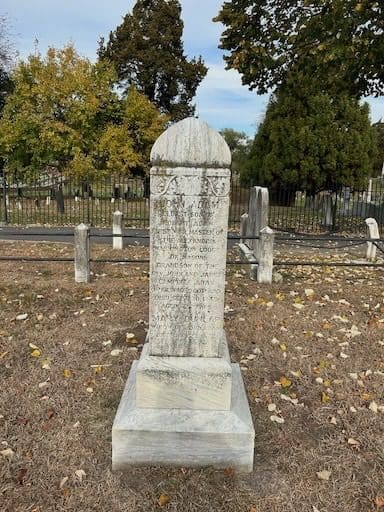
In memoriam
within these sacred
precincts lie the
departed members of
the ADAM
family
ELIZA CAMPBELL ADAM
beloved daughter of
JOHN and MARY
DUNLAP ADAM
born Sept. 12, 1819
died May 29, 1909
JANE DADE
daughter of ROBERT
and ANNA ADAM
died Jan. 23, 1873
aged 89 years
widow of CHARLES
STUART DADE who was
lost at sea July 1811
CHARLES IRVIN
son of
JOHN and MARY ADAM
died Jan. 1823
aged 5 years
THOMAS IRWIN
son of
JOHN and MARY ADAM
died Jan. 19, 1879
JOHN ADAM
eldest son of
ROBERT ADAM
First Wor. Master of
the Alexandria
Washington Lodge
of Masons
Grandson of the
Rev. JOHN and JANET
CAMPBELL ADAM
of Kilbride, Scotland
died Sept. 30, 1843
aged 62 years
MARY DUNLAP
widow of JOHN ADAM
died Jan. 29, 1873
JAMES IRWIN
of Belfast, Ireland
The faithful
guardian of JOHN ADAM
died Sept. 5, 1822
Sources of Information
Pippenger, W. E. (1992). Tombstone Inscriptions of Alexandria, Virginia: Volume 1. Westminster, MD: Family Line Publications.
Miller, T. M. (1991). Artisans and Merchants of Alexandria, Virginia 1780 – 1820 Volume 1. Heritage Books, Inc.
Miller, T. M. (1992). Artisans and Merchants of Alexandria, Virginia 1780 – 1820 Volume 2. Heritage Books, Inc.
Madison, R. L. (2005). Walking with Washington. Gateway Press, Inc.
Wright, F. E., & Pippenger, W. E. (2012). Early Church Records of Alexandria City and Fairfax County, Virginia. Heritage Books, Inc.
Dahmann, D. C. (2022). The Roster of Historic Congregational Members of the Old Presbyterian Meeting House. Unpublished manuscript.
Alexandria-Washington Lodge No. 22. (n.d.). AW22 History. Retrieved from https://aw22.org/aw22-history/
Society for the Preservation of Old Mills, Mid-Atlantic Chapter. (2009). Fairfax County & D.C. Mills. Retrieved from https://spoommidatlantic.org/uploads/editor/files/Mid-Atlantic_Mills/Fairfax_County%2526_DC_Mills-Book-5-8-2009.pdf
The Papers of George Washington, Financial Papers Project. (n.d.). Adam, Robert. Retrieved from http://financial.gwpapers.org/?q=content/adam-robert