The Legacy of the Alexandria Quaker Burial Ground
The Alexandria Quaker Burial Ground, located in Alexandria, Virginia, is a testament to the enduring legacy of the Religious Society of Friends, better known as Quakers. Founded in 17th-century England by George Fox, the Quakers faced persecution for their distinctive beliefs, particularly the conviction that the divine presence dwells within each person. They rejected elaborate rituals, had no ordained clergy, and promoted spiritual equality between men and women. Because they refused to conform to the established Church of England, Quakers were counted among England’s religious Dissenters, and that status brought fines, imprisonment, and exclusion from public life. The search for a place to worship freely was one of the reasons many Quakers crossed the Atlantic, and their arrival in mid-17th-century America marked the beginning of a significant religious and social influence. The Alexandria Quaker Burial Ground stands as a reminder of their impact on the region.
Quakers and Social Reform
Quakers are noted for their pacifism and were instrumental in the abolitionist movement and the advancement of women’s rights. That history gives special weight to Alexandria’s Quaker meeting houses, including the one built in 1811. Even as the Quaker community in Alexandria changed over time, and the Alexandria Meeting eventually dissolved, the Friends’ commitment to social justice endured.
Transformations Through Time: The Evolution of the Alexandria Quaker Burial Ground
The history of the Alexandria Quaker Burial Ground is marked by several transformations. In 1784, Alexandria’s Quaker community established the burial ground on Queen Street, near Washington Street, to replace their earlier cemetery and meeting place on South St. Asaph Street.
In 1803, yellow fever swept through Alexandria, and at least three of its victims lie buried in this ground. The epidemic pushed the town to act against burials in the heart of the city. An ordinance provided that after March 27, 1804, no one could be buried here unless a plot had already been allotted. In 1809, the town stopped issuing burial permits altogether. New Quaker burials shifted to the Friends Cemetery in Washington, D.C., although the Friends continued to use the Queen Street ground discreetly for some time afterward.
Tragedy struck the site in 1884, when a collapsing cemetery gate killed a young girl. In 1918, the Audubon Society repurposed the old burial ground as a bird sanctuary, and the site later became a children’s playground. Finally, in 1937, a lease agreement led to the construction of the Kate Waller Barrett Branch Library, which occupies the burial ground today at 717 Queen Street. The library honors Dr. Kate Waller Barrett, an Alexandria social reformer who led the national Florence Crittenton Mission for women and girls.

Of the 159 people once buried here, 66 were reinterred on the property when the library was built, while 93 still rest in their original graves. Records survive for only 78 of these burials.
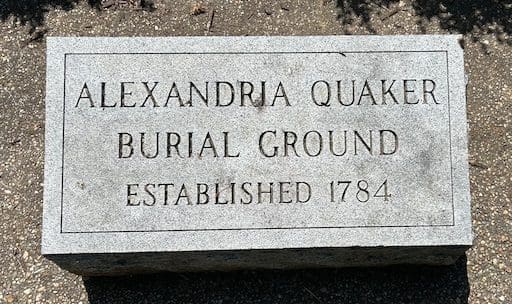
Prominent Burials at the Alexandria Quaker Burial Ground
The Alexandria Quaker Burial Ground is the final resting place of several notable Quakers who made significant contributions to the community. Among them are Dr. Elisha Cullen Dick, William Hartshorne, and William Stabler, each of whom played a part in shaping the history of Alexandria and the United States.
Dr. Elisha Cullen Dick (1762-1825) Physician and Prominent Quaker
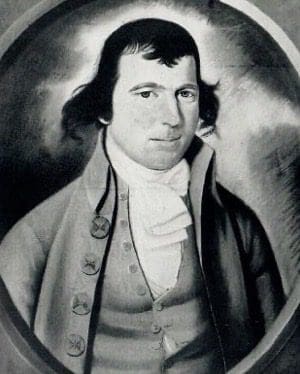
Dr. Elisha Cullen Dick was a physician who studied under Dr. Benjamin Rush. Raised an Episcopalian, he later converted and became one of Alexandria’s most prominent Quakers. In December 1799, Dr. Dick was one of the physicians called to Mount Vernon to attend George Washington in his final illness. By tradition, he stopped the clock in Washington’s bedroom at the moment of death. When Dr. Dick died in 1825, he was laid to rest in an unmarked grave in the Alexandria Quaker Burial Ground.
You can read more about him at this blog: https://gravestonestories.com/discover-the-history-of-the-quaker-burial-ground-in-alexandria-va-from-sacred-space-to-modern-landmark/.
William Hartshorne (June 1742 – October 13, 1816) Quaker Merchant and Civic Leader
Another notable figure buried here is William Hartshorne, a Quaker merchant and civic leader in early America. His life reflected a commitment to both community and enterprise. He served as a trustee of the Alexandria Academy and signed the petition to establish Overseers of the Poor.
As a merchant dealing in goods such as wine, Hartshorne prospered and played a significant role in the development of Alexandria. He married Susanna Saunders in 1767 at the Philadelphia Monthly Meeting, and the couple had eight children who survived infancy. In 1803, he married Susanna Wood Shreve at the same meeting, a sign of his deep roots in the Quaker community.
Hartshorne’s business interests reached well beyond his own trade. He served as a trustee for several companies and as treasurer of the Potomac Company, alongside influential figures such as George Washington. His lengthy will reflects his careful nature, directing that his debts be paid and his estate divided fairly among his wife and children.
His journal records a journey to treaty negotiations with Native Americans at Sandusky, Ohio, offering a rare firsthand glimpse into the complexities of that era.
Despite his business skill, Hartshorne was badly hurt by the Embargo Act of 1807, which devastated his trade and led to a rigorous inquiry by his Quaker meeting. Although he was cleared, the financial losses forced him to sell his beloved farm, Strawberry Hill, along with other properties.
William Hartshorne died on October 13, 1816, and was buried among his fellow Friends in the Quaker Burial Ground. His story is one of resilience, community service, and steadfast Quaker faith.
William Stabler: The Legacy of a Quaker Apothecary
The Alexandria Quaker Burial Ground is also the final resting place of William Stabler, a significant figure in the history of American pharmacy. Stabler, together with his father Edward and his brother-in-law John Leadbeater, ran a renowned Alexandria apothecary that served the community until 1933.
Edward Stabler, a devout Quaker and astute businessman, opened his apothecary in 1792 in rented space near the corner of South Fairfax and Prince Streets. In 1805, he bought land at 107 South Fairfax Street and built a three-story brick building for his growing business, which became a community landmark. By 1829, he had acquired the adjacent property at 105 South Fairfax and folded it into the business.
The Stabler apothecary sold a remarkable range of goods: medicines, farm and garden tools, surgical and dental equipment, soap and perfume, and household items such as Congress mineral water, window glass, paint, varnish, artist supplies, combs, and brushes.
William Stabler, Edward’s eldest son, took on responsibility for the business at a young age. Edward was often away attending Quaker meetings and left the shop in the care of William and his apprentices. After Edward’s death in 1831, William inherited the business and kept it a family enterprise, bringing in his brothers and his brother-in-law, John Leadbeater.
William Stabler led the business with continued success and earned the community’s respect. He had no children, and after his death in 1852 his widow sold the business to John Leadbeater, a trained apothecary and dentist, who renamed it under his own name. That sale marked the end of the Stabler name in the enterprise.
The shop remained open until 1933, when the hardships of the Great Depression and the death of its last owner, Edward Stabler Leadbeater Jr., brought an era of traditional apothecary practice to a close. Recognizing its historical significance, the American Pharmaceutical Association preserved the shop as a museum. Today the Stabler-Leadbeater Apothecary Museum in Old Town Alexandria holds more than 20,000 artifacts, including hand-blown glass bottles and herbal botanicals. Its archival collection of letters, invoices, account books, and ledgers from 1792 to 1933 includes the names of customers such as Martha Washington and Nelly Custis.
William Stabler lies in the Quaker Burial Ground on Queen Street, but his gravestone stands miles away at the Woodlawn Friends Meeting House cemetery at Fort Belvoir in Fairfax County. His body is in one place and his name in another, a fitting reminder of how widely the Stabler family’s ties to pharmacy and Quakerism reached across 19th-century Northern Virginia.

Preserving the History and Heritage of the Alexandria Quaker Burial Ground
From its founding in 1784 through its years as a bird sanctuary, a playground, and finally a public library, this ground has never stopped being a burial place. Ninety-three people still rest beneath the Kate Waller Barrett Branch Library. Remembering them, and telling the stories of Friends like Dr. Dick, William Hartshorne, and William Stabler, keeps faith with the Quakers who helped build Alexandria.
Sources of Information
Barber, J. G. (1998). Alexandria in the Civil War. H.E. Howard, Inc.
Catlin, M. C. (2016, October). Historical overview of the Woodlawn Quaker meeting.
City of Alexandria, VA. (n.d.). Historic Cemeteries of Alexandria. Retrieved from https://www.alexandriava.gov/historic-sites/historic-cemeteries-of-alexandria
City of Alexandria, VA. (n.d.). History of the Apothecary Museum.
City of Alexandria, VA. (n.d.). History of the Apothecary Museum. Retrieved from https://www.alexandriava.gov/museums/history-of-the-apothecary-museum
Catlin, M. C. (2016, October). Historical overview of the Woodlawn Quaker meeting.
Crothers, A. G. (2012). Quakers Living in the Lion’s Mouth: The Society of Friends in Northern Virginia, 1730–1865. University Press of Florida.
Dahmann, D. C. (2002). The Roster of Historic Congregational Members of the Old Presbyterian Meeting House. [Unpublished manuscript].
Dutton + Associates, LLC. (2013, December). Documentary study and archaeological monitoring of the Cromley Row project area, City of Alexandria, Virginia. Richmond, Virginia.
Pippenger, W. E. (1992). Tombstone Inscriptions of Alexandria, VA (Volume 3). Family Line Publications: Westminster, Maryland.
Ring, C. K., & Pippenger, W. E. (2008). Alexandria, Virginia Town Lots 1749–1801 together with Proceedings of the Board of Trustees 1749–1801. Heritage Books.
Woodlawn Friends Meeting. (n.d.). Home. Retrieved from https://woodlawnfriends.org/home/
Page last updated: October 2026