Alexandria Revolutionary War Patriots · America 250
Revolutionary War Patriots
Buried in Alexandria
Alexandria Revolutionary War patriots number 162 — buried across 13 historic burial grounds from founding fathers to forgotten soldiers.
Alexandria Revolutionary War Patriots: A City of Founders
When the Revolution ended, its survivors came home to Alexandria.
The Alexandria Revolutionary War patriots documented on this page number 162 — soldiers, civic leaders, and citizens who helped shape the founding of the nation, buried across 13 historic burial grounds. As the United States commemorates the 250th anniversary of the American Revolution (America250), Alexandria stands as a remarkable living archive of the founding era: the hometown of George Washington, the port through which tobacco and trade flowed to Britain, and the city where the Revolution’s survivors built their lives after independence was won.
These 162 men and women span every role in the struggle for independence: Continental Army officers who fought alongside Washington at Valley Forge and Yorktown, merchant patriots who funded the war effort, physicians who tended the wounded, and ordinary tradesmen who served in local militias. Their stories illuminate not just the war itself, but the world they built afterward.
Many served directly with George Washington, supported the Continental cause through commerce or civic leadership, or helped build the young republic in the decades after the war. Today, their graves are scattered across Alexandria’s historic cemeteries — from the Old Presbyterian Meeting House burial ground in Old Town to the Wilkes Street Cemetery Complex, approximately one mile west of the Potomac River waterfront, and beyond — creating an extraordinary outdoor archive of the American founding.
George Washington himself is buried eight miles south at Mount Vernon. But Alexandria was his town — and the men and women on this page were his neighbors, his physicians, his pallbearers, his business partners, and his friends. He dined at their homes, worshipped in their churches, walked in their funeral processions, and relied on their loyalty through war and peace. To walk among their graves is to understand Washington not as a monument but as a man — surrounded by a community of extraordinary people whose own stories have waited too long to be told.
A Note on the Count
This registry currently documents 162 Revolutionary War patriots associated with Alexandria burial grounds. Ongoing research shows that the true number of Revolutionary War–connected burials in Alexandria was higher — especially when wartime hospital deaths, provisional burials, unmarked graves, and lost cemetery records are taken into account.
The number 162 should therefore be understood as the documented registry count, not the final historical total.

America 250 · Official Historical Resource
This research contributes to Alexandria’s America 250 commemoration, connecting visitors to the city’s Revolutionary foundations through the individuals who made independence possible.
The cemeteries where these 162 patriots rest can be explored on our Interactive Cemetery Map — 37 Historic Cemeteries — all 37 of Alexandria’s historic burial grounds plotted in one place, from the Wilkes Street Complex to the outlying family cemeteries of Fairfax County.
Prefer it in print? The free Among the Founders tri-fold brochure distills this registry into a guide you can download, print, or share — along with David Heiby’s lecture menu for DAR and SAR chapters, schools, and civic groups.
The story continues a generation later. Many of these patriots’ sons — and a few of the patriots themselves — took up arms again in the War of 1812, when British warships came up the Potomac to Alexandria. Our companion War of 1812 Veterans Registry documents the Alexandrians who served in that second war with Britain, including the men who fell at the Battle of the White House.
Key Figures & Their Stories
Selected profiles from Alexandria’s most historically significant Revolutionary War patriots
In November 1748, three Scottish settlers — William Ramsay, John Carlyle, and John Pagan — sailed up the Potomac River from Dumfries, Virginia, looking for a better trading port. They chose a site near a tobacco inspection warehouse at Hunting Creek, which made it ideal for a deep-water port. They petitioned the House of Burgesses to establish a town. The petition was granted. The town was named Alexandria. Ramsay helped draft the town charter.
That founding act in 1749 set Ramsay at the center of everything that followed. He became the city’s first postmaster, overseer of the Alexandria Academy, Justice of Fairfax County, and on St. Andrew’s Day 1761 was voted the first and only Lord Mayor of Alexandria — presented with a gold chain and medal. By tradition, his Ramsay House is the oldest house in Alexandria. Legend holds that it was first built as early as 1724 near Dumfries, Virginia, and later barged to its present site — a claim for which no documentation has been found. The structure standing today is in fact a 1956 reconstruction based on earlier photographs of the house, and it now serves as Alexandria’s official visitor center. In 2015, the National Museum of American History devoted an exhibit to his merchant ledgers, desk, bookcase, and writing instruments.
His connection to George Washington ran deeper than civic partnership. When Ramsay married Ann Ball McCarty, he married into Washington’s family — Ann’s mother was a first cousin of Washington’s mother. In 1774, alongside George Mason, Ramsay helped form the Fairfax Independent Company of Volunteers, among the earliest of Virginia’s independent companies. Washington recorded in his diary on 12 February 1785 that he walked in the Masonic funeral procession of his old friend. Ann Ramsay died seven weeks after him, on 1 April 1785, and on 4 April Washington walked in her funeral procession too.
Ann Ball McCarty Ramsay was a patriot in her own right: elected Treasurer of Alexandria, she raised taxes and donations worth more than seventy-five thousand in the paper money of the day in support of Washington’s cause. The Ann McCarthy Ramsay Chapter of the Children of the American Revolution in Alexandria bears her name today. Both William and Ann are buried at Christ Church — no known markers have survived.
One of Washington’s honorary pallbearers at the funeral on December 18, 1799 — the pallbearers held the pall while the underbearers carried the heavy mahogany coffin from the Green Room at Mount Vernon to the tomb — and Gilpin’s own resting place was lost for over two centuries. Although 1935 library maps showed a “Gilpin plot” within the Wilkes Street Cemetery Complex, that knowledge had been forgotten entirely. Through more than a decade of cemetery stewardship and original research, the family plot was identified, and in 2024 a ground-penetrating radar survey found a grave-like feature there, beside the gravestone of Mary Gilpin. That spot is Gilpin’s presumptive resting place — a strong case, though radar alone cannot tell us who lies in a grave. The search made headlines and is one of the most significant cemetery finds in Alexandria’s recent history.
When George Washington passed through Alexandria on his way to his first inauguration, it was Mayor Dennis Ramsay who delivered the farewell address — and who became the first person in history to address Washington as “Mr. President.” That phrase was first spoken in Alexandria — and we call the President “Mr. President” to this day. Ramsay’s connection to Washington ran deep: he was also one of Washington’s honorary pallbearers at his funeral on December 18, 1799. He now rests in the Presbyterian Cemetery at the Wilkes Street Complex — Section 42, Plot 72.
No figure was closer to George Washington through both war and death than Dr. James Craik. He served alongside Washington from 1754, when he joined Colonel Joshua Fry’s Virginia Regiment as its surgeon and met a 22-year-old lieutenant colonel — through Fort Necessity and Braddock’s disastrous 1755 expedition — and in 1777 Washington brought him into the Continental Army, where he served as Assistant Director General of the Middle Department before ascending in 1781 to Chief Physician and Surgeon of the entire Continental Army.
His patients included the men closest to Washington. At Yorktown in 1781, Washington charged him to give his first attention to the Marquis de Lafayette should the Frenchman be wounded, and that November Craik attended John Parke Custis — Martha Washington’s son and Washington’s aide-de-camp — who succumbed to camp fever, a loss that profoundly affected the Washingtons. Meeting House tradition also holds that Craik tended Lafayette after the Battle of Brandywine in 1777, a story long told in the congregation, though no record of it has been found. Through every campaign, Craik remained at Washington’s side. He was present at Washington’s bedside when the General died on December 14, 1799. He died in 1814 at Vaucluse, his farm beyond the city line — and whether he was brought back to this yard, where his monument stands, remains an open question. His SAR marker at Old Presbyterian Meeting House, installed November 13, 2003, honors one of the most intimate witnesses to Washington’s life and final hours.
Inside the base of the bell tower of the Old Presbyterian Meeting House, in a storage area most visitors never see, sits a small gravestone carved with two initials: “I. Y.” It marks one of the least-known and best-documented Washington connections in Alexandria. On March 5, 1770, George Washington rode from a hunting party at Robert Alexander’s over to Georgetown, and his account ledger records why: he paid the gunsmith John Yost six pounds ten shillings, Maryland currency, for a rifle — custom work, at roughly a third more than Yost would later charge the state of Maryland per rifle for the war effort.
When the Revolution came, Yost and his brother Henry turned their Georgetown shop into an arsenal. Contracting with the Maryland Committee of Safety as early as October 1775, John agreed in July 1776 to deliver 300 muskets and 100 rifles, building a horse-powered mill for boring gun barrels to fill the order. The Maryland Archives trace his work through the whole war — muskets to the company at Port Tobacco, funds advanced “to enable him to manufacture good substantial Musquets,” repairs to public arms as late as 1781. He swore the Maryland patriot oath in 1778.
In 1783 he moved to Alexandria with his wife Rebecca and their children, keeping a shop at the northwest corner of Wilkes and Fairfax Streets — gunsmith, blacksmith, keeper of the town powder house, and seller of a variety of merchandise, especially spirits. Rev. Muir buried him in the Meeting House churchyard on March 8, 1806. Nearly every man on this page knew Washington as a neighbor, a patient, a customer, or a friend. Yost’s claim is different: Washington carried his work.
Cavan Boa holds a unique double distinction: he was George Washington’s personal tailor throughout the Revolutionary War years, and he became the very first person buried at St. Mary’s Catholic Cemetery when he died in 1798. This makes him both the inaugural burial in Alexandria’s oldest Catholic cemetery and a man who spent years measuring, fitting, and crafting the garments worn by the Commander-in-Chief himself.
In May 1782, Colonel Lewis Nicola sent Washington one of the most remarkable letters in American history — proposing that the General use the army’s loyalty to establish himself as King of America. Washington responded with one of his sharpest rebukes, calling the idea “painful” and “injurious.” Nicola, who had founded the Invalid Corps in 1777 and served the Revolution faithfully, recanted immediately. He now rests at Old Presbyterian Meeting House — a building Washington visited on two documented occasions: the 1798 National Day of Humiliation, Fasting, and Prayer, and a Masonic Lodge service held in the original structure. That building burned in 1835 and was replaced in 1837; Washington never set foot in the present-day Meeting House.
On the night of December 16, 1773, Thomas Porter was 17 years old when he slipped out of the Old South Meeting House alongside the men who would carry out one of history’s most audacious acts of protest. As Major Samuel Cooper later recorded in his first-person account, a detachment of about 20 men disguised as Indians approached in single file through the church, marching silently down the aisle and out the south door, brandishing tomahawks — their destination the wharves where the tea ships lay. Porter was among them. He later became a respected Alexandria merchant, Mason, and founding member of the Bank of Alexandria. He is buried at Old Presbyterian Meeting House — one of two confirmed Boston Tea Party participants known to be buried in Alexandria, the other being Major Samuel Cooper at Christ Church Cemetery in the Wilkes Street Complex.
Major Samuel Cooper was just 16 years old on the night of December 16, 1773, when approximately 116 men divided into three groups, each assigned to one of three British merchant ships in Boston Harbor. Cooper was among them. As he later recorded in one of only four known first-person accounts of the event — and the one most widely cited today — the men proceeded “quietly” to the wharves, gained possession of the ships, and hoisted out the chests, emptying their contents into the dock. “No noise was heard,” Cooper wrote, “except the occasional clink of the hatchet in opening the boxes, and the whole business was performed with so much expedition that before 10 o’clock that night the entire cargo of the three vessels were deposited in the docks.” Together they dumped 342 chests, totaling over 92,000 pounds of East India Company tea.
Cooper went on to serve throughout the Revolutionary War, compiling one of the most distinguished service records of any Alexandria patriot. His grave at Christ Church Cemetery in the Wilkes Street Complex bears a joint SAR/DAR marker installed in November 1985, recognizing his service to the patriot cause from the harbor of Boston to the battles of the Revolution.
Of the approximately 116 men who carried out the Boston Tea Party in December 1773, two now lie buried in Alexandria — Thomas Porter at Old Presbyterian Meeting House and Major Samuel Cooper at Christ Church Cemetery — a remarkable connection between the Revolution’s opening protest in Boston Harbor and a small port city on the Potomac.
Major Henry Piercy’s service record reads like a map of the Revolutionary War’s major engagements: he fought alongside Washington in nearly every significant battle of the conflict. After the war, Piercy settled in Alexandria and led the Independent Blues, serving as part of the military escort at Washington’s funeral in December 1799. His exact gravesite within the Wilkes Street Complex has not been located.
A Quaker merchant and one of Alexandria’s most respected civic leaders, William Hartshorne served alongside George Washington as treasurer of the Potomac Company — the ambitious early American infrastructure project Washington founded to connect the Ohio Valley to Atlantic ports. Hartshorne also served as trustee of the Alexandria Academy and attended Washington’s funeral in 1799. His grave at the Alexandria Quaker Burial Ground marks the resting place of a man who helped shape both the city’s commerce and its connection to the first President.
Note: The Quaker Burial Ground is now the site of the Kate Waller Barrett Branch Library on Queen Street in Old Town. The library was built on a concrete slab over the graves. No graves are visible; some gravestones are displayed on an outside wall, while others were relocated to the Friends Woodlawn Meeting House near Woodlawn Plantation, south of Alexandria on Route 1.
Robert Allison Sr., born in Pennsylvania around 1745, settled in Alexandria by 1777 and built a life as a sea captain, King Street merchant, and Fairfax County justice. On 7 June 1784 he married Ann Ramsay, daughter of William Ramsay, one of the city’s founders, tying him to one of Alexandria’s most prominent families. He died in 1801 having seen the new nation he helped build take shape around him. He could not have known that his son would die defending it.
On September 5, 1814, Robert Allison Jr., aged 27, was killed at the Battle of the White House (Landing) on the Potomac River — a five-day engagement pitting American militia against seven British warships making their way downriver after sacking Washington, part of the same 1814 campaign that culminated weeks later in the attack on Baltimore and the bombardment of Fort McHenry.
Robert Allison Jr. rests in the Presbyterian Cemetery in the Wilkes Street Complex, his gravestone reading: “who fell in battle on the 5th Septr. 1814 at the white house in gallantly defending his country aged 27 years.” A commemorative plaque honoring him hangs on the eastern wall of the Old Presbyterian Meeting House sanctuary — the same church where his father worshipped and is now buried. Father and son: one who fought for independence, one who died preserving it.
Rhode Island was the last of the thirteen original states to ratify the United States Constitution — holding out until May 29, 1790, more than a year after the new government had already taken effect. When the Rhode Island State Convention finally convened, William Ladd was among the delegates who cast the votes that completed the union. A delegate from Little Compton, he had already served as a soldier in the Revolution, represented his town in the Rhode Island General Assembly, and helped found the Marine Society of Newport in 1785. He was also a member of the Society of the Cincinnati — the hereditary organization of Continental Army officers founded by George Washington, whose Alexandria chapter counted many of the city’s most prominent citizens among its members.
Ladd did not settle in Alexandria. He came to visit his children, and it was here that he died of pleurisy on December 4, 1800, at the age of sixty-four. Rev. James Muir buried him the next day in the Meeting House churchyard. His flat table marker — recorded by researchers in 1913 and again in 1923 — still carries its long inscription, which closes: “Truth was his guide, integrity his solace, and he found the reward of his virtues in the regard of his friends and the hope of immortality.” A soldier, a legislator, a founder, and a father — Alexandria was simply where his journey ended.
Philip Richard Fendall built the Lee-Fendall House in 1785, was elected the first President of the Bank of Alexandria in 1793, visited Mount Vernon thirty-four times between 1770 and 1799, and in 1778 traveled to France where John Adams recorded dining with him in company that included Arthur Lee — the diplomat who had just helped secure the Treaty of Alliance, whereby France agreed to supply the Continental Army. He was, in the language of his contemporaries, a “banker, lawyer, and merchant prince.”
His three marriages created an extraordinary web of connections to the Lee family. His second wife, Elizabeth Steptoe Lee, was the widow of Philip Ludwell Lee of Stratford Hall — making Fendall the stepfather-in-law to Light-Horse Harry Lee. His third wife, Mary “Mollie” Lee, was Light-Horse Harry Lee’s youngest sister — making him simultaneously his former stepson-in-law’s brother-in-law. Light-Horse Harry Lee’s son was Robert E. Lee. Fendall stood at the intersection of Alexandria’s Revolutionary and Civil War history, connected to Washington through friendship and to the Confederacy’s greatest general through two marriages.
He was also, by the end of his life, ruined. The agricultural depression of the mid-1790s collapsed land values across the South. Fendall owned 82,408 acres and couldn’t convert a single one to cash. He declared bankruptcy and was confined to debtors’ prison in Fairfax County in 1803. He died suddenly two years later — “in usual health last Lord’s Day,” Rev. Muir wrote, “taken ill on Monday.” His will asked for burial “without pomp or show” at the private cemetery on his farm near Slater’s Lane.
That farm cemetery was destroyed in 1902 during the construction of Potomac Yards. For over a century, historians believed the Fendall family burials had been lost. They had not. This researcher identified Ivy Hill Cemetery as the likely location; historian Catherine Weinraub volunteered to search the cemetery archives and found the interment cards confirming P. R. Fendall in Section B, Lot 1. Upon learning of the finding, archaeologist Mark Ludlow volunteered to conduct a GPR survey, which identified four burial anomalies consistent with Philip, his two wives, and one additional burial. No marker exists at the site. The Fendall family plot was hidden in plain sight for over a century.
The Unknown Patriot Who Rests on South Fairfax Street
In 1826, during construction of St. Mary’s Catholic Church — now the Basilica of Saint Mary, situated adjacent to the Old Presbyterian Meeting House on South Fairfax Street — the remains of an unidentified Revolutionary War patriot were discovered. He had originally been interred in the churchyard’s northern ground — part of a strip roughly fifty feet deep that was lost when the contested boundary line, drawn in error by the 1763 town-expansion survey, was later moved. The remains were carefully reinterred in the Meeting House’s 18th-century burial ground, where they rest today — the one burial known to have been relocated as the churchyard shrank.
In 1929, the National Society of the Children of the American Revolution erected the Tomb of the Unknown Soldier of the American Revolution at the site, honoring this anonymous patriot whose name, rank, and unit are lost to history. The effort to mark and honor the grave was championed in the early 20th century by Mary Gregory Craufurd Powell, a local historian and member of the Mount Vernon Chapter of the Daughters of the American Revolution. A photograph of the February 22, 1928 dedication ceremony — for the temporary wooden marker that preceded the permanent tomb — is preserved in Special Collections at Alexandria’s Kate Waller Barrett Library, where Powell can be seen at the graveside, ten months before her death that December.
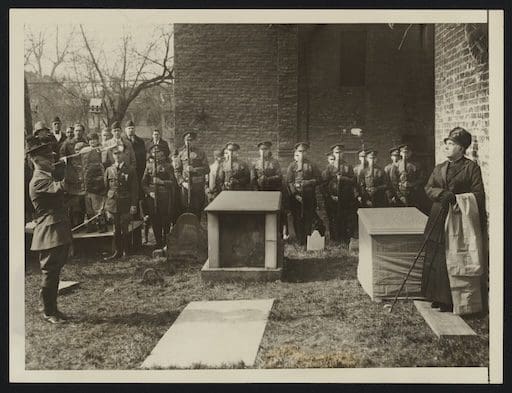
Mary Gregory Craufurd Powell at the 1928 dedication ceremony. Photo preserved in Special Collections, Kate Waller Barrett Library, Alexandria, Virginia.
In the early 1930s, Eleanor Washington Howard — a descendant of George Washington and the last child born at Mount Vernon, in 1856 — visited the Tomb of the Unknown Soldier at the Old Presbyterian Meeting House. A rare postcard from the period, published by Shenandoah Publishing House of Strasburg, Virginia, shows her standing quietly beside the grave: a poignant bridge between the Founding Era and 20th-century remembrance.
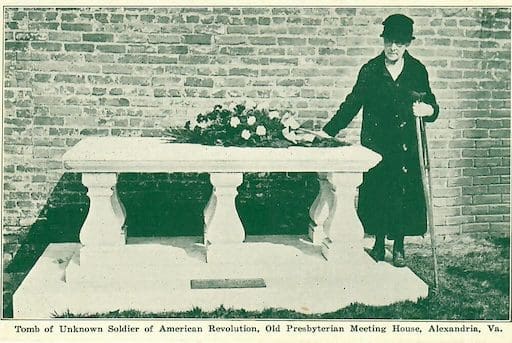
Eleanor Washington Howard — the last child born at Mount Vernon (1856) — at the Tomb of the Unknown Soldier at the Old Presbyterian Meeting House, early 1930s.
Today the Tomb of the Unknown Soldier at the Old Presbyterian Meeting House is one of the most actively commemorated graves in Alexandria. On the Saturday before Presidents’ Day, a major wreath-laying ceremony draws members of numerous SAR and DAR chapters from across the region. On Memorial Day weekend, military units, civic organizations, and heritage groups hold additional ceremonies and lay wreaths at the grave. Throughout the year, periodic remembrances continue — making this one of the few Revolutionary War sites in the country that remains in continuous ceremonial use more than two centuries after the war ended.
Few people know that Alexandria holds a second Unknown Revolutionary War soldier — entirely separate from the Tomb of the Unknown Soldier at the Old Presbyterian Meeting House. Buried at the Presbyterian Cemetery on Hamilton Avenue in the Wilkes Street Cemetery Complex, he is recorded only as “an old Revolutionary soldier from Kentucky” in the Reverend Elias Harrison’s Personal Register, where his burial on 19 January 1821 is noted as HR 9. His name, rank, unit, and grave location within the cemetery are unknown. He is believed to have died in Alexandria far from home. His existence was only recently documented through original research by historian Donald C. Dahmann, whose unpublished manuscript on the Old Presbyterian Meeting House congregation brought this forgotten soldier to light. Over the years, researchers encountering Harrison’s notation have incorrectly attributed the Kentucky description to the Tomb of the Unknown Soldier at the Old Presbyterian Meeting House. The two are different individuals, buried in different cemeteries, recorded in different sources.
Search the Registry — 162 Documented Patriots
Search by name or filter by burial location
This registry is updated as new research emerges. The founding count of 162 reflects patriots documented as of the page’s initial publication in March 2026. Additional provisional entries, wartime hospital deaths, and documentary-only burials appear below as research continues.
Not in this registry? Search every person on the site in the Alexandria Genealogy Index, or battles, regiments and events in the Alexandria History Index.
| Name | Burial Site | Notes |
|---|---|---|
| Ann Ball McCarty Ramsay | Christ Church Burial Ground Old Town | Born 1730, Lancaster County, Virginia; died Friday, 1 April 1785, Alexandria, after a lingering illness. Daughter of Major Dennis McCarty and Sarah Martha Ball; a cousin of George Washington’s mother. Wife of William Ramsay, one of Alexandria’s founders. Patriot in her own right: elected Treasurer of Alexandria, she raised taxes and donations worth more than seventy-five thousand in the paper money of the day to support George Washington and the cause of American independence — praised by Thomas Jefferson for her efforts. Fervently supported orphaned children of Revolutionary War soldiers; her legacy is honored by the Ann McCarthy Ramsay Chapter of the Children of the American Revolution in Alexandria. On Monday, 4 April 1785, George Washington rode to Alexandria for her funeral and recorded in his diary that she had died “on Friday last”; her son Dennis Ramsay wrote that she was buried that Monday evening. Buried at Christ Church contiguous to the grave of her husband, who died seven weeks earlier; a Scotch pine was planted as a memorial on their unmarked grave. No burial markers have been identified since the 1923 cemetery survey. SAR P-347233. |
| Benjamin Black | Christ Church Burial Ground Old Town | Revolutionary War patriot. |
| Benjamin Chapin | Christ Church Burial Ground Old Town | Born 1736; died 1781 in Alexandria during the war. Revolutionary War naval surgeon who settled in Alexandria by 1775 and served in the Virginia State Navy. From April 1776 to October 1777, assigned to the galley Safeguard under Captain George Elliott; from October 1777 to October 1778, served aboard the ship Tartar under Captain Richard Taylor. His service linked Alexandria to Virginia’s wartime naval defense on the Potomac and in Chesapeake waters. Believed to be buried at Christ Church; exact grave not identified. SAR P-131317. DAR A020738. SAR marker installed 17 June 2017. |
| Caleb Smith Jr. | Christ Church Burial Ground Old Town | Born 1765; died 14 July 1803. Served as a private in the Virginia Continental Line, with service in the 2nd Virginia Brigade including the 5th, 7th, 11th, and 14th Continental Lines, as well as Colonel Daniel Morgan’s Rifle Regiment — some of Virginia’s best-known wartime formations. |
| Charles Bennett | Christ Church Burial Ground Old Town | Died 1818. |
| Colin McIver | Christ Church Burial Ground Old Town | Also recorded as Colin McIvor and Colin MacIver. Born at Stornoway, Isle of Lewis, Ross-shire, Scotland; arrived in Alexandria prior to 1783; died c.1791. Part of a remarkable emigrant community from the Isle of Lewis that included William Bartleman, John McIver, Rev. Colin McIver, and Alexander McKenzie — all of whom settled in Alexandria. His brother John McIvor arrived from Scotland in 1784 alongside William Bartleman. Merchant on King Street; partner with Robert Adam and Peter Dow. Member of Alexandria militia during the Revolutionary War; sought compensation for a captured sloop on 26 August 1782. Member of the Sun Fire Company from 1780. Signer of the petition to transfer responsibility for the poor from the vestry (1783); signer of the 1785 Memorial and Remonstrance; signer of the Incorporation Petition for the Meeting House (1786). Buried at Christ Church. |
| Colonel Charles Simms Sr. | Christ Church Burial Ground Old Town | Born 1755; died 1819. Also recorded as Sims. Served as Lieutenant Colonel (always referred to as Colonel) in the 6th and 2nd Virginia Regiments during the Revolutionary War; participated in the Battle of Monmouth and Lord Dunmore’s War against the Shawnee on the Ohio River in October 1774. Original member of the Society of the Cincinnati in the State of Virginia. Alexandria attorney; represented Alexandria and Fairfax County in the Virginia House of Delegates in 1785, 1786, 1792, and 1796. President of the Potomac Company. Trustee of the Alexandria Academy; Vestryman at Christ Church; signed the 1787 petition to establish Overseers of the Poor. Honorary pallbearer at George Washington’s funeral on December 18, 1799. Mayor of Alexandria during the War of 1812. Several of his children were baptized by Rev. James Muir. Buried at Christ Church. SAR marker installed 16 November 1986. |
| Colonel Philip Marsteller | Christ Church Burial Ground Old Town | Born 1741/42 in Lancaster County, Pennsylvania; baptized Philippus Balthasar Marsteller; also recorded as Marstellar. Served during the Revolutionary War as Lieutenant Colonel in the Pennsylvania Line. Came to Alexandria after the war and established the auction and commission firm Philip G. Marsteller and Son. Obtained license to retail goods in Alexandria in 1787. Member of Alexandria City Council 1788–1799 (multiple terms); Hustings Court Justice 1789–1799 (multiple terms); Mayor of Alexandria 1791–92. Charter member of the Alexandria Library Company (1794). Honorary pallbearer at George Washington’s funeral on December 18, 1799 — the only Mason among the pallbearers not belonging to Alexandria Lodge No. 22, believed to have been a member of a Pennsylvania lodge. His son Lewis died of wounds received during the Whiskey Insurrection in western Pennsylvania. Buried at Christ Church. Grave location lost during the Civil War. |
| Edward Lewis | Christ Church Burial Ground Old Town | Died 6 January 1800. |
| George Mason Jr. | Christ Church Burial Ground Old Town | Born c.1749 in Virginia; died 24 March 1796, aged 47. Son of George Mason IV, author of the Virginia Declaration of Rights, and Ann Mason. Served the Revolutionary cause from Fairfax County, first as an ensign under Captain George Washington, later as a captain; also rendered patriotic material aid. Reportedly resigned from the regular army due to illness and traveled to France. Married Elizabeth Mary Ann Barnes Hooe, daughter of Gerard and Sarah Hooe. A memorial stone honors him at Gunston Hall in Fairfax County; his Christ Church stone reads: “In Memory of George Mason of Alexandria Who Died 24th March 1796 Aged 47 Years.” DAR A074833. |
| George Murray | Christ Church Burial Ground Old Town | Served as a private in the Virginia State Artillery during the Revolutionary War. Died 1789. |
| George Richards | Christ Church Burial Ground Old Town | Rendered patriotic service during the Revolutionary War era by signing a Fairfax County legislative petition during the war period. Recognized for civil support of the cause on the home front. Died July 1789. |
| Henry Boyer | Christ Church Burial Ground Old Town | Born 1757; died 7 March 1799. Served as a lieutenant in a Virginia regiment in Illinois during the Revolutionary War, reflecting Virginia’s western military reach and the defense of American interests on the frontier. |
| Henry Redman | Christ Church Burial Ground Old Town | Died December 1790. |
| Henry Strome | Christ Church Burial Ground Old Town | Served as a private in Captain William Heyer’s Company, Colonel Arend’s German Regiment; discharged 17 July 1779. Also identified as a prisoner of war from the 14th South Carolina Regiment — a record reflecting the complex path of a soldier whose service touched more than one state. Died after 1779. |
| Henry Zimmerman | Christ Church Burial Ground Old Town | Died 16 November 1806. |
| Jacob Cook | Christ Church Burial Ground Old Town | Revolutionary War patriot. |
| Jacob Hess | Christ Church Burial Ground Old Town | Died 6 March 1788. |
| James Conner | Christ Church Burial Ground Old Town | Revolutionary War patriot. |
| James Hayley | Christ Church Burial Ground Old Town | Died August 1789. |
| James Kidd | Christ Church Burial Ground Old Town | Died November 1795. |
| James Murray | Christ Church Burial Ground Old Town | Died June 1795. Not to be confused with James Murray Mason (b.1798), Confederate senator. |
| James Shaw | Christ Church Burial Ground Old Town | Served as a private in the Virginia line during the Revolutionary War and later worked as an orderly in a military hospital. Also linked to the consolidated 4th, 8th, and 12th Virginia Regiments, reflecting the shifting structure of Continental forces as the war continued. Died March 1793. |
| James Woodward | Christ Church Burial Ground Old Town | Died March 1788. |
| Alexander Keith | Christ Church Burial Ground Old Town | Died December 1788. Patriot, gave material aid to the cause. Burial permit issued 3 December 1788 to the widow. |
| Jesse Taylor | Christ Church Burial Ground Old Town | Died 24 December 1787. Different individual from Jesse Taylor buried at Old Presbyterian Meeting House. |
| John Boyar | Christ Church Burial Ground Old Town | Also recorded as Boyars. Died 19 November 1802. |
| John Burnes | Christ Church Burial Ground Old Town | Also recorded as Burns. |
| John Callender | Christ Church Burial Ground Old Town | Died 2 October 1797. |
| John Evans | Christ Church Burial Ground Old Town | Died February 1790. |
| John Grimes | Christ Church Burial Ground Old Town | Died May 1795. |
| John Jordan | Christ Church Burial Ground Old Town | Died February 1795. |
| John Muir | Christ Church Burial Ground Old Town | Born 1732; died 29 March 1791. Served as a midshipman in the Virginia State Navy for three years during the Revolutionary War. SAR P-338315. Not to be confused with Rev. Dr. James Muir at Old Presbyterian Meeting House. |
| John Myers | Christ Church Burial Ground Old Town | Died 17 March 1802. |
| Lewis Weston | Christ Church Burial Ground Old Town | Died July 1795. |
| Michael McMahon | Christ Church Burial Ground Old Town | Died 24 March 1786. |
| Patrick Hagerty | Christ Church Burial Ground Old Town | Died July 1791. |
| Peter Wise | Christ Church Burial Ground Old Town | Born 1745, a native of England; died 1815. Merchant and tanner in the firm of Wise & Geiger. Member of the Common Council at the creation of Alexandria’s municipal government in 1780; appointed Surveyor of Streets and Highways. Signed the 1785 Memorial and Remonstrance; signer of the congregation’s 1786 incorporation petition; signed the 1792 petition to establish the Bank of Alexandria; Overseer of the Poor when the position was first created in 1801. Resided at 501 Duke Street, a house also owned at various times by Tobias Lear, Augustine Washington, and a Mayor Simms. Granted permission in 1815 to be buried near his deceased wife in the Christ Church yard. |
| Robert Muir | Christ Church Burial Ground Old Town | Born c.1748 in Dumfries, Scotland; died 1786, aged 38, buried at Christ Church. Brother of John Muir (also buried at Christ Church). No known connection with the Meeting House; lived in Alexandria from the mid-1770s as a single-person household (1782 census). Dined with travel diarist Nicholas Cresswell on several occasions during Cresswell’s visits to Alexandria. |
| Robert Sanford | Christ Church Burial Ground Old Town | Died 18 March 1792. |
| Rodger Chew | Christ Church Burial Ground Old Town | Died 18 March 1811. |
| Thomas Croucher | Christ Church Burial Ground Old Town | Died 22 May 1792. |
| Thomas Crawford | Christ Church Burial Ground Old Town | Died 1794. Private, served in the Continental Line for three years. SAR-documented patriot at Old Christ Church. |
| Thomas Pendal | Christ Church Burial Ground Old Town | Buried 13 November 1793. |
| Thomas T. Webb | Christ Church Burial Ground Old Town | Died 1796. |
| Thomas Wade West | Christ Church Burial Ground Old Town | Manager of the Virginia & South Carolina Companies of Comedians; killed on 28 July 1799 when he fell from the upper story to the stage in his new Alexandria theater, age 54 (Alexandria Gazette, 29 Jul 1799). |
| Thomas Wilkinson | Christ Church Burial Ground Old Town | Died June 1790. |
| William Ayres | Christ Church Burial Ground Old Town | Revolutionary War patriot. |
| William Bird | Christ Church Burial Ground Old Town | Revolutionary War patriot. |
| William Connell | Christ Church Burial Ground Old Town | Revolutionary War patriot. |
| William Dunn | Christ Church Burial Ground Old Town | Died 25 December 1787. |
| William Hoy | Christ Church Burial Ground Old Town | Also recorded as Hoye. Died 3 January 1800. |
| William Ramsay | Christ Church Burial Ground Old Town | Born 1716 in Galloway, Scotland, a member of Clan Ramsay related to the Earls of Dalhousie; died 10 February 1785. Emigrated to Dumfries, Virginia in 1742. Presbyterian merchant, tavern owner, and one of the principal founders of the City of Alexandria. In November 1748, Ramsay sailed up the Potomac with John Carlyle and John Pagan, chose the site of the future city, and petitioned the House of Burgesses to establish a town there — the petition was granted and Alexandria was born in 1749. He helped draft the town charter. Served as overseer of the Alexandria Academy (1756–63), postmaster (1772), and Justice of Fairfax County. On St. Andrew’s Day, 30 November 1761, voted the first and only Lord Mayor of Alexandria, presented with a gold chain and medal. Lifelong friend of George Washington; married Ann Ball McCarty (SAR P-347233), daughter of Major Dennis McCarty and Sarah Martha Ball — Sarah being a first cousin of George Washington’s mother. In 1774, alongside George Mason, helped form the Fairfax Independent Company of Volunteers, among the earliest of Virginia’s independent companies; his son Dennis also served. Read the full story of the Fairfax Independent Company → George Washington recorded in his diary on 12 February 1785 that he walked in the Masonic funeral procession of William Ramsay, Alexandria Lodge No. 39. The Ramsay children’s marriages created an extraordinary web of connections among Alexandria’s founding families: Anne Nancy Ramsay married Robert Allison Sr. (Also on this registry); Sarah “Sally” Ramsay married Thomas Porter (Boston Tea Party participant, also on this registry), and they dined at Mount Vernon with George and Martha Washington to celebrate their nuptials; Dennis Ramsay married Jane Taylor, daughter of Jesse Taylor (also on this registry). Both William and Ann are buried at Christ Church; a Scotch pine was planted as a memorial on their unmarked grave. No burial markers have been identified since the 1923 cemetery survey. The Ramsay House, by tradition the oldest in Alexandria — though the building standing today is a 1956 reconstruction, and the legend of an original barged from near Dumfries c.1724 is undocumented — serves as the city’s official visitor center. His legacy is honored by the William Ramsay Elementary School, the William Ramsay Recreation Center, and Ramsay Alley. In 2015, an exhibit at the National Museum of American History entitled The Merchant’s Role featured over 900 pages of his ledger data alongside his desk, bookcase, writing quill, and inkwell. |
| Dr. William Ramsay Jr. | Christ Church Burial Ground Old Town — Provisional | Provisional entry pending primary source confirmation of burial location. Born c.1755; died 1795. Son of William Ramsay, one of Alexandria’s founders and its only Lord Mayor. Educated at the College of New Jersey (now Princeton) with financial support from George Washington, who visited him at college and provided pocket money. Served as surgeon’s mate and surgeon during the Revolutionary War, including a voyage on the privateer George Washington, which captured a British vessel while returning from France in June 1779 and brought her into Alexandria. Returned to Alexandria to practice medicine; foxhunted with George Washington. Charter member of the Alexandria Library Company (1794); signed a 1792 petition to the Governor seeking clemency for an enslaved man sentenced to death. Sources including Kaye, Alexandria’s First Doctors: 1749–1799 (1988) record his burial at Christ Church. SAR status unknown. |
| William Slade | Christ Church Burial Ground Old Town | Died July 1800. |
| William Wheeler | Christ Church Burial Ground Old Town | Died August 1796. |
| James Anderson | Old Presbyterian Meeting House Old Town | Born 1739, Augusta County; died 1815, Greenbrier County, WVA. Soldier, Captain David Bell’s Augusta County Militia. SAR P-103499. Note: died in Greenbrier Co., WVA but memorialized in Alexandria. |
| Alexander Hannah | Old Presbyterian Meeting House Old Town | Revolutionary War patriot. |
| Alexander Hunter | Old Presbyterian Meeting House Old Town | Born c.1746 (the Muir burial register records his death in June 1798 at 52 years of age, establishing his birth year as approximately 1746; the SAR record gives 1716, which conflicts with the primary source); died 27 June 1798, of decline, buried in the Meeting House churchyard. Merchant. Household of two white and zero Black members in the 1782 census. Recognized for patriotic public service during the Revolutionary War. Note: The SAR record gives birth year 1716, which would make him approximately 82 at death, conflicting with Rev. Muir’s burial record of 52 years. The burial record is treated as the more reliable primary source. Possibly the father of Alexander Hunter (1789–1849), who served as Adjutant in the First Regiment and Second Brigade during the War of 1812, was appointed Marshal of the District of Columbia in 1834 and served through 1848, owned Abingdon Plantation at what is now National Airport, and is buried at Pohick Church. Also possibly the father of Colin Hunter (died c.1821), block and pump maker on the Hunter docks, Mason in Lodge No. 22, member of the St. Andrew’s Society, who married Henrietta Dent Hatton in 1807 and drowned in the Potomac River in 1821. |
| Andrew Wales | Old Presbyterian Meeting House Old Town | Born c.1737; died 23 November 1799, aged 62, of decline, buried by Rev. Muir in the Meeting House churchyard. Also recorded as Andrew Wailes. Alexandria’s first commercial brewer; brewer and tavernkeeper who sold barley to George Washington in 1788. Operated a house, brewery, and store in the 100 block of South Union Street (destroyed by fire in 1786); owned Wales’ Wharf; the “Wales House” at 120 South Fairfax Street survives today as a law office. Wales Alley, running between Fairfax and Water (Lee) streets, is named for him. Member of the Alexandria militia during the Revolutionary War; sought compensation for a captured sloop on 26 August 1782. Arrested in 1777 on suspicion of loyalist sympathies but found not guilty. Member of the Society of the Cincinnati. Signer of the 1785 Memorial and Remonstrance against state support for religion; signer of the 1786 congregation incorporation petition; signed the 1787 petition to establish Overseers of the Poor; signed the 1792 petition to the Governor seeking clemency for an enslaved man sentenced to death; signed the 1792 petition to establish the Bank of Alexandria. Member of the Relief Fire Company. |
| Capt. John Harper | Old Presbyterian Meeting House Old Town | Born 3 October 1728 in Philadelphia, Pennsylvania; died 7 May 1804 in Alexandria. Son of Robert Goodloe and Margaret Scarlett (Archer) Harper. Highly successful sea captain, merchant, landowner, and civil servant. Commanded vessels in the West Indies and South American trade from Philadelphia; in partnership with William Hartshorne (also on this registry) selling flour and wheat to Philadelphia merchants. Moved to Alexandria c.1774. During the Revolution, sailed to Philadelphia at his own initiative to procure ammunition, gunpowder, musket flints, drums, and colors for the Fairfax, Prince William, and Loudoun County militia companies. Served as primary merchant selling herring caught from George Washington’s Mount Vernon estate on commission; dined and stayed at Mount Vernon numerous times. Elected to Alexandria’s first town council in February 1780. Conducted his shipping and warehousing business from Harper’s Wharf at the foot of Prince Street; purchased and developed much of the 100 and 200 blocks of Prince Street, building Federal-style rowhouses for fellow sea captains, prominent citizens including Dr. James Craik and Dr. Elisha Cullen Dick, and his own family — creating what remains today the celebrated “Captain’s Row” in the Alexandria Historic District. Also built two brick houses on Washington Street south of Prince Street, and owned the Walnut Hill estate in Fairfax County near the home of Bryan Fairfax, 8th Lord Fairfax. Participated in the Masonic ceremonies accompanying George Washington at the laying of the U.S. Capitol cornerstone on 18 September 1793. Member of Alexandria-Washington Masonic Lodge No. 22. Father of Captain William Harper (SAR P-333953, also on this registry), who commanded the Alexandria Artillery at Washington’s funeral. Married twice: first to Sarah Wells (d.1780), with whom he had twenty known children; then to Mary Reynolds Cunningham, with whom he had nine more. He was buried in the churchyard near where Rev. Dr. James Muir lay beneath the original church’s north aisle. When the 1837 church building was erected, its north wall extended over his grave; he lies beneath that wall today, near the middle of the building, and the exact location is lost. |
| Charles McKnight | Presbyterian Cemetery Wilkes Street Complex | Born 1774; died 1853. Son of William and Martha McKnight; brother of John McKnight; never married. Inherited his father’s business in 1800 and became owner of McKnight’s Tavern at the northwest corner of King and Royal Streets, which he renamed the Eagle (or Spread Eagle) Tavern; the building was destroyed by fire in 1857. Captain and commander of the Alexandria Independent Blues; led troops in review before George Washington in the last such military review before Washington’s death in 1799. Commanded the Alexandria Independent Blues at the Battle of the White House during the War of 1812. City Assessor during the War of 1812; Justice of the Peace 1837–1853; bookkeeper at Merchants Bank 1815; appointed to collect pew rents (1817). Mason in Alexandria-Washington Lodge No. 22. Certified the free status of African Americans in the county register. Listed on the burial ground Revolutionary War Patriot plaque. SAR P-246692. Note: The SAR file itself acknowledges that no proof of Revolutionary War service has been found. Born in 1774, McKnight would have been no more than seven years old when the Revolution ended in 1781. His documented military service dates entirely to the 1790s and the War of 1812. His inclusion on the SAR plaque and in this registry reflects his listing as SAR P-246692, but his Revolutionary War patriot status remains unverified. |
| Charles Spooner | Old Presbyterian Meeting House Old Town | Born c.1758; died 1798, aged approximately 40, of dropsy. Buried in the Meeting House churchyard. SAR marker installed 2006. |
| Daniel Douglass | Old Presbyterian Meeting House Old Town | Born c.1766; died 7 September 1803, aged 37, of bilious fever. Son of a Mrs. Douglass who was sister of Charles Thomson, Secretary of the Continental Congress; brother of James Douglass; and uncle of Rev. James Douglass of Fayetteville, North Carolina. Merchant; Alexandria’s Flour Inspector in 1796; charter member of the Alexandria Library Company in 1794, later serving as its treasurer; member of the Relief Fire Company. Signed the 1792 petition to the Governor seeking clemency for an enslaved man named Will who had been sentenced to death. His tombstone, recorded by Carrie White Avery in April 1923, reads: “Here lies the Body of Daniel Douglass who departed this life Septr 7th 1803 aged 37 years.” Buried in the Meeting House churchyard. |
| Dennis Johnson (also Johnston) | Old Presbyterian Meeting House Old Town | Born c.1765; died 19 July 1811. Soldier, possibly the soldier from Maine who fought in the Battle of Saratoga in 1777. SAR P-225025. SAR plaque. Not to be confused with Dennis McCarty Johnston at Presbyterian Cemetery (Wilkes St.). Note: the birth and death dates in this record match those of Dennis McCarty Johnston (born 1765; died 19 July 1811) exactly and may have been carried over from his record. This entry’s dates, and its link to the soldier from Maine, are unconfirmed pending review of the SAR file. |
| David Arell | Old Presbyterian Meeting House Old Town | Born 1740 in Philadelphia; died 1792 or 1793 in Alexandria. Son of Richard Arell (see note below), who donated the land on which the Meeting House burial ground stands. Served as First Lieutenant in the 3rd Virginia Regiment in 1776; promoted to Captain of Company 2, 3rd Virginia Regiment under Colonel Thomas Marshall in September 1776; resigned February 1778. Tavernkeeper on Market Square; lawyer; Coroner. Original Alderman at the establishment of Alexandria’s municipal government on 9 March 1780, alongside Robert McCrea and James Hendricks; appointed Recorder of the Common Council 1780. Mayor of Alexandria in 1786 and 1789–90; Hustings Court Justice for many years; Justice of Fairfax County Court from 1784; during the Revolution, Fairfax County justices held legislative and executive as well as judicial powers. Member of the Sun Fire Company from 1778; Mason in Alexandria-Washington Lodge No. 22, as were his father Richard and brother Samuel (also on this registry). Signed the 1787 petition to establish Overseers of the Poor. Listed on the burial ground Revolutionary War Patriot plaque. DAR A003021. SAR marker installed 2006. Listed, with his brother Samuel, on the April–May 1775 size roll of the Fairfax Independent Company of Volunteers. His tomb was discovered near Rev. Dr. James Muir’s grave below the steeple by the American Legion Post No. 24, as recorded by Mary Gregory Powell in 1913. Note on father: Richard Arell (c.1719–1796), David’s father, managed Arell’s Tavern on the corner of Sharpshin and Market Alleys at Market Square from at least 1768. The Fairfax Resolves — the 1774 document that preceded the Declaration of Independence — are said to have been presented at his tavern, though some accounts place them elsewhere. Richard and his wife Eleanor donated the land to the Meeting House congregation on which the burial ground stands. He died 28 July 1796, aged 77, of consumption; presumed buried at the Meeting House where his wife Eleanor was buried by Rev. Muir. The SAR’s “Henry Arell” record appears to describe this couple; see that entry. |
| David Graham | Old Presbyterian Meeting House Old Town | Born 1758; died 8 October 1803, aged 45, of fever — almost certainly a victim of the 1803 yellow fever epidemic that swept Alexandria. Merchant; partner in a pottery business with Major Henry Piercy (also buried in the Wilkes Street Complex). Member of Masonic Lodge No. 22. Listed on the burial ground Revolutionary War Patriot plaque. SAR marker installed 2006. |
| Dr. James Craik | Old Presbyterian Meeting House Old Town | Born 1730 or 1731 in Kirkcudbright, Scotland; died February 6, 1814, at Vaucluse, his farm on Seminary Hill. George Washington’s personal physician and one of his closest lifelong friends. After serving with Washington in the French and Indian War, entered the medical department of the Continental Army in 1777 at Washington’s urging, rising to Chief Physician and Surgeon of the Continental Army in 1781. Sometime after the Revolution moved from Maryland to Alexandria, became Washington’s personal physician, attended him during his final illness, and was among the principal mourners at his funeral. His monument stands in the Old Presbyterian Meeting House burial ground just outside the north walkway; erected decades after his death, it misstates both his birth year (1727 for 1730) and his death date (February 4 for February 6). Local tradition and Mount Vernon identify the Meeting House as his burial place, while the Library of Virginia suggests he was probably buried at Vaucluse and the monument serves as a memorial — an open question. SAR marker installed 13 November 2003. Read the full story → |
| Rev. Dr. James Muir | Old Presbyterian Meeting House Old Town | Born 1757 in Scotland; died 1820. Third minister of Alexandria’s Old Presbyterian Meeting House, serving from 1789 until his death. One of the city’s most influential early religious leaders; present at the ceremonies surrounding George Washington’s death and burial; present at the laying of the cornerstone of the United States Capitol and at the placement of the District of Columbia boundary stone at Jones Point. At his death, buried 13 feet beneath the north aisle of the Meeting House — a lasting testament to his importance to the congregation and the city. Chaplain of Washington’s Masonic Lodge. Read the full story → |
| Dr. Robert Creighton | Old Presbyterian Meeting House Old Town | Scottish physician who served in Braddock’s disastrous 1755 expedition to Fort Duquesne; spent 40 years practicing medicine in Jamaica before returning to Alexandria. |
| Edward Harper | Old Presbyterian Meeting House Old Town | Born 1 August 1763 in Philadelphia; died 4 December 1803 in Alexandria, aged 40, of consumption, buried in the Meeting House churchyard. Seventh son of Captain John Harper (also on this registry) and brother of Captain William Harper (also on this registry). Educated with a view to the Presbyterian ministry but pursued mercantile life instead. Served as an officer of the customs at Alexandria at the time of his death. Married Rosalie Hickerson, a native of County Down, Ireland, who died in 1804 — just one year after her husband. Survived by two daughters, Sarah Mitchell and Mary Donaldson. Member of the Sun Fire Company from 1785; Mason in Alexandria-Washington Lodge No. 22. |
| George Hunter | Old Presbyterian Meeting House Old Town | Born c.1742; died February 1798, aged approximately 56. Alexandria merchant who rendered patriotic service during the Revolutionary era by signing a legislative petition at First Presbyterian Church. Member of the Sun Fire Company; signer of the 1785 Memorial and Remonstrance; signer of petitions to establish Overseers of the Poor and the Bank of Alexandria; charter member of the Alexandria Library Company (1794). Buried in the Meeting House churchyard. |
| Henry Arell (SAR record) | Old Presbyterian Meeting House Old Town | Correction entry: The SAR lists a “Henry Arell” (P-349853): born 1719, buried 13 July 1796, aged 77, of consumption, credited with giving material aid to the cause. No Henry Arell is otherwise known in Alexandria. The record matches the Arell couple who gave the Meeting House its burial ground: Rev. Muir’s register records the burial of “H. Arell,” aged 77, read as Helena — that is, Eleanor Arell — and her husband Richard Arell (c.1719–1796), also 77, died of consumption on 28 July 1796 (see the note under David Arell). The patriot behind this listing is most likely Richard Arell. Included here so that researchers encountering the SAR listing can find the accurate record. Buried in the Meeting House churchyard. |
| James Gillies / Giles | Old Presbyterian Meeting House Old Town | SAR P-166133. Name recorded as both Gillies and Giles in different sources; confirmed as the same individual. SAR marker present. |
| James McFadden | Old Presbyterian Meeting House Old Town | Born c.1761; died April 1799, aged approximately 38, of consumption. Also recorded as James McFaden. Baker and Revolutionary War patriot; served as a captain in the Virginia Continental Line. Listed on the burial ground Revolutionary War Patriot plaque. Buried in the Meeting House churchyard. SAR marker installed 2006. |
| James Mitchell | Old Presbyterian Meeting House Old Town | Born c.1750 in Glasgow, Scotland; died 19 June 1787, aged approximately 37, in Alexandria. Scottish-born Revolutionary War soldier; received a 400-acre bounty land warrant in April 1785 for three years of service. Listed on the Meeting House burial ground Revolutionary War Patriot plaque. Buried in the Meeting House churchyard. SAR marker installed 2006. |
| James Wilson | Old Presbyterian Meeting House Old Town | Born 1766/67 in Glasgow; came to Alexandria in 1777; died 9 July 1805, aged 38 or 39, of fever, buried by Rev. Muir in the Meeting House churchyard. Brother of William Wilson. Prosperous merchant and ship owner; lived and operated his business at 124 South Fairfax Street, where he built a residence with two entrance doors — one leading to his dry and wet goods shop (fine woolens, women’s shawls, cashmeres, Gloucester cheese, port and Madeira) and one to the family residence above. Also owned a warehouse on King Street and co-owned Wilson and Herbert Wharf at the foot of Cameron Street. Owned Bush Hill in Fairfax County. Signed the congregation’s incorporation papers (1786); charter member of the Relief Fire Company (1788); signed the 1792 petition to establish the Bank of Alexandria. Mason in Lodge No. 22. Vendue Master (auctioneer). Married Eliza Johnston Taylor, daughter of fellow Meeting House patriot Jesse Taylor. Recognized by the SAR for Patriotic Service — providing material aid to the cause — and listed on the burial ground’s Revolutionary War Patriot plaque. His death of fever at 38 was reported in the Alexandria Gazette of 10 July 1805, and his burial is recorded in Rev. James Muir’s 1805 diary. |
| Jesse Taylor | Old Presbyterian Meeting House Old Town | Born 1741 in Belfast, Ireland; died October 1800 in Alexandria, aged 59, of bilious fever. Emigrated to America in 1779, settling in Alexandria during the latter years of the Revolution. Furnished supplies with remuneration furthering the cause of American independence in 1780. Member of the Sun Fire Company from 1783; served on a commission to review road conditions in Fairfax County in 1786. Twice elected Mayor of Alexandria (1788–1789 and 1792–1793); served as city recorder in 1791. Merchant of imported goods; owned Taylor’s Wharf and operated a ferry south of the county warehouses at Oronoco Street. Purchased a prominent quarter-block at the southwest corner of King and South Pitt Streets in 1780; constructed the Federal-style house at 109 South Pitt Street, now known as the Taylor–Fraser House at 414 Franklin Street (relocated 1975), which still stands today. His daughter Jane Allen Taylor married Dennis Ramsay, son of William Ramsay, one of Alexandria’s founders — linking two of the most prominent families on this registry. SAR P-302259 (qualifying service: furnishing supplies, 1780). SAR marker installed 2006. Note: different individual from Jesse Taylor buried at Christ Church. |
| John Ainsworth Stuart | Old Presbyterian Meeting House Old Town | Born 1746 in Belfast, Ireland; died September 1800 in Alexandria. Also recorded as Stewart. Served as a Marine officer in the U.S. Navy during the Revolutionary War; appointed Captain on 24 August 1776. SAR P-297803. SAR marker installed 2006. |
| John Carlyle | Old Presbyterian Meeting House Old Town | Born 1720 in Dumfriesshire, Scotland; died 1780 in Alexandria. Emigrated from Carlisle in the Borderlands of Cumbria to Virginia by 1741 as agent of William Hicks of Whitehaven. One of the founders of Alexandria; first Trustee of Alexandria (1748); Justice of Fairfax County Court 1748–1780; Commissary to the Virginia Regiment during the French and Indian War. His house at 121 North Fairfax Street — Carlyle House, now managed by the Northern Virginia Park Authority — served as General Braddock’s headquarters in 1755, where the fateful council of war took place that helped set the American Revolution in motion. Signed Virginia’s Nonimportation Association in 1770; member of Fairfax County’s Committee of Correspondence and Committee of Safety; signer of the Fairfax Resolves on 18 July 1774; Justice of Fairfax County during the Revolution 1775–79, when justices held legislative and executive as well as judicial powers. General contractor with William Ramsay for construction of the original Meeting House sanctuary in 1775; signs the deed conveying the churchyard from Arell to Rev. Thom. Founding member of the Sun Fire Company from 1777. Partner with Robert Adam (also on this registry) in the firm Carlyle & Adam, and later with John Dalton in Carlyle & Dalton. His will requested burial “under the Tombstone in the enclosed Ground in the Presbyterian Yard near where my first wife and Children are interred” and included funds designated for “the Presbyterian poor.” Buried at the Old Presbyterian Meeting House churchyard immediately west of the bell tower and south of the brick walkway; a brass plaque erected by the Alexandria Chamber of Commerce in 1922 marks the site. His raised gravestone stands next to the tablet gravestone of his first wife Sarah. Listed on the burial ground Revolutionary War Patriot plaque. Married twice: first to Sarah “Sally” Fairfax (1728–1761), daughter of William Fairfax of Belvoir, who died on 22 January 1761, aged approximately 31, in childbirth of her seventh child — her grave is the oldest in the Meeting House burial ground; then to Sybil West, daughter of Alexandria town trustee Hugh West. His daughter Sarah Carlyle married William Herbert (Irish-born mayor of Alexandria, also on this registry at Christ Church Cemetery in the Wilkes Street Complex). His son George William Carlyle was killed at the Battle of Eutaw Springs, South Carolina during the Revolutionary War. |
| John Dunlap | Old Presbyterian Meeting House Old Town | Born c.1756; died 1806. Also recorded as John Dunlop. Prominent Alexandria merchant, Mason, and civic leader; listed on the Meeting House burial ground Revolutionary War Patriot plaque. Served as secretary of Lodge No. 22 when George Washington laid the cornerstone of the United States Capitol in 1793. Active in church, charitable, and public petitions. Buried in the Meeting House churchyard with Masonic honors. SAR marker installed 2006. |
| John Hunter | Old Presbyterian Meeting House Old Town | Born 1760 at Irvine, Ayrshire, Scotland; died 4 September 1826, aged 67, buried in the Meeting House churchyard. Son of Edward and Margaret Morris Hunter. Founder of Hunter’s Shipyard at the foot of Wilkes Street — described as “the most complete private establishment of the kind in the country” — which continued operating until 1863. Builder and owner of the ship Metamora of Alexandria. Member of Masonic Lodge No. 22; served on the Church Committee from 1819. Signed the 1787 petition to establish Overseers of the Poor. Listed on the burial ground Revolutionary War Patriot plaque. An enslaver who at his death arranged for the manumission of at least four enslaved people — Sam Brown, Dennis Hackett, Luke Lee, and Lucy — whose freedom was contingent on his death. Married Cordelia Meeks Hatton Hunter (c.1756–1815), daughter of Joseph Hatton, in 1785 by Rev. Stephen Bloomer Balch; she was buried by Rev. Muir on 22 September 1815, aged approximately 59. Their son Robert W. Hunter (1787–1858) became Elder of the Meeting House from 1830, first president of the Relief Fire Company (1835), a private in the 60th Regiment Virginia Militia during the War of 1812, and proprietor of the Hunter shipyard — from which the barque General Harrison was launched on 8 August 1840; the shipbuilding business continued under his sons until 1863. Robert W. Hunter also certified the free status of African Americans in the county register and signed a warrant for a free Black woman named Mary to reside within the bounds of Alexandria in 1822. |
| John Vowell | Old Presbyterian Meeting House Old Town | Served as a soldier in the 6th Continental Line during the Revolutionary War. Died 1806. SAR P-349710. |
| John Yost | Old Presbyterian Meeting House Old Town | Born 1743 in Lancaster, Pennsylvania (Rev. Muir recorded his age at death as seventy); died 1806 in Alexandria, buried by Rev. Muir in the Meeting House churchyard on 8 March 1806. Also recorded as Youst, Yoast, and Yoest — and, in George Washington’s account ledger, Jost. Gunsmith, blacksmith, and keeper of the town powder house; purveyor of a variety of merchandise, especially spirits, with a shop at Lot No. 146, the northwest corner of Wilkes and Fairfax Streets. Married Rebecca Waggoner at Lancaster in 1767; from 1770 to 1782 operated a gunsmithery with his brother Henry at First and High Streets in Georgetown, Maryland, before relocating to Alexandria early in 1783; household of ten in the 1782 census. On 5 March 1770, George Washington rode from a hunting party at Robert Alexander’s over to Georgetown and, as his account ledger records (General Ledger A, folio 302, Library of Congress), paid “John Jost” £6 10s. Maryland currency for a rifle — roughly a third more than Yost would later charge the state of Maryland per rifle during the war. Qualifying patriotic service: contracted with the Maryland Committee of Safety as early as October 1775; agreed in July 1776 to deliver 300 muskets and 100 rifles for the Maryland forces, erecting a horse-powered mill in Georgetown for boring gun barrels; made guns, muskets, cannon, and military accessories for the Maryland militia and the Continental Line; swore the Maryland patriot oath in 1778 on the list of Richard Thompson of Georgetown, Montgomery County; still repairing public arms for the state as late as July 1781. Died intestate; his widow Rebecca survived him into the 1810s. His small gravestone, inscribed “I. Y.,” survives inside the base of the Meeting House bell tower, in a storage area not open to visitors; the location of his grave within the churchyard is no longer known. Note: a family account instead places his burial in the Christ Church yard, in the lot of Jacob Wess; the Rev. Muir burial record and the surviving marker support the Meeting House churchyard. |
| Joseph Riddle | Old Presbyterian Meeting House Old Town — Burial location uncertain | Also recorded as Joseph Reddle and, incorrectly, as Joshua Riddle. Born c.1763; date and place of death uncertain (see below). Graduate of Princeton College, 1783. Prominent Alexandria merchant with hardware and dry goods businesses on King and Union Streets and in the 100 block of South Fairfax Street; owned 103 and 105 Prince Street; operated a warehouse with Baltimore partner James Dall at 2 Swift Alley. Charter member of the Alexandria Library Company (1794) and subsequently a director. Original Director of the Bank of Potomac (1804–05); Director of the Washington and Alexandria Turnpike Company (1808); member of the Alexandria Board of Health (1812); member of the Sun Fire Company from 1790 and Regulator; member of the Relief Fire Company; member of the St. Andrew’s Society; member of the Church Committee; signed the 1809 congregation incorporation papers; signed the deed receiving the Presbyterian Cemetery property in 1813. Dined at Mount Vernon in 1798; corresponded with George Washington. Participated in the Masonic funeral lodge held for George Washington from Alexandria-Washington Lodge No. 22 in 1799. Opened a school on Fairfax Street near Dr. Muir’s church in 1817. Appeared in two U.S. Supreme Court cases: Moss v. Riddle & Co., 5 Cranch 351 (1809) and Riddle & Co. v. Mandeville, 5 Cranch 322 (1809). Cited in scholarship on Quaker merchants and slavery in early Alexandria. His portrait was painted by Cephas Thompson (1775–1856). Believed to have moved to Richmond c.1819 and later to Woodville, Mississippi, where he served as postmaster until his death in 1844. Other accounts state only that he died before 1827, so his death date remains unresolved. Two infant Riddle children who died in 1800 are interred at the Old Presbyterian Meeting House burial ground. Note: If Riddle lived beyond 1809 as evidence suggests, his own burial location would more likely be the Presbyterian Cemetery in the Wilkes Street Complex rather than OPMH; this entry remains provisional pending further research. |
| Lawrence Sanford | Old Presbyterian Meeting House Old Town | Also recorded as Lawrence Sandford. Brother of Thomas Sanford and William Sanford. Sea captain and merchant; captain of the brig Adventure, sailed in the Virginia Navy 1764–1779. Rendered material aid to the patriot cause by serving as a merchant ship captain and master, delivering goods from the West Indies and supplies to American colonists including George Washington. His ship was detained and he was imprisoned during the conflict. Listed as SAR Revolutionary War Patriot; presumably interred at the Meeting House burial ground, though his name does not appear on the cemetery SAR plaque. Note: separate individual from Thomas Sanford (SAR P-284465), also buried at Old Presbyterian Meeting House. |
| Lewis Nicola | Old Presbyterian Meeting House Old Town | Born 1717 in Dublin, Ireland, into a Huguenot family; both his father and grandfather were officers in the British Army. Died 9 August 1807, aged approximately 90, of old age, buried by Rev. Muir in the Meeting House churchyard. Began his military career as a British Army ensign in 1740, rising to Major; appointed commander of Fort Charles near Kinsale, Ireland in 1766. Emigrated to Philadelphia in 1766; founded and edited the American Magazine (1769); member of the American Philosophical Society. At the onset of the Revolution, served as barracks-master-general of Philadelphia; published A Treatise of Military Exercise, Calculated for the Use of Americans (1776); planned river defense boats and maps of British damage in Philadelphia. His proposal for a regiment of invalids — a veterans’ refuge, recruiting corps, and military school — led to his commission as its Colonel in 1777. On 22 May 1782, wrote the celebrated “Newburgh Letter” to George Washington proposing that Washington assume the role of a monarchical head of state. Washington’s reply was unsparing: “No occurrence in the course of the War has given me more painful sensations than your information of there being such ideas existing in the Army as you have expressed, and I must view with abhorrence, and reprehend with severity… no Man possesses a more sincere wish to see ample justice done to the Army than I do… Let me conjure you then, if you have any regard for your Country, concern for yourself or posterity, or respect for me, to banish these thoughts from your Mind.” Nicola recanted immediately and expressed deep regret. Awarded brevet Brigadier General rank in November 1783; original member of the Pennsylvania Society of the Cincinnati. Spent his final years in Alexandria from 1798 until his death. Listed on the burial ground Revolutionary War Patriot plaque as Lewis Nicholas (also Nichola). The exact location of his grave has been lost. Read the full story → |
| Robert Allison Sr. | Old Presbyterian Meeting House Old Town | Born c.1745 in Pennsylvania; settled in Alexandria prior to 1777. Sea captain and merchant — retailer on King Street from 1784. Member of the Sun Fire Company from January 1777. Signed the 1785 Memorial and Remonstrance and the 1786 congregation incorporation papers; served on the Church Committee in 1786. Justice of Fairfax County during the Revolution, when justices held legislative and executive as well as judicial powers (1783). Mason in Lodge No. 22. Charter member of the Alexandria Library Company (1794). Listed on the burial ground’s Revolutionary War Patriot plaque; SAR marker installed 2006. Slaveholder: five white and nine Black household members in 1782 (three white and one Black listed under “Allison & Ramsay”), four enslaved people in 1788. Married Ann Ramsay, daughter of William Ramsay, one of Alexandria’s founders and its only Lord Mayor, on 7 June 1784. Ann remained a member of the Meeting House through at least 1818 and was recorded in the 1810 census as a seamstress and owner of four enslaved people. Died of consumption 11 June 1801, aged 56, buried in the Meeting House churchyard. His son Robert Allison Jr. (c.1787–1814) was a ship’s captain — commanding the Eleanor, captured by the British in December 1812 per the Alexandria Gazette — killed 5 September 1814 at the Battle of the White House on the Potomac, and buried 6 September in the Presbyterian Cemetery, Rev. Muir conducting a joint funeral with Captain William Magruder. He is commemorated with a plaque on the eastern wall of the Old Presbyterian Meeting House sanctuary. Read the full story of the Battle of the White House → |
| Robert Bailie | Old Presbyterian Meeting House Old Town | Also recorded as Robert Baillie. Born c.1744; died 19 August 1804, aged approximately 60, buried in the Meeting House churchyard. Served as Second Lieutenant in Captain Joseph Warley’s Company, 3rd South Carolina Regiment, August 1779. Listed on the burial ground Revolutionary War Patriot plaque as Robert Bailie. SAR marker installed 2006. |
| Robert Mease | Old Presbyterian Meeting House Old Town | Born 1746; died 7 March 1803, aged approximately 57, of decline. Qualifying service: signed a legislative petition in Fairfax County during the Revolutionary War era. Death notice in the Alexandria Gazette, 9 March 1803. Buried in the Meeting House churchyard. |
| Samuel Arell | Old Presbyterian Meeting House Old Town | Born 1755; died 1795, Alexandria, buried in the Meeting House churchyard. Son of Richard Arell and brother of David Arell (both also connected to this registry). Served as Captain of Marines in the Virginia militia in 1776; served as Marines officer in the U.S. Navy, recommended for Captain 13 December 1776; signed a legislative petition on 25 October 1779 to establish a naval office in Alexandria. Justice of Fairfax County during the Revolution, when justices held legislative and executive as well as judicial powers (1783). Appointed surveyor of a road in Fairfax County in October 1788. Served in the Virginia General Assembly House of Delegates 1793–1795. Owned Mount Salus Farm, approximately 412 acres on both sides of the middle branch of Great Hunting Creek, six miles from Alexandria, advertised for sale in March 1793. Mason in Alexandria-Washington Lodge No. 22. Listed on the Meeting House burial ground Revolutionary War Patriot plaque. SAR P-104833. SAR marker installed 2006. Listed, with his brother David, on the April–May 1775 size roll of the Fairfax Independent Company of Volunteers. Note: Sources list him as Lodge secretary in 1804 and 1806; as he died in 1795, these entries likely refer to another Lodge member and may reflect a transcription error in the Masonic records. |
| Samuel Craig | Old Presbyterian Meeting House Old Town | Also recorded as Samuel Graig. Born 1763; died 24 January 1808, aged 45. Merchant at the northeast corner of Prince and Fairfax Streets, and later on King Street a few doors west of Pitt Street; distributed copies of Rev. James Muir’s Age of Reason to subscribers. Signed the 1792 petition to establish the Bank of Alexandria; signed the 1792 petition to the Governor seeking clemency for an enslaved man named Will who had been sentenced to death. Charter member and founding Treasurer of the Alexandria Library Company (24 July 1794); Secretary of the Alexandria Relief Fire Company; member of Alexandria City Council. Listed on the burial ground Revolutionary War Patriot plaque as having served as Captain. Rev. Muir dined with him in 1805. His wife Joanna (c.1756–1806) was buried in the Meeting House churchyard, 21 October 1806, aged 50, of fever. Resided at 202 Duke Street. SAR Plaque installed 2006. |
| Thomas Porter | Old Presbyterian Meeting House Old Town | Participated in the Boston Tea Party at age 17 on December 16, 1773; later became a merchant, Mason, and founding member of the Bank of Alexandria. |
| Thomas Sanford | Old Presbyterian Meeting House Old Town | Served as Second Lieutenant in the 2nd Virginia State Regiment, 1777–1778. Brother of Lawrence Sanford and William Sanford, also connected to the Meeting House community. SAR P-284465. Separate individual from Lawrence Sanford, also buried at Old Presbyterian Meeting House. |
| Thomas Simms | Old Presbyterian Meeting House Old Town | Born c.1762 in Alexandria; died 7 April 1808, aged approximately 46, buried in the Meeting House churchyard by Rev. Muir. In 1777 he enlisted for a three-year term in the Continental Army, appointed Sergeant in Captain Francis Willis’s Company, Colonel William Grayson’s Additional Continental Regiment. The regiment saw action in northern New Jersey in early 1777, at the Battle of Brandywine (September 1777), the Battle of Germantown (October 1777), and the Battle of Monmouth (June 1778). He fell ill at Valley Forge in May–June 1778 and was discharged 18 July 1778. After the war he returned to Alexandria and became a grocer and merchant; his shop at the lower end of Prince Street sold gin, brandy, Jamaica spirits, wine, shad, seed potatoes, muscatel raisins, figs, olives, Scotch herrings, and general groceries. His first wife Margaret (Peggy) Fristoe died in childbirth on 28 December 1797 and was buried in the Meeting House churchyard; he remarried on 18 November 1798, the ceremony performed by Rev. Muir. Two young children — one aged 9 months of smallpox (August 1800) and one aged 2 years of measles (July 1802) — were also buried in the Meeting House churchyard. A daughter, Nancy Neville Simms, survived only 2 days (September 1808); and Maria Simms, aged 18, was buried in the Presbyterian Cemetery in August 1812. Listed on the burial ground Revolutionary War Patriot plaque. SAR marker installed 2006. |
| Tomb of the Unknown Soldier of the American Revolution | Old Presbyterian Meeting House Old Town | In 1826, during construction of St. Mary’s Catholic Church — now the Basilica of Saint Mary, situated adjacent to the Old Presbyterian Meeting House on South Fairfax Street — the remains of an unidentified Revolutionary War patriot were discovered — he had originally been interred in the churchyard’s lost northern ground, a strip roughly fifty feet deep surrendered when the contested boundary line was resurveyed. The remains were reinterred in the Meeting House’s 18th-century burial ground. In 1929, the National Society of the Children of the American Revolution erected the Tomb of the Unknown Soldier of the American Revolution at the site, honoring this anonymous patriot who gave his life in the cause of American independence. The effort to mark and honor the grave was championed in the early 20th century by Mary Gregory Craufurd Powell, a local historian and member of the Mount Vernon Chapter of the Daughters of the American Revolution, who was a close friend of Kate Waller Barrett — the namesake of Alexandria’s Kate Waller Barrett Library, where a photograph of the February 22, 1928 dedication ceremony for the temporary wooden marker that preceded the permanent tomb is preserved in Special Collections. Powell can be seen in that photograph at the dedication of the marker, ten months before her death that December. In the early 1930s, Eleanor Washington Howard — a descendant of George Washington and the last child born at Mount Vernon, in 1856 — visited the tomb. A rare postcard from the period, published by Shenandoah Publishing House of Strasburg, Virginia, shows her standing quietly beside the grave, offering a poignant visual bridge between the Founding Era and 20th-century remembrance. Eleanor Washington Howard lived until 1937 and was buried at Zion Episcopal Churchyard in Charles Town, West Virginia. Note: Alexandria holds a second, entirely separate Unknown Revolutionary War soldier — recently brought to light through the original research of historian Donald C. Dahmann. Buried at the Presbyterian Cemetery on Hamilton Avenue in the Wilkes Street Cemetery Complex, he is recorded only as “an old Revolutionary soldier from Kentucky” in the Reverend Elias Harrison’s Personal Register (HR 9), buried 19 January 1821. His grave location within the cemetery has not been identified. Over the years, researchers have incorrectly attributed the Kentucky description to the Tomb of the Unknown Soldier at the Old Presbyterian Meeting House. They are different individuals, in different cemeteries, recorded in different sources. See the full entry for the Unknown Revolutionary War Soldier in this registry. |
| Washington Blunt | Old Presbyterian Meeting House Old Town | Also recorded as Washer Blount and Washer Blunte. Born c.1738; died 30 October 1806, aged approximately 68, of decay. Merchant, ship owner, and skilled block and pump maker on Water Street — a trade essential to shipbuilding and maritime commerce. His sloop Molly, commanded by Captain Richard Conway, provided crucial supplies to American forces along the east coast during the Revolutionary War; he was a documented supplier to the Continental cause as early as January 1777. Signed the 1785 Memorial and Remonstrance; signed the 1787 petition to establish Overseers of the Poor; signed a Naval Office petition to the Virginia General Assembly in 1799. Superintendent of the Alexandria Alms House, serving the city’s poor. Member of the Committee of Health during the 1803 yellow fever epidemic. Witnessed and signed manumission documents for enslaved individuals. Pew still held by heirs in late 1816. Buried in the Meeting House churchyard; the pew was retained by his family well after his death. |
| William Henry Smith | Old Presbyterian Meeting House Old Town | Born c.1723, probably in New Hampshire; died 1808 in Alexandria. Rendered patriotic civil service in New Hampshire during the Revolutionary War: signed the Association Test in Peterborough, NH on 17 June 1776; served as Justice of the Peace in NH from 11 June 1776; member of the New Hampshire Provincial Congress in 1775; served on the town committee to supervise employment for the Continental Army in 1781; Selectman in 1783. Later settled in Alexandria, where he was buried in the Meeting House churchyard. SAR marker installed 2006. |
| William Hunter | Old Presbyterian Meeting House Old Town | Also recorded as William Hunter Jr. Born 20 January 1731 in Galston, Ayrshire, West Lowlands, Scotland; died 19 November 1792 in Alexandria, aged 61. Sea captain, merchant, and civic leader. Emigrated from Scotland in early life. Served as elder of the congregation; attended a meeting of the Presbytery of Baltimore with Rev. Muir and Elder James Irvin in April 1791. Signed a notice of a ship sailing for Europe in 1786, possibly as owner. Councilman and member of the Common Council at the creation of municipal government in 1780; appointed Superintendent of Streets and Highways in 1783; Mayor of Alexandria February 1787–February 1788 and February 1790–February 1791. Magistrate who signed Rev. Muir’s slave non-importation paper. Signed the 1785 Memorial and Remonstrance. Mason in Lodge 22, junior warden in 1789. Member of the Sun Fire Company from 1780. Founder and leader of the St. Andrew’s Society of Alexandria. Resided at 501 Duke Street. His wife Mary Hunter (c.1747–1809) was buried at the Presbyterian Cemetery on 20 November 1809, aged approximately 52, of palsy. Their children included William T. Hunter (died 1827), who later became known as General Hunter in New York City and was a member of the St. Andrew’s Society there; and Hamilton Hunter, who also worked in New York City. His tombstone, recorded by Carrie White Avery in April 1923, reads: “In memory of William Hunter, a native of Scotland who died at Alexandria Nov. 19, 1792. The characteristics of his life were benevolence & friendship. Beloved, honored & lamented. The St. Andrew’s Society of Alexandria whose leader he was, and among whom he resided until removed by death, erected this monument of gratitude & respect.” Buried in the Meeting House churchyard. |
| William Ladd | Old Presbyterian Meeting House Old Town | Born 30 October 1736, Little Compton, Rhode Island; died 4 December 1800, aged 64, of pleurisy, buried by Rev. Muir the next day, 5 December 1800 in the Meeting House churchyard. Sea captain. Soldier in the American Revolution; member of the Rhode Island General Assembly; delegate from Little Compton to the Rhode Island State Convention that ratified the United States Constitution. Charter member of the Marine Society of Newport, Rhode Island (1785). Member of the Society of the Cincinnati. Listed on the burial ground Revolutionary War Patriot plaque. SAR Plaque installed 2006. Died while visiting his children in Alexandria. His flat table marker survives; its inscription, recorded in 1913 and 1923, reads in part: “Probity, benevolence, and patriotism characterized his life and gained him the esteem and confidence of society.” |
| William Mitchell | Old Presbyterian Meeting House Old Town | SAR marker installed 2006. |
| Captain Henry Lyles | Old Presbyterian Meeting House Old Town — Provisional | Provisional entry: funeral conducted by the Meeting House minister, 1786; interment in the churchyard probable but unconfirmed, no surviving marker. Born 1755; died April 1786 in Alexandria. Captain in the Third Maryland Regiment of the Maryland Line, Continental Army, during the Revolutionary War. Brother of Colonel William Lyles, buried at St. John’s in Fort Washington, Maryland. After the war he settled in Alexandria as a merchant and tavernkeeper, keeping the Alexandria Inn and Coffeehouse at 201 North Fairfax Street — the large house later operated by John Wise and long remembered as Wise’s Tavern — where he let furnished rooms and sold dry goods; by 1789 the property was advertised as the Bunches of Grapes Tavern. Joined the Sun Fire Company in 1784; held a proprietor’s share in the Potomac (Patowmack) Company, the river-navigation venture George Washington founded and led as its first president; and in 1785 signed the Memorial and Remonstrance, James Madison’s petition against state-funded religion. He died after a short illness in April 1786 and was buried the following day; his remains were carried in procession by the brethren of Masonic Lodge No. 39 and a number of Alexandria’s leading inhabitants, and the funeral discourse was delivered by the Reverend Isaac Stockton Keith, then minister of the Presbyterian Church of Alexandria (the congregation known today as the Old Presbyterian Meeting House, a name not adopted until 1949). That the congregation’s own minister conducted the service is the firmest tie binding Lyles to the Meeting House, but the newspaper account names no place of burial and no marker survives. Sources: Maryland State Archives; Moore (1949); Virginia Journal and Alexandria Advertiser, 6 April 1786, 22 June 1786, 26 April 1789; Miller, Artisans and Merchants of Alexandria, I:290; research notes by Don Dahmann, OPMH archivist. |
| Benjamin Shreve Jr. | Quaker Burial Ground Old Town (beneath Kate Waller Barrett Library) | Died 18 November 1801. SAR P-289559. |
| Dr. Elisha Cullen Dick | Quaker Burial Ground Old Town (beneath Kate Waller Barrett Library) — unmarked grave | Born 15 March 1762 in Chester County, Pennsylvania; died 22 September 1825 at Cottage Farm in what is now the Lincolnia section of Fairfax County. Son of Major Archibald Dick, who served in the Continental Army as Deputy Quartermaster General and died in 1782. Received a classical education under Episcopal clergymen including Rev. Samuel Armor; studied medicine under Dr. Benjamin Rush and Dr. William Shippen at Philadelphia, receiving his Bachelor of Medicine in 1782. Settled permanently in Alexandria in 1783 at the invitation of prominent residents following the death of one of the town’s leading physicians. Married Hannah Harmon of Chester County, Pennsylvania, in 1783; their daughter Julia married Gideon Pearce, and their grandson James Alfred Pearce served as U.S. Senator from Maryland for nineteen years (1843–1862), playing a central role in crafting the Compromise of 1850. Succeeded George Washington as Worshipful Master of Alexandria-Washington Lodge No. 22; presided at the 1791 placement of the District of Columbia boundary stone at Jones Point and the 1793 laying of the cornerstone of the United States Capitol. One of the physicians present during Washington’s final illness in December 1799. As Worshipful Master of Alexandria Lodge No. 22, he also conducted the Masonic “Lodge of Sorrow” for Washington, leading the town’s formal Masonic expressions of grief. At the funeral on 18 December 1799 at Mount Vernon, it was Dr. Dick who read the burial service at the graveside, described by contemporaries as delivered with great dignity and solemnity. On 22 February 1800 — Washington’s birthday — citizens processed from Market Square to the Presbyterian Meeting House, where Dr. Dick delivered a major public memorial address that became one of the earliest civic memorials to Washington in the nation. His words resonated deeply: “America has lost its first of patriots and best of men… the statesman’s polar star, the hero’s destiny, the companion of maturity, and the goal of youth.” This annual observance, initiated during his lifetime, continues in Alexandria to this day. Held numerous public offices in Alexandria: health officer, justice of the peace, coroner, and mayor (elected 1804). As Superintendent of the Yellow Fever Quarantine, personally ordered vessels to quarantine and wrote to Governor James Monroe describing his authority under the quarantine laws. Commanded a cavalry company during the suppression of the Whiskey Insurrection in 1794, serving under Light-Horse Harry Lee. During the War of 1812, joined Rev. James Muir and Episcopal rector William Holland Wilmer in a mission through a violent storm to meet Rear Admiral George Cockburn in Georgetown, seeking terms to spare Alexandria from British occupation. Despite substantial commercial transactions — including the 1797 sale of the brig Julia with its cargo for $10,000 — poor investments led him to declare bankruptcy in 1801; Alexandria elected him mayor just three years later. In 1811, he manumitted an enslaved woman named Nancy, granting her freedom around the time of his conversion to the Society of Friends, who opposed slavery on moral grounds. He renounced dueling by throwing his pistols into the Potomac River; they were later recovered and are now preserved at the George Washington Masonic National Memorial. Described by his great-grandson in 1885 as a tall man of commanding presence — five feet ten inches — with a fine voice, an ear for music, and a deep love of learning; he sang, played instruments, and moved comfortably in social settings, remembered for warmth, intellect, and humanity. His personality is captured in a playful poetic dinner invitation he penned for his close friend Philip Wanton, who lived at 216 Prince Street: “If you can eat a good fat duck, / Come up with us and take pot luck… Come up precisely at two o’clock / The door shall open at your knock. / The day tho’ wet, the streets tho’ muddy / To keep out the cold we’ll have some toddy. / And if, perchance, you should get sick, / You’ll have at hand Yours E. C. Dick.” Although sometimes described in secondary sources as Presbyterian, archival and family correspondence clarifies that Dr. Dick was raised and educated within an Episcopal milieu and later in life became a committed member of the Society of Friends, in which faith he died and was buried. His remains were transported through Alexandria on a funeral wagon and interred in an unmarked grave in the Friends Burying Ground on Queen Street — now the site of the Kate Waller Barrett Branch Library. Namesake of the Elisha Cullen Dick Chapter of the DAR. |
| John Butcher | Quaker Burial Ground Old Town (beneath Kate Waller Barrett Library) | Died 22 November 1811. SAR P-338237. |
| John Saunders | Quaker Burial Ground Old Town (beneath Kate Waller Barrett Library) | Died 18 May 1790. SAR P-284753. |
| William Hartshorne | Quaker Burial Ground Old Town (beneath Kate Waller Barrett Library) | Quaker merchant and civic leader; treasurer of the Potomac Company alongside George Washington; trustee of the Alexandria Academy; attended Washington’s funeral. |
| Andrew Fleming | Presbyterian Cemetery Wilkes Street Complex | Born 1759 at Scrathaven, Lanarkshire, Scotland; died 1820. Carpenter, joiner, and house builder; owned 101 and 103 King Street, and property fronting the Potomac River between Oronoco and Princess Streets that served as Fishtown. Married Catherine Steele on 25 April 1793, the ceremony performed by Rev. Muir. Member of the St. Andrew’s Society (roster of 1810); Mason in Lodge No. 22; member of the Society of the Cincinnati. Superintended the election for Alexandria Council alongside Colin Auld (1816); attended congregational meetings in 1816 and 1817 before transferring to Second Presbyterian Church. Dined with travel diarist Nicholas Cresswell on documented occasions. Attends congregational meetings in December 1816 and March 1817. Listed as a Revolutionary War Patriot interred at the Presbyterian Cemetery. Andrew and Catherine had eleven known children, many baptized by Rev. Muir: Peterson (1795–1801, died aged 6 of dropsy of the head, buried at OPMH); Robert (b.1798); Andrew Jr. (1799–1805, died aged 6 of fever, buried at OPMH); Ann (1806–1807, died aged 5 months of bowel complaint, buried at OPMH); James (1794–1828, Mason in Lodge No. 22, fought with the Alexandria Independent Blues in the War of 1812); Margaret (b.1801); Mary (b.1803); Anna (b.1806); Elisabeth (b.1808); Andrew Jamieson (1810–1889, later a prominent Alexandria civic figure, auctioneer at the Custom House, member of the St. Andrew’s Society, and incorporating board member of the Alexandria Savings Institution; arrested in 1862 by U.S. Army forces for furnishing aid to Confederate families, later released); John (b.1813); and Catherine Sabel (b.1816). |
| Anthony Ramsey | Presbyterian Cemetery Wilkes Street Complex | Died 18 September 1814. SAR P-275187. |
| Captain David Black | Presbyterian Cemetery Wilkes Street Complex | Born 1762; died 1831. Sea captain; lived on Pitt Street; operated a store at the corner of Washington and King Streets. Married Elizabeth “Eliza” Black on 25 April 1799, the ceremony performed by Rev. Muir; both transferred to Second Presbyterian Church in 1817. Member of the Relief Fire Company from 1799; Mason in Lodge No. 22; member of the St. Andrew’s Society (roster of 1810). Listed as a Revolutionary War Patriot interred at the Presbyterian Cemetery; served as a drummer boy in four New York Continental Army regiments during the Revolutionary War, later becoming a prominent sea captain and civic leader. The family was marked by grief: son Dr. Robert Black (c.1776–1803) was buried at the Old Presbyterian Meeting House churchyard at age 27; daughter Esther Ann (1803–1811) was baptized by Rev. Muir and died aged 10 of water in the head; son Charles William (1811–1815) was baptized by Rev. Muir and died of croup at 1 year and 8 months. Other children baptized by Rev. Muir include David Jr. (b.1799), Margaret (b.1810), and Helen (b.1812). Both David and Elizabeth are buried at the Presbyterian Cemetery. |
| Captain William Harper | Presbyterian Cemetery Wilkes Street Complex | Born 14 March 1761 in Philadelphia; died 18 April 1829 in Alexandria; married Mary Scull. Son of Captain John Harper (also on this registry). Served throughout the Revolutionary War with distinction: participated in the Battle of Trenton, crossed the Delaware River with Washington, and wintered at Valley Forge. Ropemaker and civic leader in Alexandria. Commander of the Alexandria Artillery at Washington’s birthday celebration in February 1799, and commanded the Artillery Company that served as military escort at George Washington’s funeral at Mount Vernon in December 1799. Commanded the Artillery Company that received President Thomas Jefferson to Alexandria in 1801. Justice of the Hustings Court 1798–99; Alderman 1798–99, 1801–02, 1804–05, 1806–07; elected to City Council 1805. Member of Alexandria-Washington Masonic Lodge No. 22; member of the Relief Fire Company from 1794. One of President John Adams’s forty-two “midnight appointments” to Justice of the Peace — a contested appointment that became part of the landmark U.S. Supreme Court case Marbury v. Madison (1803); he was never seated. SAR P-333953. |
| Colonel Dennis Ramsay | Presbyterian Cemetery Wilkes Street Complex — Section 42, Plot 72 | Born 1756 in Alexandria; died 1 September 1810, aged 56, buried by Rev. Muir. Son of William Ramsay, one of Alexandria’s founders, and Ann Ball McCarty Ramsay (both also on this registry). Began his Revolutionary War service as a Captain and rose to Colonel in the Virginia militia. Member of the Society of the Cincinnati. Merchant who began his career with Jenifer and Hooe; leased George Tavern at the corner of Royal and Cameron Streets in 1787; investor in Joseph Cooper’s Tavern 1809–1816. Appointed Superintendent of Streets and Highways on the Alexandria Common Council in 1783; Justice of Fairfax County during the Revolution, when justices held legislative and executive as well as judicial powers; Hustings Court Justice from 1783; Mayor of Alexandria 1789–1790 and 1793–1794; city recorder, alderman, and councilman throughout the 1790s. Member of the Sun Fire Company from 1778 and Regulator from 1801. Mason in Alexandria-Washington Lodge No. 22 — junior warden 1789–91, secretary and treasurer, active for approximately 25 years; charter member of the lodge. Signed the 1785 Memorial and Remonstrance; signed the 1787 petition to establish Overseers of the Poor; signed the 1792 petition to establish the Bank of Alexandria; signed the 1792 petition to the Governor seeking clemency for an enslaved man named Will sentenced to death. One of President John Adams’s forty-two “midnight appointments” to Justice of the Peace — a contested appointment that became part of the landmark U.S. Supreme Court case Marbury v. Madison (1803); he was never seated. He subsequently sued James Madison directly; according to the Historic Alexandria Quarterly (Winter 2000), he eventually received a commission as justice of the peace for the District of Columbia Circuit Court of Alexandria after the Alexandria court was established in 1801. One of Washington’s six honorary pallbearers at his funeral on December 18, 1799. As mayor of Alexandria, delivered Washington’s farewell address as he departed for his first inauguration — the first person in history to address Washington as “Mr. President.” Married Jane Allen Taylor on 17 November 1785; she was the daughter of Jesse Taylor (also on this registry). His widow Jane later issued a Certificate of Manumission on 6 September 1836, declaring her “mulatto boy Henry Rowe to be free” in two years; four years after his death in 1814, his estate allowed a man named Daniel Payne to purchase his own freedom for $250. Buried at the Presbyterian Cemetery with his wife and children; an oil portrait of Dennis Ramsay hangs in the Ramsay House — Alexandria’s visitor center — on loan from Clement E. Conger. Note: Some sources incorrectly state he is buried at Old Presbyterian Meeting House. He is buried at the Presbyterian Cemetery, Section 42, Plot 72. Listed on the April–May 1775 size roll of the Fairfax Independent Company of Volunteers, the company in which his father William served as first captain. SAR Stake (1986). Read the full story → |
| Dennis McCarty Johnston | Presbyterian Cemetery Wilkes Street Complex | Born 1765 in Alexandria; died 19 July 1811, aged 46, buried by Rev. Muir. Son of George and Sarah McCarty Johnston. Sea captain, ship master, and planter-farmer; resided at 201 Gibbon Street and at “West Grove,” a Fairfax County property near what is today Belle Haven Country Club. Signed the 1785 Memorial and Remonstrance. Mason in Alexandria-Washington Lodge No. 22. Listed as a Revolutionary War Patriot interred at the Presbyterian Cemetery; buried in what is now the McKenzie lot. His children were baptized by Meeting House clergy; daughter Jane, baptized in July 1799, died five weeks later and was buried by Rev. Muir in August 1799. Listed as Captain in contemporary newspapers. His son Dennis Johnston (1787 – 22 July 1852), buried in the Presbyterian Cemetery, Section B, Plot 192, bought West Grove in 1830 and married twice — first Rebecca Simms Johnston (1785–1823) and then Eliza Dale Johnston (1790–1853); their sons George Johnston (1829–1897) and Samuel Richard Johnston (1833–1899) both served in the Confederate Army and are buried in the Presbyterian Cemetery. George was a high-ranking officer in the Quartermaster Department of the Confederacy. Samuel Richard Johnston served on General Robert E. Lee’s personal staff as his reconnaissance officer — and is the man some historians hold responsible for Lee’s defeat at Gettysburg. On the morning of July 2, 1863, Johnston conducted a pre-dawn reconnaissance and reported to Lee that Little Round Top was undefended and the Union left flank was exposed. His report was inaccurate — most likely because he was on the slopes of Big Round Top rather than Little Round Top — and Lee’s attack plan was built on that flawed intelligence. Johnston surrendered with the Army of Northern Virginia at Appomattox on April 9, 1865. He later became a railroad engineer, working in thirteen states, and died on December 24, 1899, in East Orange, New Jersey. He named his son Robert Edward Lee Johnston in tribute to his commanding general; Lee replied that he was grateful for the great honor. Both Samuel and his son Dr. Robert Edward Lee Johnston (1865–1909) are buried in the Presbyterian Cemetery, Section 44, Plot 161. Civil War enthusiasts visit the cemetery specifically to find his grave. Read the full story → Note: Not to be confused with Dennis Johnson (also Johnston) buried at Old Presbyterian Meeting House burial ground. |
| Dr. Henry Rose | Presbyterian Cemetery Wilkes Street Complex | Died 4 February 1810 at Occoquan, Virginia; buried by Rev. Muir with Masonic honors on 6 February 1810 in the Presbyterian Cemetery. Graduate of the University of Pennsylvania School of Medicine; his inaugural dissertation, submitted on 19 May 1794 for his Doctor of Medicine degree, was titled “An Inaugural Dissertation on the Effects of Passion Upon the Body” — submitted to the Rev. John Ewing, S.T.P., Provost, the trustees and medical faculty of the University of Pennsylvania, and published in Philadelphia by William W. Woodward, 1794 (Evans Early American Imprints, 27640). At the time, Penn was the epicenter of American medical education, led by Dr. Benjamin Rush, and Rose’s work was heavily influenced by the prevailing “Brunonian” system and Rush’s theories on the relationship between mental states and excitability in the nervous and vascular systems. Rose argued that emotions act as powerful stimuli affecting the body’s fibers: sthenic passions (anger, joy) could cause inflammatory disease through over-stimulation of the heart and arteries, while asthenic passions (fear, grief, despair) caused debility and chronic illness. The dissertation’s central therapeutic argument — that managing a patient’s emotional state could influence the physical course of disease — makes it a notable precursor to modern psychosomatic medicine. Digitized copies are held at the National Library of Medicine under the Early American Medical Imprints collection and at the University of Pennsylvania Archives. Physician with offices at 208 North Royal Street; resided at Union Hill in Fairfax County. Revolutionary War veteran. Appointed Major in the Second Legion, District of Columbia Militia by President Jefferson in 1802. Elected as a Republican to the Alexandria Common Council from Ward No. 2 in 1805 and chosen President of the Council. Served as Health Officer of the Port of Alexandria; Superintendent of Quarantine 1806–07; Trustee of the Poor and Work House; Physician to the Alexandria Dispensary (established 1805). Examiner at the Washington Free School (part of the Alexandria Academy) in 1796. Member of the St. Andrew’s Society; member of Alexandria-Washington Masonic Lodge No. 22; member of the Sun Fire Company 1793–96. Possibly served in the Virginia House of Delegates 1801–02. Owned more than 800 acres on the Little River Turnpike in Fairfax County and 1,170 acres in Amherst County, Virginia. Listed as SAR Revolutionary War Patriot interred at Presbyterian Cemetery. |
| Henry Nicholson | Presbyterian Cemetery Wilkes Street Complex | Possible Revolutionary War cavalry veteran who served in Nelson’s Corps of Light Dragoons. SAR Pomeroy eligibility under review as of 2024. |
| James Irwin | Presbyterian Cemetery Wilkes Street Complex — Adam family lot (41:14:FR6) | Also recorded as James Irvin and James Irvine. Born 1757 in Belfast, Northern Ireland; died 5 September 1822, aged 65, of fever, buried by Rev. Harrison on 7 September 1822 in the Presbyterian Cemetery on the Adam family lot — his gravestone reads “The Faithful Guardian of John Adam.” Ropemaker; built a ropewalk 14 feet wide and 660 feet long on his Mount Erin (Mount Airy) property in Fairfax County at what is now 6403 Hillview Avenue, between Telegraph Road and South Kings Highway. Resided at 609 Cameron Street. Served as Guardian of John, Robert, and Jane Adam, orphans of Robert Adam of Fairfax County, as appointed by Hustings Court in July 1797. Signed the 1785 Memorial and Remonstrance; signed the congregation incorporation papers of 1786 and 1809; signed the deed for the Presbyterian Cemetery property in 1813; signed the petition to establish the Bank of Alexandria (1792); member of the Church Committee from 1809; member of the Church Committee for the lottery to finance the bell tower and steeple in 1790; contributed $150 toward the Hilbus organ in 1818. Elder commissioner from the Presbytery of Baltimore to the General Assembly in 1790, 1802, 1803, 1806, 1816, 1818, 1819, and 1822. Justice of the Peace from 1796; executor of Robert Adam’s will in 1789; member of Alexandria City Council 1795–1797; charter member of the Alexandria Library Company (1794); member of the St. Andrew’s Society; Mason in Alexandria-Washington Lodge No. 22, Fourteenth Master of the Lodge; member of the Relief Fire Company from 1794; Commissioner of the Domestic Manufacturing Company (1809); Director of Farmer’s Bank (1812). Petitioned the General Assembly to establish a branch of the Bank of Virginia in Fairfax County. Member of the Society of the Cincinnati. Listed as SAR Revolutionary War Patriot interred at the Presbyterian Cemetery. |
| Dr. James Kennedy | Presbyterian Cemetery Wilkes Street Complex | Born c.1753, Dumfriesshire, Southwest Lowlands, Scotland; emigrated to Alexandria 1791; died 8 January 1816, aged 63, buried by Rev. Muir in the Presbyterian Cemetery. Served as Sergeant in Captain Matther Jouett’s Company, Colonel Alexander McClenachan’s 7th Virginia Regiment of Foot during the Revolutionary War. Physician and druggist on King Street; charter member of the Alexandria Library Company (1794) and second Librarian, 1796–1818. One of thirteen original directors of the Marine Insurance Company of Alexandria. Signed the 1787 petition to establish Overseers of the Poor and the 1792 petition to establish the Bank of Alexandria. Signed petition for Relief Fire Company 1788. An enslaver who in 1801 sold an enslaved man named George Triplett (also known as George Kennedy) to Hartshorne and Sons on the condition that he be freed. Listed as SAR Revolutionary War Patriot interred at Presbyterian Cemetery. Note: not related to other Alexandria residents named James Kennedy. The Kennedy-Barton Book Collection (MS277) is held at Alexandria Library Special Collections. |
| John Dundas | Presbyterian Cemetery Wilkes Street Complex | Born 28 February 1759 in Philadelphia; died 28 August 1813 (also recorded as 29 or 30 August in different sources) in Alexandria, aged 54 years and 6 months, of dropsy. Gentleman and merchant who moved to Alexandria from Philadelphia; probable business partnership with his father-in-law William Hepburn, with whom he owned warehouses near Union and Oronoco Streets. Served on Alexandria City Council; signed the 1785 Memorial and Remonstrance; signed the 1799 petition to extend the charter of the Bank of Alexandria; member of the Church Committee from 1790; served as Treasurer of the congregation. Mayor of Alexandria February 1795–February 1796 and February 1798–February 1799. Attended the last George Washington Birthnight Ball. Built the three-story Washington Tavern at the southeast corner of King and Pitt Streets — the building that would later become the Marshall House Hotel and the scene of the Civil War’s first acts of lethal violence. For a month before Union forces occupied Alexandria, proprietor James W. Jackson had flown a large Confederate flag from the inn’s rooftop; President Lincoln and his Cabinet reportedly observed it through field glasses from an elevated position in Washington. Jackson had vowed the flag would come down only “over his dead body.” On 24 May 1861 — the day after Virginia’s secession was ratified by referendum — Colonel Elmer E. Ellsworth, founder of the Fire Zouaves and a close personal friend of President Lincoln, entered the inn with seven soldiers, climbed to the roof, and cut down the flag with a knife. As his party descended, Private Francis E. Brownell led the way when Jackson emerged from a dark passage and fired a double-barreled shotgun directly into Ellsworth’s chest, killing him instantly. Brownell immediately returned fire, striking Jackson in the face, then bayoneted him. Ellsworth was the first Union officer killed in the Civil War; his body was laid in state in the East Room of the White House. Brownell was later awarded the Medal of Honor. “Remember Ellsworth” became a Union rallying cry; Jackson was hailed as a martyr by the Confederacy. Soldiers and souvenir hunters stripped portions of the stairway and balustrades as mementos. Largely reconstructed after an 1873 arson fire, the building was demolished around 1950. The site at 480 King Street, near the southeast corner of King and South Pitt Streets, is now occupied by The Alexandrian Hotel. Lived in a brick house on the south side of Pendleton Street between Washington and Columbus Streets, built c.1785–1790, known as Dundas Castle and later Castle Thunder. Signed the contract for construction of the church steeple; as Treasurer, placed a notice in the Alexandria Gazette (4 August 1791) offering a reward for the discovery of persons who had “carved and written many indecent expressions, on the top of the gallery in the Presbyterian Church.” Conveyed Commerce Street to the city, which ran across his property. Served as Private in Captain Jehu Eyre’s Company, 1st Battalion, Philadelphia City Militia (1777); Ensign in Captain John Kling’s Company, 3rd Company, 2nd Battalion, Philadelphia City Militia; and Lieutenant in Captain George Esterly’s Company, 1st Company, 3rd Battalion, Philadelphia City Militia (4 September 1780 through after April 1782). DAR Ancestor #A209630. His wife Agnes Hepburn Dundas and their daughters Nancy Moore Keene and Sophia Matilda Peyton survived him. Rev. Muir delivered a funeral sermon — The Mortal and Immortal State — in his memory on 5 September 1813, published in Alexandria in 1814. Burial location: Pippenger’s Tombstone Inscriptions of Alexandria places him at the Presbyterian Cemetery, where an obelisk stands on the plot of his wife Agnes Dundas, though the inscriptions are now illegible. Don Dahmann’s unpublished manuscript records him as buried at the Old Presbyterian Meeting House churchyard. Both sources cite Rev. Muir’s burial record; the conflict remains unresolved. |
| John Kincaid | Presbyterian Cemetery Wilkes Street Complex | Born 1754 in Belfast, Plantation of Ulster, Northern Ireland; died 1 January 1811, aged 60, of apoplexy, buried by Rev. Muir in the Presbyterian Cemetery. Merchant on King Street. Mason in Brooke Lodge No. 47; Deputy Grand Master of the Grand Lodge of the District of Columbia in 1811. Listed as SAR Revolutionary War Patriot interred at Presbyterian Cemetery. SAR Pomeroy eligibility under review as of 2024. |
| John Turpin Brooks | Presbyterian Cemetery Wilkes Street Complex | Also recorded as John T. Brooke and John T. Brook. Continental Army veteran in the 2nd Virginia Regiment. Sea captain and merchant; owner of the second-largest ship registered at Alexandria, the 342-ton Potomac. Operated a vinegar yard on the east side of Fairfax Street opposite the Presbyterian Church, advertising choice cider vinegar by the barrel or gallon in the Daily National Intelligencer and local newspapers from 1817 into the 1820s; also offered three lots on the same street for ground rent. Member of Alexandria City Council during the War of 1812; Mason in Lodge No. 22; collected pew rents for the congregation (January 1817); remained with the congregation at the split creating Second Presbyterian Church. Listed as a Revolutionary War Patriot interred at the Presbyterian Cemetery. |
| John Westcott | Presbyterian Cemetery Wilkes Street Complex | Also recorded as John Wescott. Born c.1734; died 1813, aged approximately 79, as recorded on his tombstone at the Presbyterian Cemetery, which also identifies him as “Merchant.” Revolutionary War captain in the New Jersey line. Wholesale merchant; printer and publisher. Published the Alexandria Times and District of Columbia Daily Advertiser c.1797–1802, printed Monday through Saturday from his office on Royal Street, five doors from King Street. Worked with the Alexandria Gazette c.1800; served as printer to the Corporation of Alexandria alongside James D. Westcott. Note: John Westcott and James D. Westcott are different individuals, though sources sometimes conflate them. Member of the Society of the Cincinnati. Listed as a Revolutionary War Patriot interred at the Presbyterian Cemetery. Two infants were buried by Rev. Muir at the Meeting House churchyard — one in August 1799 at six months of age, and one in April 1800, baptized as soon as born. SAR P-316637. |
| John Young | Presbyterian Cemetery Wilkes Street Complex | Also recorded as Jno. Young. Born c.1774–1775; died 24 May 1813, aged 38, as recorded on his tombstone at the Presbyterian Cemetery (Section 42, Plot 53). Merchant; owned 19 slaves in 1810. Mason in Lodge 22; buried with Masonic honors. SAR P-326234. Note: The SAR has flagged this entry for further research, noting that Young was born in 1775 and would have been approximately six years old when the Revolutionary War effectively ended at Yorktown in 1781. The SAR registry records his qualifying service as “Soldier, VA” but acknowledges that creditable service at his age would require further documentation. His inclusion in the registry reflects his listing as an interred patriot; the question of his service record remains under review. |
| Joseph Dean | Presbyterian Cemetery Wilkes Street Complex | Also recorded as Joseph Deane. Born 1763; died May 1818. Warehouse merchant; owned a warehouse on Union Street between Duke and Prince Streets that burned in September 1810; a three-story brick warehouse belonging to his estate in the same block burned again in 1827. Resided at 215 Jefferson Street. Member of the Church Committee from January 1816; trustee on the 1809 congregation incorporation papers; trustee for the Presbyterian Cemetery property purchase in 1813; member of the Relief Fire Company from 1799; member of Alexandria City Council; President of the Little River Turnpike Company (1814); member of the Committee of Vigilance during the War of 1812 negotiations with the British. His wife Hannah (1769–1843) and their children Mary, Jane, William, and John were also members of the congregation; sons William and John were baptized by Rev. Muir in 1812. Both Joseph and Hannah are buried at the Presbyterian Cemetery. Listed as a Revolutionary War Patriot interred at the Presbyterian Cemetery. Served as Private in the 8th Virginia Regiment. SAR Stake (12 May 2018). |
| Joseph Harper | Presbyterian Cemetery Wilkes Street Complex | Born 1751, died November 1809. SAR P-181814. |
| Robert Adam | Presbyterian Cemetery Wilkes Street Complex | Born 4 May 1731 in Kilbride, Scotland; died 27 March 1789. Son of Rev. John Adam, Doctor of Divinity, and Janet Campbell Adam. Emigrated to Alexandria in 1753 at age 22. Partner with John Carlyle in Carlyle & Adam, trading in wheat and flour; later formed Robert Adam & Company with Matthew Campbell and James Adam (1770–1776). Built and operated a grist mill along Four Mile Run c.1763. Major buyer of flour and fish from George Washington’s mill and fisheries; business partner, hunting companion, and social intimate of the Washington family. Signer of the Fairfax Resolves in 1774 — one of the earliest formal statements of American liberty. Provided supplies, provisions, vessels carrying ammunition and weapons to the Continental Army during the Revolutionary War. Sheriff of Fairfax County; militia officer; founding Worshipful Master of Alexandria’s Masonic Lodge. Helped manage lotteries to finance the market house and Alexandria’s first schoolhouse. His probable burial location within the Presbyterian Cemetery has been identified through Gravestone Stories research; a GPR survey has shed new light on the location of his unmarked grave. His name is commemorated on the Adam Family Obelisk, plot 41:14, Presbyterian Cemetery. Read the full story → |
| William Bartleman | Presbyterian Cemetery Wilkes Street Complex | Scottish-born merchant from the Isle of Lewis; emigrated to Alexandria at age 14; served with distinction in the War of 1812; active Mason and community leader. |
| William Henry Brawner | Presbyterian Cemetery Wilkes Street Complex | Also recorded as William B. Brawner. Born 16 March 1814 in Prince William County, Virginia; died 2 October 1870 at Bristoe Station, in his 57th year. Mason in Lodge 22. Married twice. Listed in the JLARC 2001 report and in M. E. Lyman’s Genealogical, Burial, and Service Data for Revolutionary War Patriots Buried in Virginia (2021) as a Revolutionary War soldier, Virginia service, buried at the Presbyterian Cemetery (SAR P-120258). Note: The dates recorded in Don Dahmann’s unpublished manuscript place William Henry Brawner’s birth in 1814 — more than three decades after the Revolutionary War ended. A separate Masonic record references a Henry Brawner born c.1790 who died November 14, 1820, aged 30 — also too young to have served in the Revolution. The qualifying service and lineage in the SAR application have not been independently verified and may reflect a generational misattribution similar to other flagged entries on this registry. Research is ongoing. |
| William McKnight | Presbyterian Cemetery Wilkes Street Complex | Born c.1733; died 25 July 1812, aged approximately 80, of old age, buried by Rev. Muir on 26 July 1812. Death notice in the Alexandria Gazette, 27 July 1812. Son of Captain John McKnight (1705–1786), who emigrated from Scotland via Ireland to America c.1735. Lived in Pennsylvania before the Revolution; commissioned a Captain in the First Battalion of the Pennsylvania Regiment during the French and Indian War, serving with the troops that took Fort Duquesne. Served in the Revolutionary War as a Private in the 8th Virginia Regiment, fighting at the Battle of King’s Mountain (7 October 1780) under Captain David Beattie; also gave material aid to the patriot cause. Moved his family to Alexandria in 1774–75 and soon opened McKnight’s Tavern at the sign of the Spread Eagle — also known as the Eagle Tavern — on the northwest corner of King and Royal Streets; troops dined there following the Washington birthday celebration in February 1799. Built a red brick townhouse at 208 South St. Asaph Street on land acquired in 1774. Signed the petition on the congregation’s original incorporation papers (1786); signed the petition to establish the Bank of Alexandria (1792); member of the board of the Mechanics Relief Society (1798, 1804); member of the Alexandria militia, seeking compensation for a captured sloop in August 1782. Married twice: first to Martha Bryan (c.1745–3 June 1775); then to Susannah Evans (1746–10 November 1836). Portraits of William, Susannah, and William’s son Captain Charles McKnight (also on this registry) were exhibited at the 1956 “Our Town” exhibit at Gadsby’s Tavern. Listed as SAR Revolutionary War Patriot interred at the Presbyterian Cemetery. Note: A second William McKnight of South Carolina (SAR P-246711) also fought at the Battle of King’s Mountain; the two should not be confused. |
| William Newton | Presbyterian Cemetery Wilkes Street Complex | Born 25 February 1763 (or 26 February 1765 per Elliot) at Little Falls Plantation, Stafford County, Virginia; died 26 December 1814 in Alexandria, aged approximately 50, buried by Rev. Muir on 28 December 1814, of epidemic — though a death notice in the Alexandria Gazette of 29 December 1814 gives the date as 25 December. Living in Alexandria by at least 1786. Served as a soldier in the Western Battalion of Virginia State troops during the Revolutionary War. Merchant; founded William Newton and Co., with advertisements in local newspapers from 1786; later partnered in the firm of Ricketts and Newton. Charter member of the Alexandria Library Company in 1794; member of the Relief Fire Company from 1794; Mason in Lodge 22; signed the petition to establish the Bank of Alexandria in 1792. Married Jane Barr Stuart (c.1777–25 February 1815); she survived him by only two months. SAR plaque installed at the entrance to the Presbyterian Cemetery. Listed in the JLARC 2001 report. SAR P-256062. |
| William Reynolds | Presbyterian Cemetery Wilkes Street Complex — Section 41, Plot 26 | Born c.1757, likely in Scotland, as were many early immigrants to Alexandria and Fairfax County; died 22 August 1830, aged approximately 73. By spring 1778, the approximately 20-year-old Reynolds enlisted as a Private in Captain Peter Bernard’s Company, 2nd Virginia State Regiment, commanded by Colonel Gregory Smith. No later than May 1778 the regiment was at Valley Forge, Pennsylvania, training with the Continental Army; it camped at Middlebrook, New Jersey, in the winter of 1778–1779 and participated in the Battle of Monmouth. The regiment remained in Continental service until late 1779, when it was recalled to Virginia. After the war Reynolds returned to Alexandria, living near the Old Presbyterian Meeting House on Fairfax Street. His wife Sarah died on 15 November 1811, aged 37; her funeral was held the following day from their Fairfax Street home. She is buried with four of their children. Three children survived: William C., Joel C., and Elizabeth, who married George Johnston. Reynolds died on 22 August 1830; his Last Will and Testament bequeathed multiple lots on Fairfax Street to his sons Joel and William and daughter Elizabeth Johnston. His tombstone reads: “Sacred to the memory of William Reynolds who died 22nd August 1830 in the 74th year of his age. With love & affection his children reverence the memory of their Father.” Listed in Gwathmey’s Historical Register of Virginians in the Revolution and in the Valley Forge Legacy Muster Roll Project (ID VA10503). SAR P-277565. |
| Robert Young | Presbyterian Cemetery Wilkes Street Complex — Section 42, Plot 53 | Born 27 December 1768; died 27 October 1824 in Alexandria. Merchant, civic leader, militia officer, and diplomat. Partner with Philip Fendall and William Yeaton; charter member of the Alexandria Library Company (1794); original Director of the Bank of Potomac (1804–05); President of the Mechanics Bank until his resignation in 1818; co-owner with William Yeaton of the schooner General Pinkney, which was the subject of a federal court case that reached the U.S. Supreme Court regarding ship’s passage to Haiti during the embargo of 1806. Signed the 1792 petition to the Governor seeking clemency for an enslaved man named Will who had been sentenced to death. Member of the Sun Fire Company; member of the St. Andrew’s Society; Mason in Lodge No. 22, buried with military and Masonic honors. Appointed by President Thomas Jefferson as U.S. Consul to the Port of Havana on 4 April 1802, via recommendation of John T. Mason. Dined at Mount Vernon and noted in George Washington’s diaries. Commanded the Alexandria cavalry as Captain at Washington’s 1798 Fourth of July parade, reviewed by Washington himself; commanded the cavalry at Washington’s birthday celebration in February 1799; commanded the cavalry at George Washington’s funeral in December 1799. In the War of 1812, served as Brigadier General commanding the Second Brigade, District of Columbia Militia (1813–1817). His militia, composed of shopkeepers, clerks, laborers, and other Alexandria citizens, was present at the Battle of the White House at present-day Fort Belvoir alongside General Hungerford and Captain Porter; and the Alexandria cavalry under his command fired the first shots at the British on their way to Bladensburg and Washington, accompanying Secretary of State James Monroe as he scouted British movements. His residence at 1315 Duke Street, built 1812–13, was later purchased by John Armfield in 1832 and became the infamous Franklin & Armfield slave trading pen — today Freedom House Museum, owned and operated by the City of Alexandria as part of its African American History Division — formed in 2023 to ensure the continued inclusion of Black history in city museums and public programming, and to advance the city’s goal of building a welcoming community through equity and inclusion. He and his wife Elizabeth Conrad are buried at the Presbyterian Cemetery, Section 42, Plot 53, the Fendall family plot, beneath an obelisk. SAR P-326359. Note: Robert Young is listed on the bronze Revolutionary War Patriot plaque at the Presbyterian Cemetery, but the SAR record itself acknowledges this is an error. Born 27 December 1768, Young would have been approximately 15 years old when the Revolution effectively ended in December 1783. He has no documented Revolutionary War service; his military career belongs entirely to the post-war era and the War of 1812. He is included here so that researchers encountering his name on the cemetery plaque can find the accurate record. |
| William Scull | Presbyterian Cemetery Wilkes Street Complex | Born June 1739 in Philadelphia; died 6 February 1813 in Alexandria, aged approximately 75, of old age, as recorded by Rev. Muir. Married Jane Lodge on 25 October 1763 in Philadelphia. Served as Captain in the 11th Virginia Regiment, commanded by Colonel Richard Hampton, from May 1777. Cited in Gwathmey’s Historical Register of Virginians in the Revolution. DAR A205576. His daughter Mary Scull Harper (1763–1842) married Captain William Harper (also on this registry), who is buried at the Presbyterian Cemetery, Section 42, Row 43, Plot 8. As Muir’s burial records note, those who died after 1809 were most likely buried at the “new” Presbyterian Cemetery on Hamilton Avenue rather than the Meeting House churchyard; no grave marker has been found in either cemetery. A death notice appeared in the Alexandria Gazette on 9 February 1813. SAR P-309938. |
| George Gilpin | Christ Church Cemetery (Wilkes St.) Wilkes Street Complex | Born 1740; died December 1813. Merchant, civic leader, and one of George Washington’s closest Alexandria neighbors. Served as a lieutenant in the Fairfax Independent Company of Volunteers in 1775 — the company George Washington reviewed and exercised with in Alexandria that winter and spring. Read the full story of the Fairfax Independent Company → Member of the Potomac Company alongside Washington; Mason in Alexandria-Washington Lodge No. 22; charter member of the Alexandria Library Company (1794). On 18 December 1799, Gilpin was one of Washington’s six honorary pallbearers at the funeral at Mount Vernon — holding the pall while the underbearers carried the coffin, chosen for the honor of accompanying his friend to the tomb. His presumptive resting place is an unmarked grave in Christ Church Cemetery within the Wilkes Street Cemetery Complex. Though 1935 library maps recorded a “Gilpin plot,” that knowledge had been entirely forgotten. Through more than a decade of original research by Gravestone Stories, the Gilpin family plot was identified; in 2024, archaeologist Mark Ludlow’s ground-penetrating radar survey found a grave-like feature in the plot, beside Mary Gilpin’s gravestone — one of the most significant cemetery finds in Alexandria’s recent history. Read the full story of the search for Gilpin’s grave → |
| James Lawrason | Christ Church Cemetery (Wilkes St.) Wilkes Street Complex | Born 2 December 1753; died 18 April 1823. Merchant; co-owner with Benjamin Shreve of a warehouse at 100 Prince Street; resided at 305 South Asaph Street. Member at Christ Church, where he rented pew No. 19. Married Alice Levering on 23 June 1779; she was originally from Roxborough, Philadelphia County, Pennsylvania, her family having relocated to Loudoun County, Virginia, in 1775. James and Alice had at least four children who survived into adulthood; church records note the loss of an additional child in 1788. Alice died on her 65th birthday, 25 April 1821. The obelisk of James and Alice Lawrason stands within Christ Church Cemetery adjacent to the historic 1796 Mandeville Lane. His Revolutionary War service is associated with the care of soldiers during Alexandria’s 1777 smallpox inoculation of Continental recruits; the underlying source for that role is still being located, and the location of the inoculation hospital itself is unrecorded (see “The 22 Soldiers Who Died at Alexandria in 1777” below). |
| John Thompson | Christ Church Cemetery (Wilkes St.) Wilkes Street Complex | Died 15 February 1815. SAR P-304234. |
| Major Henry Piercy | Christ Church Cemetery (Wilkes St.) Wilkes Street Complex | Fought alongside Washington in nearly every major battle of the Revolutionary War; led the Independent Blues at Washington’s funeral. |
| Major Samuel Cooper | Christ Church Cemetery (Wilkes St.) Wilkes Street Complex | Boston Tea Party participant and Revolutionary War patriot. SAR/DAR marker installed November 1985. |
| Robert Evans | Christ Church Cemetery (Wilkes St.) Wilkes Street Complex | Died 14 December 1810. SAR P-155607. |
| William Herbert | Christ Church Cemetery (Wilkes St.) Wilkes Street Complex | Irish-born mayor of Alexandria and president of the Bank of Alexandria; attended Washington’s funeral; son-in-law of John Carlyle. |
| Samuel Hilton | Methodist Protestant Cemetery Wilkes Street Complex | Managed Lamb’s Tavern; present at George Washington’s last birthday celebration on February 22, 1799; died exactly on Washington’s birthday in a later year. |
| Lawrence Hooff Sr. | St. Paul’s Cemetery Wilkes Street Complex | Born 1756; died 26 May 1834 in Alexandria. Married Ann Gretter (1760–8 June 1846). Signed three legislative petitions to the Virginia House of Delegates: incorporation of Alexandria as a town (3 December 1778), reduction of Virginia import fees to match Maryland rates (27 May 1782), and parish elections (21 November 1783). First Senior Warden of St. Paul’s Episcopal Church; member of its first Vestry. His home at 521 Duke Street, Alexandria, still stands. His son Lawrence Hooff Jr. (b.1780) served as a bier carrier at George Washington’s funeral on 18 December 1799. Note: his daughter Margaret Hooff married Peter Tatsapaugh (also on this registry at St. Paul’s Cemetery), connecting the two entries. |
| Peter Tatsapaugh | St. Paul’s Cemetery Wilkes Street Complex | Also recorded as Tertesebaugh and Tatsebaugh. Born 1752 in Lancaster County, Pennsylvania; died 5 October 1818 in Alexandria. Son of George Adam Dortzbach (23 April 1722, Germany – 7 April 1780, Frederick, Maryland); appears to have adopted his mother’s maiden name of Tatsapaugh rather than his father’s surname of Dortzbach. Served as Sergeant in Captain Peter Mantz’s Company of the Maryland Militia from September 1775 through October 1776. Married twice: first to Margaret Hooff; then to Susanna V. Tatsapaugh (1763–10 July 1830). Note: his first wife Margaret Hooff connects him to the Hooff family of Alexandria — Lawrence Hooff Sr. is also buried in the Wilkes Street Complex (St. Paul’s Cemetery) and is on this registry. Vertical military headstone with SAR Stake. |
| Colonel Francis Peyton | St. Paul’s Cemetery Wilkes Street Complex | Born 1764; died 26 August 1836 in Alexandria, aged approximately 71. Merchant and civil servant; operated his shop and living quarters on King Street. Served on the Alexandria Town Council 1794–1797; elected Mayor of Alexandria twice (1797–1798 and 1799–1800). Married Sarah Foushee on 20 October 1789. Owned a 24-acre tract known as “Stump Hill” outside the original town boundary, of which his remaining 11-acre plot stood near the present intersection of Janney’s Lane and Quaker Lane, near the Virginia Theological Seminary. On 2 March 1801, President John Adams nominated him as a justice of the peace for Alexandria County in the District of Columbia in a midnight appointment; he was retained and renominated by incoming President Thomas Jefferson on 6 January 1802. Later in 1802, Jefferson appointed him Commissioner of Bankruptcy for Alexandria County and Lieutenant Colonel in the District of Columbia Militia. His gravestone inscription identifies him as Colonel. Note: Francis Peyton is attributed Revolutionary War service on his grave marker and in some historical documents, but subsequent research has established that this is an error. His uncle of the same name — Francis Peyton Sr. — served as a Colonel in the Loudoun County Militia during the Revolution (1775–1783) and is DAR Ancestor #A089982. The subject of this entry, born 1764, would have been approximately 19 years old when the Revolution ended and has no documented Revolutionary War service of his own. The DAR has revised its record for Ancestor #A089983 to require additional proof of service. He is included here so that researchers encountering the grave marker attribution can find the accurate record. |
| Capt. Julius Adolphus De Lagnel | St. Paul’s Cemetery Wilkes Street Complex | Correction entry: Born about 31 October 1798, probably in New York; died in New York, May 1840. His ledger stone gives his birth year as 1744 — a carving error, cut more than thirty years after his death — and the SAR record (P-146494) follows the stone. Entered West Point in 1814 and graduated with the Class of 1821; a career ordnance officer, promoted to captain in 1837 during the Second Seminole War. First buried in the post cemetery at Fort Columbus, Governors Island; when the Army gave up that cemetery in the 1870s, his widow, Harriet Sanford De Lagnel (1801–1891), had him moved to the family plot at St. Paul’s, where she rests beside him. Father of Gen. Julius Adolphus De Lagnel. Born fifteen years after the Revolution ended, he could not have served; included here so that researchers encountering the SAR listing can find the accurate record. Service details courtesy of David Harrity, Find a Grave contributor. |
| Abraham Faw | Trinity Cemetery Wilkes Street Complex | Swiss-born Maryland merchant; delegate to Maryland’s 1788 ratification convention, where he voted to ratify the U.S. Constitution; supplied cloth for Revolutionary War soldiers. |
| James Campbell | Trinity Cemetery Wilkes Street Complex | SAR Stake installed 22 June 2017. SAR P-127874. |
| John Longden | Trinity Cemetery Wilkes Street Complex | Revolutionary War veteran; settled in Alexandria in 1783 and served in numerous civic roles; built the house at 1707 Duke Street. |
| John Potter | Trinity Cemetery Wilkes Street Complex | Also recorded as John Potten. Died 30 September 1835. SAR P-266461. |
| John Sloan | Trinity Cemetery Wilkes Street Complex | Possible veteran of the 8th Virginia Regiment. SAR #329188. |
| Joseph Smith | Trinity Cemetery Wilkes Street Complex | SAR Stake installed 24 October 2020. Died 20 July 1846. SAR P-292528. |
| Robert Going Lanphier | Trinity Cemetery Wilkes Street Complex | Died 27 August 1846. SAR P-303003. |
| William Patterson | Trinity Cemetery Wilkes Street Complex | Died 16 February 1816. SAR P-266782. |
| John Pipsico | Penny Hill Cemetery Wilkes Street Complex | Born c.1749 in Virginia; died 1 December 1842, aged approximately 93 — one of the longest-lived patriots in Alexandria. A freeman of color of mixed heritage, John Pipsico enlisted in Fairfax County in September 1780 in the company commanded by Captain John Snead of the 3rd Virginia Regiment (recorded in his 1820 pension statement as the 2nd Virginia Regiment under Colonel Richard Campbell). He served until the autumn of 1782, when he was discharged in Richmond, Virginia — having lost his discharge papers. His Revolutionary War pension application (S36230) records his presence at four of the Southern Campaign’s most significant engagements: the Battle of Guilford Courthouse (15 March 1781), the Battle of Eutaw Springs (8 September 1781), the Battle of Hobkirk’s Hill near Camden, South Carolina (25 April 1781), and the Siege of Ninety-Six, South Carolina (22 May – 19 June 1781). When he appeared before the Circuit Court of the United States for the District of Columbia on 16 June 1818 to apply for his pension, he declared himself “in reduced circumstances, and stands in need of the assistance of his country for support.” His total worldly possessions at the time of application amounted to $5.50: six old chairs, two pots, a half dozen cups and saucers, and a half dozen knives and forks. He signed the document with an X. By 1820 he was listed in the federal census as head of a household of “Free Colored Persons.” Married Catherine (surname unrecorded), aged approximately 65 in 1820; they had at least nine known children: John Jr., Thomas, George, Lucinda “Lucy,” Harry, Katherine “Kitty,” William, Charles, Samuel, and Priscilla. After the war he returned to Alexandria, where he lived for six decades after Yorktown, carrying the memory of the Revolution longer than almost any other patriot on this registry. Gravesite location unknown. Penny Hill became the final resting place for Alexandria’s poor, destitute, and marginalized populations. Although more than 1,800 individuals were buried there — most in unmarked graves — only a handful of gravestones survive today. That John Pipsico, a Black patriot who fought for American liberty, rests here alongside the city’s forgotten poor is itself a profound statement about the unfinished promises of the Revolution he served. |
| Joseph Harris | Penny Hill Cemetery Wilkes Street Complex | Born c.1767; died c.1832–1834, aged approximately 67. SAR P-175873. Gravesite location unknown. Joseph Harris served as the personal manservant of Dr. James Craik — George Washington’s physician and closest military companion. In 1777, Washington brought Dr. Craik into the Continental Army as a surgeon, first as Assistant Director of the General Hospitals of the Continental Army’s Middle Department, and in 1781 as Chief Physician and Surgeon of the Continental Army. Throughout that service, Harris was at Dr. Craik’s side — present at the same encampments, the same headquarters, the same moments of history that shaped the nation. His name appears in none of the official accounts. When the war ended, Harris was still enslaved. When Dr. Craik moved from Maryland back to Virginia after the war and settled in Alexandria — the year is not recorded — Virginia law required that the entry of an enslaved person into the state be formally registered with local authorities. Dr. Craik did not comply. Harris later sued Dr. Craik for his freedom in Alexandria Hustings Court — on that precise legal technicality. The case was appealed to the Virginia State Appeals Court. Harris won. He lived as a free man in Alexandria for nearly forty years. He died around 1832–1834 and was buried in Penny Hill Cemetery in an unmarked grave among the city’s poor and forgotten. Dr. Craik, who died in 1814, is honored by a granite monument in the burial ground of the Old Presbyterian Meeting House, less than a mile away — though whether he actually lies there remains an open question. Harris rests here in an unmarked grave whose exact location is unknown. Joseph Harris helped win this country’s freedom before he won his own. |
| William Scott | Penny Hill Cemetery Wilkes Street Complex | Died 4 November 1844 at approximately 78 years of age. SAR P-310119. Gravesite location unknown. |
| Philip Richard Fendall I | Ivy Hill Cemetery Other Alexandria Cemeteries — Section B, Lot 1 (no marker) | Born 24 November 1734, Charles County, Maryland; died suddenly 10 March 1805 in Alexandria, recorded by Rev. James Muir: “Mr. Fendall died this morning. He was in usual health last Lord’s Day and at church service. Taken ill on Monday.” Described by contemporaries as a “banker, lawyer, and merchant prince.” Built the Lee-Fendall House at 614 Oronoco Street in 1785; elected first President of the Bank of Alexandria in 1793, the first bank south of the Potomac. Married three times, with extraordinary connections to the Lee family: first to Sarah Lettice Lee (died 1761); second to Elizabeth Steptoe Lee (died 1789), widow of Philip Ludwell Lee of Stratford Hall — making Fendall the stepfather-in-law to Light-Horse Harry Lee; third to Mary “Mollie” Lee (died 1827), Light-Horse Harry Lee’s youngest sister — making him simultaneously his former stepson-in-law’s brother-in-law. Light-Horse Harry Lee’s son was Robert E. Lee, placing Fendall at the intersection of Alexandria’s Revolutionary and Civil War history. In 1778, traveled to France to audit the accounts of American diplomatic personnel and was present in the circle around Arthur Lee during the negotiation of the Treaty of Alliance. John Adams recorded dining with him on 13 May 1778. George Washington visited Mount Vernon and the Lee-Fendall House with extraordinary frequency — Washington dined at the house seven times and Fendall visited Mount Vernon thirty-four times between 1770 and 1799. Invested heavily in the Potomac Canal Company, Georgetown Bridge Company, and the Pimmitt Run Industrial Park; by the mid-1790s agricultural depression had destroyed land values and Fendall — who owned 82,408 acres — could not convert his holdings to cash. Declared bankruptcy and was confined to debtors’ prison in Fairfax County in 1803. His will directed burial “without pomp or show” at the private family cemetery on his farm near present-day Slater’s Lane and Route 1. That farm cemetery was destroyed during construction of Potomac Yards in 1902. Cemetery records and ground-penetrating radar confirm his subsequent reinterment at Ivy Hill Cemetery, Section B, Lot 1 — the first lot purchased at Ivy Hill, acquired by his son Philip Richard Fendall II in 1858. No marker exists at the site. Four burials have been identified by GPR in Section B, Lot 1, consistent with Philip, his second wife Elizabeth, his third wife Mollie, and one additional unidentified burial. Grave location identified by this researcher, after which historian Catherine Weinraub volunteered to search the cemetery archives and found the interment cards confirming P. R. Fendall in Section B, Lot 1. Upon learning of the finding, archaeologist Mark Ludlow volunteered to conduct a GPR survey, which identified four burial anomalies consistent with Philip, his two wives, and one additional burial. No marker exists at the site. The Fendall family plot was hidden in plain sight for over a century. |
| Benjamin Tasker Delany (Dulaney / Dulany) | Shuter’s Hill Cemetery (Lost) Other Alexandria Cemeteries | Also recorded as Dulaney and Dulany. SAR P-150941. Listed on the April–May 1775 size roll of the Fairfax Independent Company of Volunteers. Born c.1752 in Maryland; died 1816. County court clerk of Frederick County, Maryland, 1773–1776; signatory of the Frederick Resolves (1774), a resolution in support of besieged Boston. Personal friend of George Washington, a frequent guest at Mount Vernon, and a close friend of Washington’s stepson John Parke Custis, alongside whom he had been schooled under the Reverend Jonathan Boucher in Annapolis. His wife Elizabeth French was a ward of Colonel Washington, who gave her away at their marriage on 10 February 1773 — and shortly after the wedding, Dulany presented Washington with the celebrated gray horse Blueskin, one of the two mounts Washington rode through the Revolution, alternating him with the chestnut Nelson. Blueskin was the more easily unsettled of the pair under cannon fire, and Washington reserved him for marches, reviews, and staff work — yet it was Blueskin, with his striking light coat, whom the painters chose: he is the “white horse” of John Trumbull’s studies, of John Faed’s Washington Taking the Salute at Trenton, and of much of the heroic equestrian imagery of Washington that followed. In November 1785, Washington returned the aged horse to Elizabeth Dulany with a graceful note of apology: “Marks of antiquity have supplied the place of those beauties with which this horse abounded — in his better days,” trusting that only the recollection of Blueskin “having been the favourite of Mr Dulany in the days of his Court ship” could reconcile her to his meager appearance (Washington to Elizabeth French Dulany, 23 November 1785, Papers of George Washington, Confederation Series). By 1777 the Dulanys had settled in the Alexandria area as near neighbors of Washington; they acquired the Shuter’s Hill estate from Ludwell Lee in 1799 — fourteen years after Blueskin’s return, by which time the horse was almost certainly dead of old age. Where Blueskin spent his final years, and when he died, appears in no surviving record; the famous horse never grazed on Shuter’s Hill. Dulany’s country seat gave the cemetery its name, and both Benjamin and Elizabeth were buried in the small private cemetery atop the hill. Shuter’s Hill Cemetery is a lost cemetery predating 1795, serving Alexandria’s early elite families — among them members of the Lee family, buried on the hilltop during Ludwell Lee’s ownership before the 1799 sale to Dulany. Union forces reportedly removed gravestones during the Civil War, when the hilltop was fortified as Fort Ellsworth, for use in a military bakery. The site was cleared during the 1922–23 construction of the George Washington Masonic National Memorial, when the hilltop was graded down from 138 feet to 107 feet; the disposition of the Dulany graves during that work has never been documented in the public record, and no visible traces remain today. Location: 400 Hilltop Road, Alexandria, VA. Note: Shuter’s Hill Cemetery is entirely separate from the Bloxham Family Cemetery, with which it is sometimes confused. |
| Cavan Boa | St. Mary’s Catholic Cemetery Other Alexandria Cemeteries | George Washington’s personal tailor and Revolutionary War veteran; the very first person buried at St. Mary’s Cemetery in 1798, making him the inaugural burial in Alexandria’s oldest Catholic cemetery. |
| Francis Ignatius Hagan | St. Mary’s Catholic Cemetery Other Alexandria Cemeteries | Also recorded as Hagins. SAR Plaque installed 7 December 2015. SAR P-334430. |
| Francis Murphy | St. Mary’s Catholic Cemetery Other Alexandria Cemeteries | Died 30 June 1837. SAR Plaque installed 7 December 2015. SAR P-334432. |
| Jeremiah Simpson | St. Mary’s Catholic Cemetery Other Alexandria Cemeteries | Died 25 February 1822. SAR P-290306. |
| John Riordan | St. Mary’s Catholic Cemetery Other Alexandria Cemeteries | Died 10 October 1803. SAR Plaque installed 7 December 2015. SAR P-334433. |
| Lawrence Hurdle | St. Mary’s Catholic Cemetery Other Alexandria Cemeteries | Served in the 7th Regiment of the Maryland Line; wounded at the Battle of Camden, South Carolina, August 16, 1780. |
| Pierre Lacroix | St. Mary’s Catholic Cemetery Other Alexandria Cemeteries | French-born patriot. SAR Plaque installed 7 December 2015. Died 1830/1831. SAR P-334431. |
| Robert Townshend Hooe | St. Mary’s Catholic Cemetery Other Alexandria Cemeteries | Died 16 March 1809. Member of a prominent Virginia Catholic family. SAR P-186608. |
| Francis Summers | Summers Family Cemetery Fairfax County (Alexandria ZIP) | Son of John Summers. Born c.1732/33; died 14 October 1800, aged 67 years, 8 months, 11 days. Patriot recognized for civil service: paid personal property tax in 1782 and 1783 supporting the colonial cause, and served as Overseer of the Poor, Fairfax County, 24 March 1777 to 27 November 1783. SAR P-300284. DAR A032424. |
| John Summers | Summers Family Cemetery Fairfax County (Alexandria ZIP) | Born 14 November 1688, Middlesex County; died 4 December 1790 at approximately 102 years of age — one of the longest-lived patriots associated with Alexandria. Patriot, gave material aid to the cause. Buried at Summers Family Cemetery, off Deming Avenue & Lincolnia Road. Located just two blocks west of Alexandria’s city limits, the burial ground lies in Fairfax County. SAR P-300317. Son of John & Elizabeth Summers; died in “Summers Grove” near Annandale. |
| Unknown Revolutionary War Soldier | Presbyterian Cemetery Wilkes Street Complex — Grave location unidentified | Name unknown. Rank unknown. Unit unknown. Buried by the Reverend Elias Harrison on 19 January 1821, according to Harrison’s Personal Register (source notation: HR 9). Recorded only as “an old Revolutionary soldier from Kentucky.” He is believed to have died in Alexandria, far from his home state; the circumstances of his presence in the city are unknown. His burial by Rev. Harrison suggests he was received with care, if not with a name on record. His exact grave location within the Presbyterian Cemetery has not been identified. Note: This individual has been the source of persistent historical confusion. Over the years, researchers encountering Harrison’s Register notation have incorrectly attributed the description “an old Revolutionary soldier from Kentucky” to the Tomb of the Unknown Soldier of the American Revolution commemorated in the burial ground of the Old Presbyterian Meeting House. That is a separate individual entirely — separately discovered in 1826 during construction of St. Mary’s Catholic Church, separately reinterred in the Meeting House burial ground, and separately commemorated by the Children of the American Revolution monument erected in 1929. The Kentucky soldier is buried at the Presbyterian Cemetery on Hamilton Avenue. The Tomb of the Unknown Soldier is located at the Old Presbyterian Meeting House on South Fairfax Street. They are different people, in different cemeteries, recorded in different sources. |
The 22 Soldiers Who Died at Alexandria in 1777
A documented roster — and the question of where they lie
Not every soldier of the Revolution who came to Alexandria lived to leave it. In the fall of 1777, the town served as the principal smallpox inoculation center for North Carolina and Virginia Continental recruits marching north to join Washington’s main army. They were quarantined and inoculated under Dr. William Rickman, Deputy Director General of Hospitals for the Southern Department, in a military hospital in the town. Most survived the procedure. A number did not — and we know their names only because of a quarrel.
Officers who lost hard-won recruits filed complaints against Rickman that reached the Continental Congress. Its Medical Committee investigated, took sworn affidavits, and in March 1778 acquitted him. In the course of his defense, Rickman filed the hospital’s returns, among them a list of every soldier who died there between September 22 and November 30, 1777. Those returns survive in the Papers of the Continental Congress (National Archives Microfilm M247). Twenty-one deaths appear on Rickman’s return; a twenty-second man, Second Lieutenant William Shackleford of the 14th Virginia, is documented separately in a Virginia bounty land warrant. The roster was assembled from these records by author Daniel M. Popek and cross-referenced against J.D. Lewis’s N.C. Continental Line, Heitman’s Historical Register, and the North Carolina State Records.
For several of these men — Whitfield, Posey, Hodge, and others who left no pension and no other trace — this single return is the only surviving record that they served, and died, at all. That alone is reason to name them here.
Where they are buried
We do not know — and the honest answer is more useful, and more interesting, than a guess.
One published account places these soldiers in the Old Presbyterian Meeting House burial ground, reached by eliminating Alexandria’s other 18th-century churchyards. The reasoning runs out before it arrives. Eliminating the Episcopal churches does not make a congregation’s private, in-town churchyard the default destination for the men on this list, and no record supports it: the Meeting House’s own registers note none of them, and neither the Sons of the American Revolution nor the Daughters of the American Revolution record any of the 22 as interred there.
The deeper problem is that the question assumes a single burial place, and the operation never had a single anything. The inoculation hospital was not one building. Officers testified under oath that the men were “dispersed all over the Town and could seldom or ever be found in their Barracks together”; that the director went “house to house” to visit them; that the sick were gathered “to one place every day or two” only to ease treatment, while quartered elsewhere. More than four hundred soldiers were billeted across barracks and requisitioned houses throughout the town, dying a few at a time over ten weeks — the standard pattern of Revolutionary military medicine, which relied on temporary, scattered quarters rather than a central hospital.
If the deaths were dispersed, the burials would have been too — each to the nearest available ground, not gathered into one cemetery. That single fact explains what otherwise looks like a mystery. It is why no burying ground shows a cluster of twenty-two, and why no record — church, SAR, or DAR — places them anywhere: scattered soldier and pauper burials in modest or public ground are precisely the kind that leave no paper behind. The silence is not a gap concealing a hidden cohort at the Meeting House. The silence is exactly what dispersed burial would produce.
Period practice would still have favored public ground over consecrated churchyards for transient men with no congregational claim, and contagion custom kept smallpox dead away from the populated core. But the candidate public grounds cannot be pinned. The site sometimes called the “original” Penny Hill, near Great Hunting Creek at the south end of Royal Street, rests on a single source — an 1861 reminiscence whose earliest described burials are the yellow fever dead of 1803, and whose own chronology the historian Mark Greenly found unreliable; its very existence is, in Greenly’s word, only “plausible.” A second early burying ground stood at the north edge of town, near Montgomery and Royal. Neither is documented in 1777, and the hospital’s own location — which would at least mark where the heaviest concentration of deaths fell — is itself unrecorded. To name any one site would repeat, under a different label, the inference-as-fact that the Meeting House claim commits.
Gravestone Stories records these men as documented deaths at Alexandria with burial location undetermined and very likely dispersed. They are not included among the 162 documented burials in the registry above.
| Name | Rank & unit | Died | Recorded cause |
|---|---|---|---|
| James Antony (Anthony) | Pvt., 9th North Carolina | Sept. 30, 1777 | Putrid fever |
| Jesse Whitfield | Pvt., 6th North Carolina | Oct. 1, 1777 | Putrid fever |
| William Warren | Pvt., 7th North Carolina | Oct. 2, 1777 | Fall from a house |
| William Posey (Josey) | Pvt., 2nd North Carolina | Oct. 3, 1777 | Putrid fever |
| Edward Robinson | Sgt., 9th North Carolina | Oct. 5, 1777 | Putrid fever |
| William Cooper | Lt., 5th North Carolina | Oct. 6, 1777 | Putrid fever |
| John Winburn | Lt., 7th North Carolina | Oct. 7, 1777 | Putrid smallpox |
| Benjamin Pike | Capt., 6th North Carolina | Oct. 10, 1777 | Smallpox |
| Marmaduke Hodge | Pvt., 1st North Carolina | Oct. 16, 1777 | Putrid fever |
| Jacob Brewer | Pvt., 6th North Carolina | Oct. 16, 1777 | Putrid fever, after smallpox |
| Benjamin Thomas | Pvt., 9th North Carolina | Nov. 8, 1777 | Flux |
| Thomas Poole | Pvt., 5th North Carolina | Nov. 19, 1777 | Peripneumony |
| Robert Chappel | Pvt., 3rd North Carolina | Nov. 19, 1777 | Nervous fever |
| George Peck | Pvt., 6th North Carolina | Nov. 21, 1777 | Peripneumonia |
| Philip Whitsler | Pvt., 4th North Carolina | Nov. 29, 1777 | Natural smallpox |
| John Lafong | Pvt., 1st Virginia | Oct. 24, 1777 | Fever |
| William McDurmont | Pvt., 4th Virginia | Oct. 26, 1777 | Putrid fever |
| William Turner | Pvt., 15th Virginia | Nov. 4, 1777 | Putrid fever |
| Joshua Santee (Sander) | Pvt., 5th Virginia | Nov. 8, 1777 | Fever |
| William Ives | Pvt., 15th Virginia | Nov. 22, 1777 | Natural smallpox |
| William Shackleford * | 2nd Lt., 14th Virginia | Nov. 23, 1777 | — |
| David Brown | Pvt., 6th Virginia | Nov. 27, 1777 | Peripneumonia |
* Not on Rickman’s hospital return; documented in a Virginia Revolutionary War bounty land warrant. “Putrid fever” and “peripneumony” are the period terms recorded on the original return, denoting septic fevers and pneumonia respectively.
Roster compiled by Daniel M. Popek from the Papers of the Continental Congress (NARA M247); cross-referenced against J.D. Lewis, Francis B. Heitman, and the State Records of North Carolina, vol. 16.
Walk Among America’s Founders
These 162 patriots didn’t just witness the birth of a nation — they built it, funded it, fought for it, and shaped the city that became Washington’s home. Their stories are waiting in Alexandria’s historic burial grounds.
Page last updated: October 19, 2026