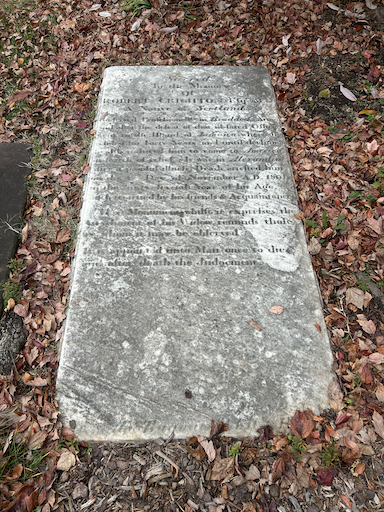
Dr. Robert Creighton, who lies in Alexandria’s Presbyterian Meeting House burial ground, was a young medical officer in General Edward Braddock’s army when it marched on Fort Duquesne in the summer of 1755.
Born in Ayrshire, Scotland, in 1734, he was about twenty-one years old on July 9, 1755, when the British column collapsed under French and Native fire at the Monongahela. Braddock was mortally wounded, roughly two-thirds of his force were killed or wounded, and the defeat reshaped British strategy in North America. The war it belonged to would cost Britain a fortune, and the effort to recover that money from the colonies fed the grievances that ended in revolution.
Creighton left the mainland after the defeat and spent forty years in Jamaica. When his health failed, he came to America seeking relief and settled in Alexandria, where he practiced medicine on Cameron Street. He died of consumption on November 18, 1801, aged sixty-seven, and was buried in the Meeting House churchyard two days later. His widow’s stone tells the whole arc in a few lines:
He served Professionally in Braddock’s Army and after the defeat of that ill-fated Officer went to the Island of Jamaica where he resided for Forty Years and until declining health induced him to come to America in search of relief.
A few yards away stands the memorial stone of Dr. James Craik, the other Braddock’s-army surgeon connected with this ground. Craik tended the dying general on the retreat and later became George Washington’s personal physician.
Both stones are stops on the Rebellious Scoundrels walking tour.