

Introduction to St. Paul’s Episcopal Cemetery, Alexandria, VA
Founded in 1809 amid a significant schism within Alexandria’s historic Christ Church, St. Paul’s Episcopal Cemetery, Alexandria, VA, is one of the earliest purpose-built burial grounds in what is now the Wilkes Street Cemetery Complex. The breakaway congregation that formed St. Paul’s parish did so nearly a decade before its new church was finished. With Alexandria prohibiting new burials in town for reasons of public health, the young parish established its cemetery first, part of a decisive shift away from crowded colonial churchyards toward larger, organized cemeteries beyond the town center.
Only later, in 1818, was St. Paul’s church on South Pitt Street, designed by Benjamin Henry Latrobe, consecrated, giving the parish a new sanctuary to go with a burial ground already rooted in the community.
Although closely tied to the parish, St. Paul’s Episcopal Cemetery, Alexandria, VA, has always been more than a congregational burying ground. Not everyone buried here belonged to St. Paul’s, and some early parishioners chose Christ Church or other burial places, while the cemetery welcomed Alexandrians from across the city. Today more than 1,500 people rest here, including members of many of Alexandria’s most prominent families, among them the Fairfax, Hooff, Zimmerman, Peyton, Corse, McLean, Entwisle and Smoot families, whose names echo throughout the city’s history.
The historical record is incomplete. Many early documents were lost in a funeral home fire in the 1950s and in a flood at the Smoot Lumber Company. Surviving sources include an 1857 list of lot owners, a record of more than 300 burials by 1861, 1,309 gravestone inscriptions recorded in 1979, a 1948–49 plot map, and a vintage card catalog still kept in the parish office.
The cemetery’s management changed over time as well. Once run by a sexton, it came under the vestry’s direct oversight by the mid-twentieth century and is now maintained as part of the church’s operating budget.
Recognized for its historic landscape and cultural significance, St. Paul’s Episcopal Cemetery, Alexandria, VA, is listed on the National Register of Historic Places (DHR #100-0143). It remains a sacred place of remembrance and one of the city’s richest outdoor archives, where Alexandria’s history can be read in stone, from Revolutionary-era families and War of 1812 officers to Civil War figures, civic leaders, entrepreneurs and one of the city’s enduring legends, the Female Stranger.
C
General Thomas Childs (March 16, 1796 – October 8, 1853): The Mexican War Hero Buried in St. Paul’s Episcopal Cemetery, Alexandria, VA
Brevet Brigadier General Thomas Childs, a hero of the Mexican War, is buried in St. Paul’s Episcopal Cemetery, Alexandria, VA, Lot 32. Childs was born on March 16, 1796, in Pittsfield, Massachusetts. He graduated from the United States Military Academy at West Point in 1814 and was commissioned a third lieutenant in the 1st Artillery on March 11 of that year. In 1819 he married Ann Eliza Coryton, daughter of the Alexandria jeweler Josiah Coryton and niece of General Adam Lynn, in whose lot the couple rests; she is named on his obelisk.
Read the full story of General Thomas Childs.
As a young West Point graduate, Childs helped spike the British guns at Fort Erie in 1814, and in the Mexican War he held Puebla through a 28-day siege. His story is told in “The Boy Who Spiked the Guns,” a Gravestone Stories column in the Alexandria Gazette Packet, October 22, 2026. Read the column (page 6).
Montgomery Dent Corse (March 14, 1816 – February 11, 1895): From Battlefields to Banking
Montgomery Dent Corse was born at 504 Prince Street in Alexandria on March 14, 1816, the eldest son of John and Julia Corse. He attended Major Bradley Lowe’s military school at Colross and Benjamin Hallowell’s school on North Washington Street.
As a boy, Corse witnessed the Marquis de Lafayette’s 1824 visit to Alexandria, and he took part in the inauguration of President Andrew Jackson in 1829.
In 1846 Corse raised a company of volunteers for the Mexican War and served as its captain. In 1849 he sailed for California and took part in the Gold Rush.
Although he made a short visit to Alexandria in 1855, he did not return for good until December 1856. In 1857 he went into banking with his brothers, J. D. and Wilmer D. Corse.
Corse served as first lieutenant of the Alexandria Home Guard in 1859 and was elected captain of the Old Dominion Rifles on January 7, 1861. When Virginia seceded that year, he was appointed colonel of the 17th Virginia Infantry, which served in Longstreet’s command and later in Kemper’s Brigade. The regiment fought at First Manassas, Yorktown, Williamsburg, Seven Pines and the Seven Days, and then at South Mountain and Antietam, where Corse was wounded. His conduct at Antietam won him promotion to brigadier general.


The 17th Virginia was on detached duty during the Gettysburg Campaign and missed that battle, but it remained active in later campaigns, notably the siege of Petersburg and Richmond. At the Battle of Sayler’s Creek, Corse was captured along with a large part of Lee’s Army of Northern Virginia and sent to Fort Warren in Boston as a prisoner of war.
After taking the Oath of Allegiance and being released from Fort Warren on July 24, 1865, Corse returned to Alexandria and went back into banking with his brothers. He made his home at 414 North Washington Street, a Greek Revival house known as Grosvenor House, and later as the Corse-Leadbeater House, built around 1830 for Anthony Cazenove. During the Civil War, Union forces had turned the house into Grosvenor House Hospital, with room for more than 160 patients, and used the Lee-Fendall House, directly across the street, as an annex. After the war Corse lived there with his wife, Elizabeth, and their four children until both he and Elizabeth died in early 1895.
The house later passed to new owners, including the Leadbeater family, and was torn down in 1960. A large office building now stands on the site. Anthony Cazenove, for whom the house was built, is buried nearby in the Presbyterian Cemetery, across Hamilton Lane from St. Paul’s Cemetery.

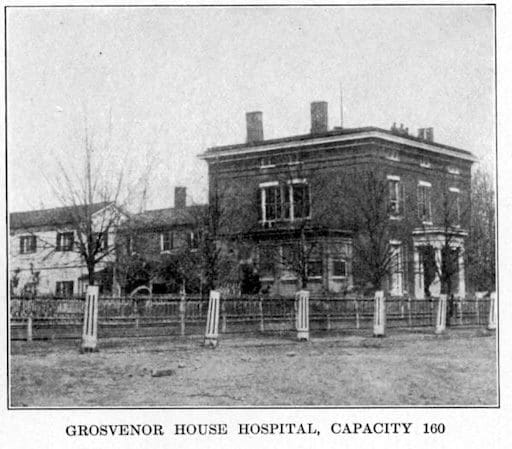
Corse remained active in veterans’ affairs after the war as a charter member of the R. E. Lee Camp of the United Confederate Veterans. In 1870 he was badly injured in the collapse of part of the Virginia State Capitol in Richmond. On April 27 of that year, the floor of a crowded courtroom gave way without warning, plunging hundreds of people into the Hall of the House of Delegates below. More than sixty people were killed and more than a hundred injured. Corse survived but suffered lasting injuries, including partial blindness for several years.
Despite these hardships, Corse kept up his public life. On May 24, 1880, he was an honored guest at the dedication of the Confederate monument Appomattox at the intersection of Washington and Prince Streets in Alexandria. The National Park Service added the monument to the National Register of Historic Places in 2017.


On June 2, 2020, amid nationwide protests after the murder of George Floyd, the statue’s owner, the United Daughters of the Confederacy, removed it. The statue is now in storage, and its base has since been placed over Confederate graves in Bethel Cemetery, in the Wilkes Street Cemetery Complex. Montgomery Dent Corse died on February 11, 1895, and his wife, Elizabeth, followed him just two weeks later.
Corse has two gravestones, and one of them gives his birthday incorrectly as March 18, 1816.

| MONTGOMERY DENT CORSE Born in Alexandria, Virginia March 14, 1816 Died in Alexandria, Virginia Feb. 11, 1895 | MONTGOMERY DENT CORSE BGEN 17 VA INF Confederate States Army Mar 18 1816 (Maltese Cross) Feb 11 1895 Presented by M.O.S. & B. Samuel Cooper Chapter |


D
Captain Julius Adolphus De Lagnel (c. 1798 – 1840): The Ordnance Officer Whose Gravestone Gets His Birth Year Wrong
Captain Julius Adolphus De Lagnel, father of the general whose entry follows, was born around October 31, 1798, probably in New York. His parents’ names are not known. He entered the United States Military Academy at West Point in August 1814, at fifteen, and graduated with the Class of 1821. His early postings took him to the western frontier at Fort Armstrong, on Rock Island in Illinois, and in March 1823 he married Harriet Sanford in Essex County, New Jersey. The couple had five children, including two sons who would serve as Confederate officers: Julius Adolphus, the colonel who declined a general’s commission, and Johnston, a major who died of pneumonia in South Carolina in 1864.
De Lagnel made his career in ordnance. Promoted to first lieutenant, he served at the Augusta Arsenal in Georgia, where in 1834 and 1835 he acted as post commander, commissary of subsistence, and quartermaster. In September 1837, during the Second Seminole War, he was promoted to captain and served as ordnance officer at Fort Heilman, near present-day Middleburg, Florida. He died in New York in May 1840, at forty-one, probably while posted to the New York Arsenal on Governors Island, and was buried in the post cemetery at Fort Columbus.
After his death, Harriet brought the children to Alexandria to live with her sister, Jane, and Jane’s husband, the Reverend James T. Johnston, rector of St. Paul’s. When the Army gave up the Fort Columbus cemetery in the 1870s, Harriet had her husband moved to the family plot here at St. Paul’s and marked with a new ledger stone. She died in 1891 and rests beside him.
That ledger stone gives his birth year as 1744, which cannot be right. A 1744 birth would have made him a seventy-year-old West Point cadet and an eighty-three-year-old father when his son, the future general, was born in 1827. The stone was carved more than thirty years after his death, and the mistaken date was cut then.
| Sacred to the memory of Julius Adolphus deLagnel, Esq. Captain of Ordnance in the army of the United States who was born Oct. 31st A.D. 1744 [sic] and died at New York, May 21st 1840. Most affectionate as husband and father As a man most honorable and exemplary In family, his units and his fellow soldiers May [long] deplore his loss. __ the thought console them that dying is __ed in the __ of a christian’s hope under the Great caption of our Salvation. In the same grave with her father rests the remains of his infant daughter SARAH EVELINA deLAGEL Born September 14, 18[39] Died June 21st 184[0] |
Acknowledgment: Service details for Captain De Lagnel are courtesy of David Harrity, Find a Grave contributor, whose research draws on the 1821 West Point Register, Army post returns, and the Fort Columbus burial register.
Julius Adolphus De Lagnel (1827 – 1912): The Confederate Officer Who Declined a General’s Star
Julius Adolphus De Lagnel was born on July 24, 1827, in Newark, New Jersey, the son of Captain Julius Adolphus De Lagnel and Harriet Sanford (see his father’s entry above). He served in the 2nd Regiment of Artillery of the U.S. Army from March 1847, rising to first lieutenant, and resigned on May 17, 1861, to join the Confederacy.
As chief of artillery to Brigadier General Robert S. Barnett, De Lagnel was wounded and captured at the Battle of Rich Mountain in July 1861. He later served as a major in the 20th Battalion Virginia Artillery and as a lieutenant colonel in the Confederate Ordnance Department, inspecting arsenals from Richmond. In 1862 he was appointed a brigadier general but declined the commission and remained a lieutenant colonel.
After the war he worked in shipping out of Washington, D.C., and in the Pacific steamship service. He married twice, to Madeline (1843–1900) and to Josephine Conklin Cowles (1846–1931). He died of heart disease in Washington on June 3, 1912, at 84, and was buried in the Johnston family lot at St. Paul’s Episcopal Cemetery, Alexandria, VA.

| In memoriam JULIUS A. DeLAGNEL born July 24, 1827 Lieut. 2nd Regiment of Artillery U. S. Army from March 1847 to May 1861 Capt. and Col. of Artillery of Confederate States Army during the Civil War died June 3rd 1912 A brave and distinguished officer Considerate of the welfare of his men beloved by them and honored by his country as well as by his companions. A Southern gentleman, One who lived and died without fear and without reproach |
F
The Female Stranger (1793? – October 14, 1816): Alexandria’s Most Visited Grave
In September 1816, a veiled young woman and her husband arrived in Alexandria from the West Indies and took rooms at Gadsby’s Tavern, insisting that their identities remain secret. She was gravely ill and was attended by Dr. Samuel Richards, with the help of Elizabeth Tretcher Steuart, who later remembered her as refined and strikingly beautiful. Within weeks, the woman was dead.
She was buried in St. Paul’s Episcopal Cemetery, Alexandria, VA, beneath a monument that names her only as “a Female Stranger.” After the funeral, her husband, valet and maid vanished from Alexandria. More puzzling still, the large payment left to cover her care and burial later proved to be counterfeit. No record ever revealed who she was or where she came from.
The mysterious inscription, the legends that followed and the unanswered questions about her death have made the Female Stranger’s grave the most visited burial site in Alexandria.
For the inscription, the later legends and new historical context, read our in-depth feature, The Most Visited Grave in Alexandria.
H
James Wallace Hooff (February 18, 1825 – November 30, 1915): The Courtship Behind the “Alexandria Blue Boy”
James Wallace Hooff was born in Alexandria in 1825. He married his second cousin, Jannett Hooff Brown, after a courtship complicated by their different churches: he was Presbyterian, and she was Episcopalian.
One remarkable relic of their secret courtship is an 1847 letter bearing the famous “Alexandria Blue Boy” stamp. The postal rarity sold for $1 million in 1981 and is worth even more today.
James and Jannett had three children, among them their eldest, Mary Goulding Hooff Fawcett, born on December 1, 1853, and their son, Douglas, born on September 18, 1858.
Before the Civil War, Hooff served as Alexandria’s Deputy Collector and Inspector of Weights & Measures. During the war he protected his church’s silver communion goblets by burying them in the yard of his home at 517 Prince Street, out of reach of Union soldiers.
Hooff went on to work for the War Department for fifty-four years, remaining energetic and devoted to the end. He died of capillary bronchitis at his home at the age of 90 and is buried in Lot 65, beneath a Celtic cross.
Lawrence Hooff Jr. (1780 – March 10, 1842): Bearer at George Washington’s Funeral
Lawrence Hooff Jr. was one of four lieutenants of the 106th Regiment of the Virginia Militia who carried George Washington’s coffin to the original family tomb at Mount Vernon on December 18, 1799. He owned the property at 210 North Fairfax Street in Alexandria and is buried in the Hooff family vault in St. Paul’s Episcopal Cemetery, Alexandria, VA.

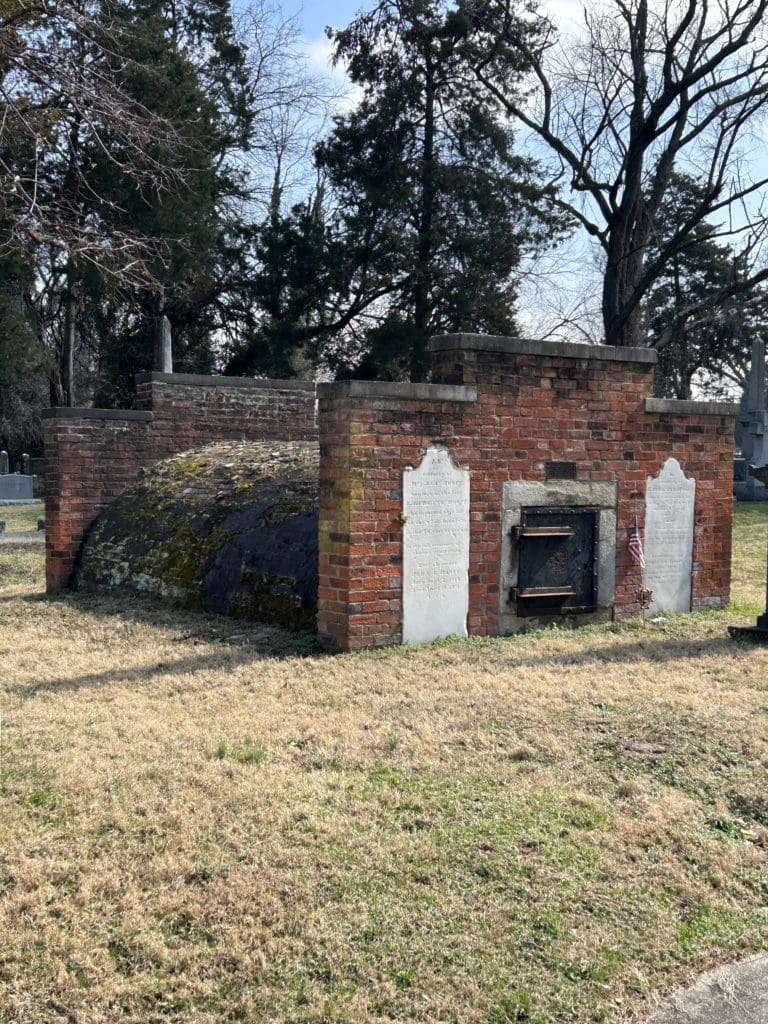
He was also a major in the War of 1812 and fought at the Battle of White House Landing.
J
The Reverend James T. Johnston (July 4, 1797 – February 28, 1877), “Parson Johnston,” and Jane Sanford Johnston

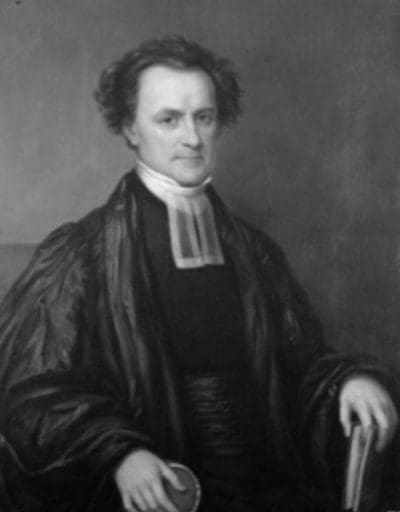
The Reverend James T. Johnston, known affectionately as “Parson Johnston,” and his wife, Jane, are woven into the history of St. Paul’s Church and of Alexandria. Born in Savannah, Georgia, Johnston graduated from Yale and trained in the law before deciding to enter the ministry. After theological studies in New York, he was called to St. Paul’s and served as its rector from 1834 to 1859. He turned down tempting offers to lead larger, wealthier churches, including Trinity Church in New York City, and remained loyal to St. Paul’s.
Failing health forced Johnston to resign in 1859. Jane Sanford Johnston, a native of New York City, shared her husband’s devotion to the church and the community. Her sister, Harriet, was the wife of Captain Julius Adolphus De Lagnel, whose entry appears above.
In 1851 the Johnstons built an elegant brick house at 806 Prince Street, their home until May 1861. When the Civil War began, Federal authorities seized the property. The house served as a branch of the Mansion House General Hospital from March to September 20, 1862, and later became part of the 2nd Division General Hospital in Alexandria, along with the Fowle house across Prince Street.
After the war, the Johnstons returned to 806 Prince Street, where they lived for the rest of their lives. He died on February 28, 1877, and she on August 2, 1884.
In 1884 the house became the headquarters of the R. E. Lee Camp of Confederate Veterans. Today it is the Robert E. Lee Camp Hall Museum, overseen by the Mary Custis Lee–17th Virginia Regiment Chapter No. 7 of the United Daughters of the Confederacy.

| Rev. JAMES T. JOHNSTON born in Savannah, Ga. July 4, 1797 Died in Alexandria, Va. February 28, 1877. His record is on High. Mrs. JANE JOHNSTON died August 2nd, 1884 aged 85 years. We took sweet counsel together, and walked unto the house of God in company |
K
Delaware Kemper (August 24, 1833 – June 30, 1899): Confederate Artillery Officer, Educator, U.S. Consul and Alexandria Civic Leader
Delaware Kemper was born on August 24, 1833, and rose to prominence as captain of the Alexandria Light Artillery, part of Brigadier General P. G. T. Beauregard’s short-lived Confederate Army of the Potomac. His battery played a key role in the skirmish at Blackburn’s Ford on July 18, 1861, and again at the First Battle of Bull Run three days later. From a hilltop overlooking Cub Run, Kemper’s guns struck the Union retreat just as a wagon overturned on the bridge, helping turn the withdrawal into the chaotic rout remembered in the Southern press as “the Great Skedaddle.”


Wounded at Second Manassas in 1862, Kemper recovered and continued to rise in the Confederate artillery. He served as a major in S. D. Lee’s Battalion, then as a lieutenant colonel under Beauregard at Charleston, and in 1864 he was promoted to colonel of artillery under General Joseph E. Johnston. He served until Johnston’s army surrendered in April 1865.

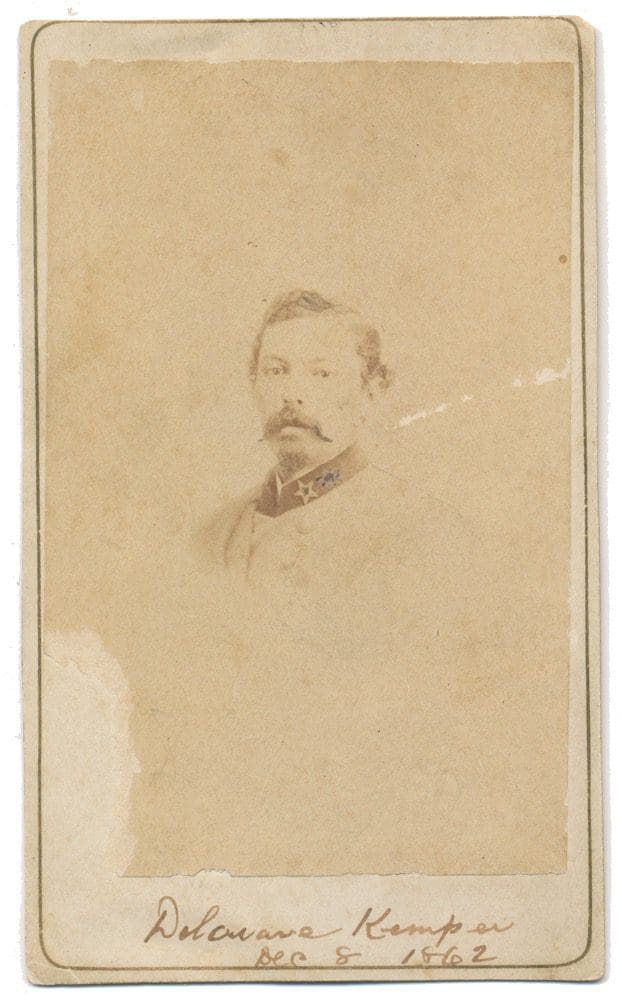
After the war, Kemper turned to teaching. He opened a boys’ school in the Alexandria Lyceum and then became professor of mathematics at Hampden-Sydney College (1866–1882), later teaching at the Citadel in Charleston and at King College in Tennessee. In 1871 he married Frances Snowden Hays. President Grover Cleveland later appointed him U.S. consul at Amoy, China. Back home, he went into the newspaper business in Alexandria and served as captain of the Friendship Fire Company.

Delaware Kemper died in Alexandria on June 30, 1899. He rests in St. Paul’s Episcopal Cemetery, Alexandria, VA, where his broken gravestone still awaits repair, a reminder of a man who left his mark on the battlefield, in the classroom and in his community.

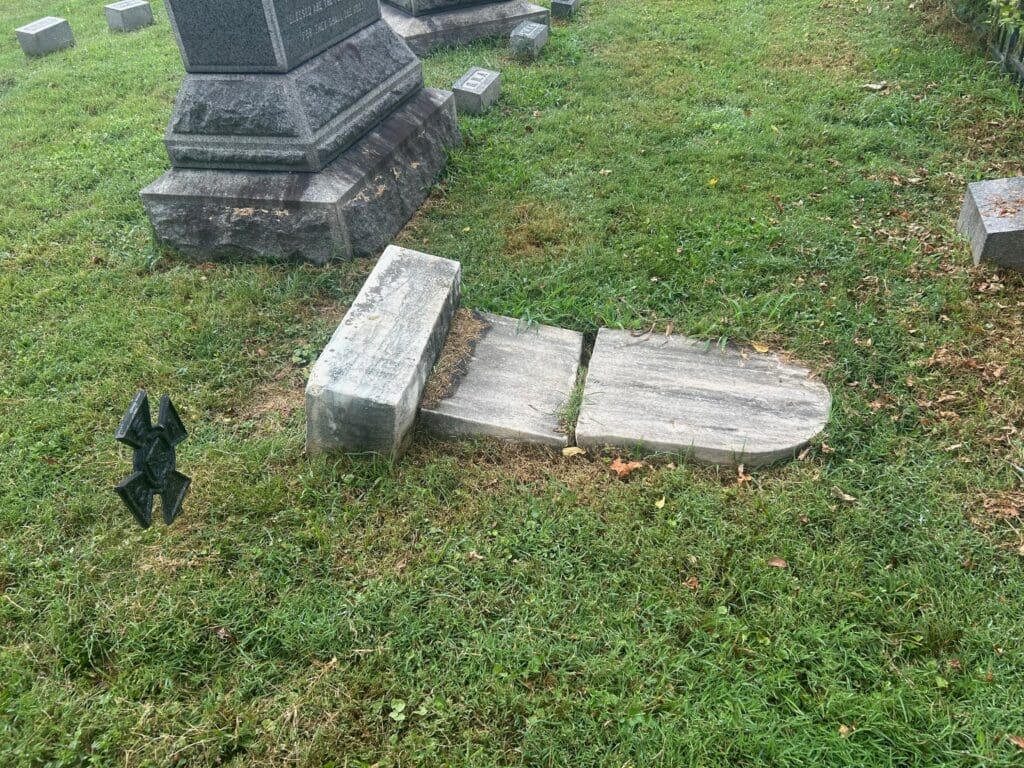
| DELAWARE KEMPER born August 24, 1833 died June 30, 1899 |
Kemper’s grave in Lot 228 is also marked by a Confederate iron cross and a small footstone inscribed “D.K.” It lies beside the grave of his brother, Kosciusko Kemper.
Kosciusko Kemper (June 18, 1835 – January 26, 1910): Soldier, Mayor, School Superintendent and Grand Master
Kosciusko Kemper was born on June 18, 1835, in Warrenton, Virginia, and educated at the University of Virginia, where he excelled as a scholar. He married the daughter of Ira Garrett, clerk of the court in Albemarle County, and together they raised a large family.
Kemper’s life combined military service, education, law and civic leadership. In the Civil War he volunteered for the Confederate army and served notably at Fort Sumter. General Beauregard’s dispatches praised his gallantry, and he was promoted to lieutenant.
After the war, Kemper settled in Alexandria and practiced law. He served as mayor of Alexandria in 1874–75, 1875–76 and 1877–78, and was a vice president of the Alexandria Library Company in the 1870s. From 1892 to 1908 he was superintendent of Alexandria’s public schools, a post he filled, in the words of his eulogists, with “high zeal and inflexible fidelity.”

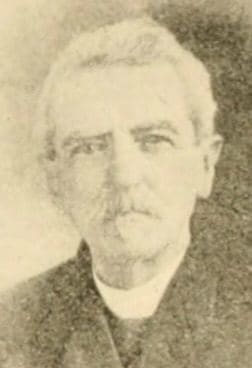
Kemper’s law office was at 56 King Street, according to Chataigne’s directory of the 1870s, and in 1873 he lived at 108 Cameron Street. He was also active in historic preservation as a member of the Board of Managers of the Society for the Restoration of Historic Alexandria.
He rose quickly in Freemasonry. Initiated in 1875, he became the 67th Grand Master of Masons in Virginia and remained committed to the fraternity even as his health declined.
Kemper was a devout Presbyterian and served his church as an elder. He died in Washington, D.C., on January 26, 1910, and was buried in St. Paul’s Episcopal Cemetery, Alexandria, VA, beside his brother Delaware. The Grand Lodge of Virginia issued a memorial honoring his life and service.
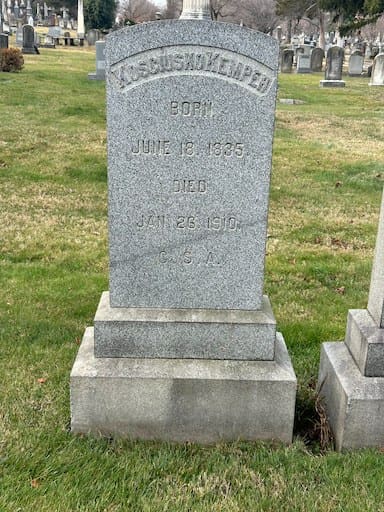
| KOSCIUSKO KEMPER born June 18, 1835 died Jan. 26, 1910 C.S.A. |
Robert Fitzgerald Knox (November 19, 1835 – April 2, 1916): Soldier, Civic Leader and Faithful Alexandrian
Robert Fitzgerald Knox was born in Warrenton, Virginia, on November 19, 1835, the son of John Somerville Knox and Elizabeth Selden Knox. The family moved to Fredericksburg and later to Alexandria, where he spent most of his life. At the outbreak of the Civil War, on April 25, 1861, Knox enlisted as a second lieutenant in Company G, 17th Virginia Infantry, later part of Corse’s Brigade in Pickett’s Division, First Corps, Army of Northern Virginia.

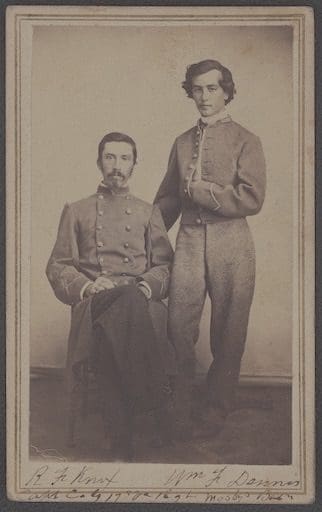
Knox saw heavy combat. He was wounded in the thigh at the Battle of Seven Pines in 1862, promoted to captain that year, and wounded again at Drewry’s Bluff in 1864 and at Dinwiddie Court House in 1865. He served on until he was paroled on May 13, 1865.
After the war, Knox returned to Alexandria and became a leading figure in the community. He worked as a commission merchant, served as the city’s Commissioner of Revenue, and was a vestryman of St. Paul’s Episcopal Church. He died of pneumonia at his home at 521 Duke Street on April 2, 1916, survived by his wife.
| ROBERT FITZGERALD KNOX son of John Somerville and Elizabeth Selden Knox born on Nov. 19, 1835 died April 2, 1916 Captain Co. G, 17th Va. Regt. C.S.A. None knew thee but to love thee Nor named thee but to praise |
L
General Adam Lynn Jr. (1775 – December 6, 1836): Silversmith, Justice of the Peace and War of 1812 Officer
General Adam Lynn was the son of the Revolutionary War colonel Adam Lynn. He appears to have become the brother-in-law of the jeweler Josiah Coryton, whose business he took over in 1801, and he was the uncle of Ann Eliza Childs, who is buried in the same lot.
In the War of 1812, Lynn served as a lieutenant colonel in the Alexandria militia. In peacetime he worked as a silversmith, clockmaker and merchant at Adam Lynn & Co. on King and Royal Streets. He was a member of Masonic Lodge No. 22 and held public offices including justice of the peace, clerk of the Common Council and magistrate.
Lynn filled many roles at St. Paul’s Episcopal Church: he was one of its first vestrymen, a pewholder and the contractor for the church’s hardware. His name appears on the Reverend William Jackson’s calling list, which places his home in the first division, south of King Street and east of St. Asaph Street.

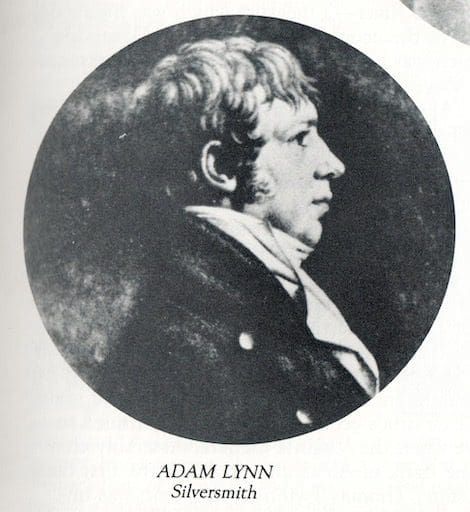
| Sacred to the memory of GENERAL ADAM LYNN who after a severe and lingering illness which he bore with Christian fortitude calmly resigned his soul to his Redeemer in whom he alone trusted for salvation on the 6th of Dec. 1836 Aged 61 years Hallowed be this spirit belonged… until the … |
M
Wilmer McLean (May 3, 1814 – June 5, 1882): Witness to the Beginning and End of the Civil War
Wilmer McLean, whose family had long ties to St. Paul’s Episcopal Church, married Virginia Hooe Mason in 1853. The marriage brought him Yorkshire, her farm near Manassas Junction.
When the Civil War began, Yorkshire stood in the middle of the First Battle of Bull Run and was damaged in the fighting. Seeking a quieter place, McLean moved his family to the village of Appomattox Court House, only to have history find him again. In April 1865, Generals Robert E. Lee and Ulysses S. Grant met in his parlor to arrange the surrender that effectively ended the war.

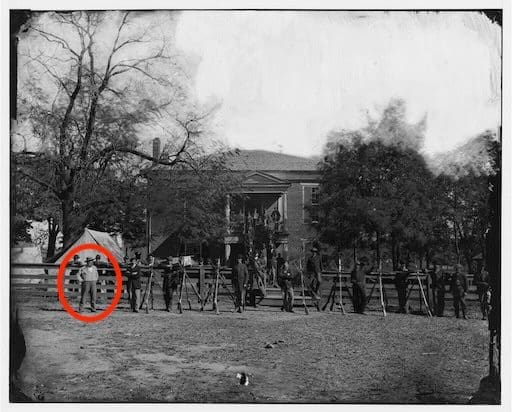
McLean’s life ran from the pews of St. Paul’s to the front lines of American history, and it ended here, in St. Paul’s Episcopal Cemetery, Alexandria, VA. Read the full story in The Beginning and the End of the Civil War.

| WILMER McLEAN Son of Daniel & Lucretia McLean Died June 5, 1882 In the 68th year of his age |
Abraham Charles Myers (May 14, 1811 – January 29, 1889): The Namesake of a Florida City
Abraham Charles Myers, a veteran of the Seminole Wars for whom Fort Myers, Florida, is named, served as an officer first in the United States Army and then in the Confederacy. As the Confederacy’s quartermaster general, his tenure was largely judged a failure, and he was removed from the post.
Read the rest of the story in The Unique Engagement Gift.
P
Dr. Holmes Offley Paulding (October 7, 1852 – May 1, 1883): From a Military Family to the Little Bighorn
Dr. Holmes Offley Paulding came from a family with a long record of military service. His forebears included the Revolutionary War hero John Paulding and the naval officer Hiram Paulding, but Holmes chose a different path: military medicine.
As an Army surgeon, he was present for the campaign that ended in the Battle of the Little Bighorn in 1876, and his diary records the grim aftermath. He died in 1883, still in the service, at just thirty, and was buried in St. Paul’s Episcopal Cemetery, Alexandria, VA.
His diary and the historical record offer a window onto a family whose service ran from the Revolution to the Western frontier. Read the full story in The Remarkable Life of Dr. Holmes Offley Paulding.
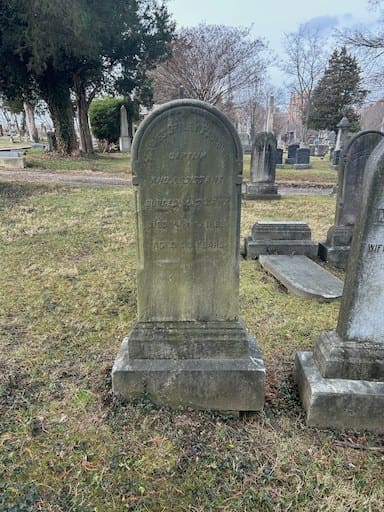
| HOLMES OFFLEY PAULDING Captain and Assistant Surgeon U. S. Army died May 1, 1883 aged 30 years |
S
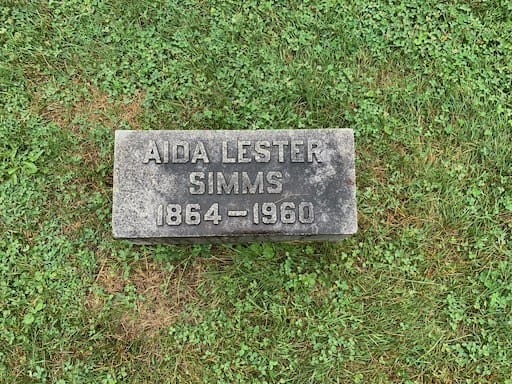
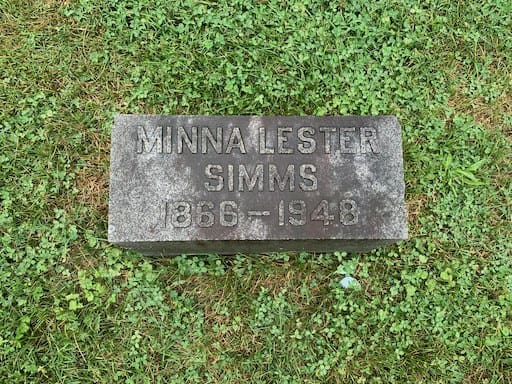
Minna Simms and Aida Lester Simms: The Sisters Behind Chicago’s Most Notorious Brothel


Minna Simms (July 13, 1866 – September 16, 1948) and Aida Lester Simms (February 15, 1865 – January 3, 1960) ran one of Chicago’s best-known brothels from 1900 to 1911.
Read the rest of the story in The Most Notorious Brothel in Chicago.
Captain Benjamin Thomas (March 12, 1811 – September 19, 1856): Merchant, Fire Company Patron and Tragic Figure
Born in Wales on March 12, 1811, Benjamin Thomas emigrated to the United States and became a prominent citizen of Alexandria. Wealthy and well respected, he took part in local affairs and supported the city’s fire companies. His likeness appears on the restored Prettyman hose reel carriage, preserved today at the Friendship Firehouse Museum, a testament to that support.
His life ended in despair. On September 19, 1856, Thomas died by suicide, reportedly cutting his throat before throwing himself into a cistern. The Abingdon Virginian reported the shocking details, a sign of how deeply his death affected Alexandria.
Captain Benjamin Thomas is buried in the Thomas family lot in St. Paul’s Episcopal Cemetery, Alexandria, VA, Section 4, Lot 235.
Sources of Information for St. Paul’s Episcopal Cemetery, Alexandria, VA
City of Alexandria, Virginia. (2009, May 28). 414 North Washington Street. Out of the Attic. Retrieved from the City of Alexandria.
Hakenson, D. C. (2011). This Forgotten Land, Volume II: Biographical Sketches of Confederate Veterans Buried in Alexandria, Virginia. Donald Hakenson.
Harrity, D. (n.d.). Capt. Julius Adolphus deLagnel [Memorial biography]. Find a Grave.
Herbert, P. N. (2010). God Knows All Your Names: Stories in American History. AuthorHouse.
Hibbeler, R. (1960). Upstairs at the Everleigh Club (V 9503 N). Volitant Books.
Hurst, B. V. (Ed.). (2021). An Infernal Failure: Little Bighorn Diary 1876 by Dr. Holmes Offley Paulding. Big Byte Books.
Kay, R. L. (1984). The History of St. Paul’s Episcopal Church, Alexandria, Virginia: November 12, 1809–November 12, 1984. Springfield, VA: The Goets Printing Company.
Madison, R. L. (2003). Walking with Washington. Gateway Press, Inc.
Moore, G. M. (1949). Seaport in Virginia: George Washington’s Alexandria. Garrett and Massie, Incorporated.
Pippenger, W. E. (2014). Tombstone Inscriptions of Alexandria, Virginia (Vol. 5). Heritage Books.
Powell, M. G. (2000). The History of Old Alexandria, VA, from July 13, 1749 – May 24, 1861. Willow Bend Books. Index by W. E. Pippenger.
Virginia Department of Historic Resources. (2022). St. Paul’s Episcopal Cemetery, 2022 NRHP Draft Final. Retrieved from the Virginia Department of Historic Resources.
Virginia State Capitol History Project. (n.d.). The 1870 “Capitol Disaster.” Retrieved from the Virginia State Capitol History Project.
Page last updated: October 30, 2026