General Thomas Childs rests beneath an obelisk in lot 32 of St. Paul’s Cemetery in Alexandria, one of the thirteen burial grounds of the Wilkes Street Cemetery Complex. Born in Pittsfield, Massachusetts, on March 16, 1796, he spent nearly forty years in the U.S. Army — from the War of 1812 through the Seminole War and the Mexican War — and married into one of Alexandria’s old families.

War of 1812
Childs graduated from the U.S. Military Academy at West Point in 1814 and was commissioned a third lieutenant in the 1st Artillery on March 11 of that year. He was soon on the Niagara frontier, where American troops held Fort Erie under a British siege through the late summer of 1814.
In the same week of September 1814 that the British bombarded Fort McHenry in Baltimore harbor, the Fort Erie garrison burst out and stormed the British siege batteries. Childs was among the attackers. He helped spike the enemy’s cannon, hammering iron into the touchholes so the guns could not fire. The Fort Erie sortie of September 17 broke the siege.
By order of President Madison, Childs received a captured quadrant, the instrument gunners used to aim a cannon. It was engraved:
“Presented to Lieut. Thomas Childs, by order of the President of the United States, for gallant conduct in the Sortie from Ft. Erie and for spiking the guns of the enemy’s batteries, at the age of seventeen years, Sep. 17, 1814.”
The inscription gives his age as seventeen. Born in March 1796, he had actually just turned eighteen — a small slip on a large honor.
Between the Wars
Childs made the army his life. From 1818 to 1819 he was stationed at Fort Washington, Maryland, on the Potomac below Alexandria. In 1836 he went to Florida for the Seminole War; his gravestone records that he “served with distinction through the Florida War, 1836–41.”
Marriage and Family
Alexandria claimed him through marriage. In 1819 Childs married Ann Eliza Coryton, daughter of Josiah Coryton, whose house stood at 522 King Street. Her uncle Adam Lynn — a silversmith and clockmaker who sold jewelry and tools in Alexandria from 1791 until his death in 1836, a justice of the peace, and a lieutenant colonel of the Alexandria militia in the War of 1812 — is buried in St. Paul’s Cemetery.
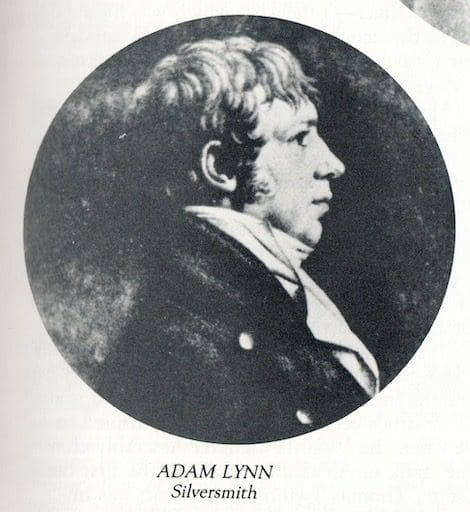
Thomas and Ann Eliza had at least seven children and buried most of them. Two were infant sons, each named Henry Lynn Childs in honor of Ann Eliza’s uncle.
The Mexican War
When war with Mexico came in 1846, Childs commanded the Artillery Battalion in General Zachary Taylor’s army. He fought at Palo Alto and Resaca de la Palma in May 1846, and his conduct there earned him the first of several brevet promotions.
Action at Monterey
The Artillery Battalion, fighting as infantry, then joined General William Worth’s division in the march on Monterey. Childs was ordered to take the fortified heights near the Bishop’s Palace. With regular infantry and Texas Rangers beside them, his men climbed the slope in the dark, and before sunrise on September 22, the battalion’s flag flew over the position. The next day he led his men through the streets of the city toward its main plaza.

The Siege of Vera Cruz and the Battle of Cerro Gordo
When much of Taylor’s army was sent to join General Winfield Scott, Childs served as chief of staff of Worth’s command during the siege of Vera Cruz. He then led his regiment in General David Twiggs’s division at the Battle of Cerro Gordo on April 17–18, 1847. (Twiggs’s daughter and her husband, Abraham C. Myers — the namesake of Fort Myers, Florida — are buried in St. Paul’s Cemetery, too.) After Cerro Gordo, Childs served for a time as military governor of Jalapa.
The Siege of Puebla
His hardest test came at Puebla. When Scott marched on Mexico City, Childs stayed behind as military governor of a city of 60,000. His job was to guard the army’s hospitals, and he had about 400 able men to do it.
For twenty-eight days a Mexican force of more than 8,000 — for a time commanded by General Santa Anna himself — besieged them, firing from streets, balconies, rooftops and churches. The garrison held. Scott praised the defense in his official report, and Childs was made a brevet brigadier general — the rank carved on his gravestone.
Commander of Ft. McHenry
After the war Childs commanded Fort McHenry in Baltimore for three years — the same fort whose bombardment had coincided with his own first fight at Fort Erie in 1814. He was then sent to command in Florida.
Death at Fort Brooke
Yellow fever killed General Thomas Childs at his headquarters, Fort Brooke, on Tampa Bay, on October 8, 1853. He was 57. He was brought home to Alexandria and buried in St. Paul’s Cemetery.
The Obelisk
General Thomas Childs’s obelisk in lot 32 is carved with crossed sabres and a roll call of his battles. Ann Eliza, who died in South Carolina in 1875, is named on the same stone. The inscriptions read:
| Sacred to the memory of Brevet Brigadier General THOMAS CHILDS born at Pittsfield, Mass. March 16, 1796 died at Tampa Bay, Florida October 8, 1853 Honored as a soldier of his country for faithful services in peace and war he felt it a greater honor to be a soldier of the cross I have fought a good fight I have finished my course I have kept the faith Commenced his military career at the sortie from Fort Erie 1814 Served with distinction through the Florida War, 1836–41. Took a prominent part in the Mexican War, 1846–48 and particularly in the following battles and sieges: Palo Alto Resaca de la Palma Monterey Cerro Gordo Puebla ANN ELIZA wife of Gen’l Thos. Childs died at Acton, Sumter Co., S.C. October 29, 1875 aged 75 years |
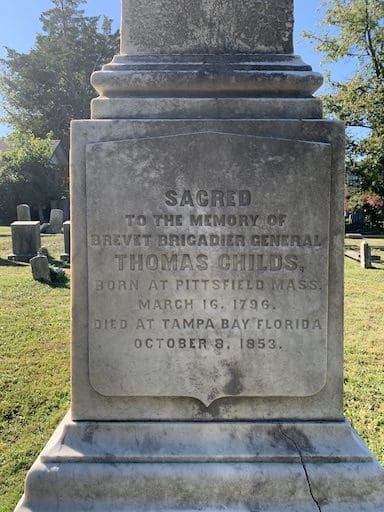
More than 170 years after yellow fever took him far from home, his stone in St. Paul’s Cemetery still tells his story to anyone who stops to read it.
Sources of Information
The Alexandria Association. (1956). Our Town 1749–1865 at Gadsby’s Tavern, Alexandria, Virginia. The Dietz Printing Company.
City of Alexandria Archaeology. (n.d.). 500 Block of King Street: Lot Histories.
Corpus Christi Public Libraries. (n.d.). Thomas Childs. The U.S.-Mexican War. Archived December 14, 2005, Internet Archive.
Miller, T. M., & Smith, W. F. (2001). A Seaport Saga: Portrait of Old Alexandria, Virginia. The Donning Company Publishers.
Pippenger, W. E. (2005). Tombstone Inscriptions of Alexandria, Virginia, Volume 5. Heritage Books.
Powell, M. G. (2000). The History of Old Alexandria, VA, from July 13, 1749 – May 24, 1861. Index by W. E. Pippenger. Willow Bend Books.