When I documented the burials of 162 Revolutionary War patriots in Alexandria, the rule for the registry was simple: a name goes in only when the grave is here. That rule leaves out some of the best stories. Several Old Presbyterian Meeting House patriots served the cause from Alexandria and then died on campaign, moved away, or were buried in ground that no record names.
Donald C. Dahmann, the Meeting House archivist, compiled a list of the congregation’s patriots for the 250th anniversary of the Declaration of Independence. Using the guidelines of the Sons of the American Revolution, he counts 83 members of the congregation and one minister. By his count, 43 of them lie in the churchyard on South Fairfax Street or in the Presbyterian Cemetery. The eight men below are among the others. They belonged to the congregation that the English traveler Nicholas Cresswell had in mind in November 1774 when he wrote, “These are a set of rebellious scoundrels.”
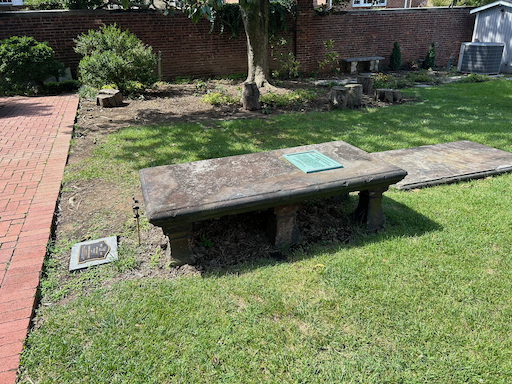
Old Presbyterian Meeting House Patriots Who Died in Service
George William Carlyle (died 1781)
George William Carlyle was the only son to survive John Carlyle, the merchant whose stone house still stands on North Fairfax Street and who is buried in the Meeting House churchyard. John died in 1780. Within months the boy had entered the Third Light Dragoons, the cavalry regiment commanded by Lieutenant Colonel William Washington, as a cadet. He began as a dispatch rider between Williamsburg and commanders in the field.
On September 8, 1781, at Eutaw Springs, South Carolina, he was killed in a cavalry charge against the British line. He was 15. Henry “Light Horse Harry” Lee, who fought in the same battle, remembered him in his memoirs as “the gallant young Carlisle of Alexandria.” As far as is known he was buried in South Carolina, and his father’s grave in the churchyard is the nearest thing to a marker he has in his hometown.
George Johnston Jr. (1750–1777)
George Johnston Jr. was the eldest son of a member of the House of Burgesses. His father was also the man who, in 1763, bought the two town lots that became the Meeting House churchyard. The son went to war early, as a captain in the Second Virginia Regiment, and fought at Great Bridge in December 1775. As a major in the Fifth Virginia he crossed the Delaware for the attack on Trenton. In January 1777 George Washington made him an aide-de-camp.
He held the post for about four months. On May 29, 1777, he died of camp fever at Morristown, New Jersey. One of his younger brothers, Dennis McCarty Johnston, was eleven when independence was declared and served in the local militia before the war ended. Dennis is in the registry, buried in the Presbyterian Cemetery. George is not.
Old Presbyterian Meeting House Patriots Who Moved On
Not all of the Old Presbyterian Meeting House patriots stayed in Alexandria once the fighting ended. Three of them left town for good.
John Allison (1745–1803)
John Allison came to Alexandria from Lancaster, Pennsylvania, by the early 1770s and kept a shop that sold imported goods, from surveying equipment to loaf sugar. He served first as a lieutenant colonel in the First Virginia Regiment. Virginia also kept a small navy on the Potomac, and Allison went on to command the marines aboard its flagship, the American Congress, and later all the marines of that squadron. After the war he moved to Washington, Georgia, where he is buried.
James Hendricks (1722–1795)
James Hendricks had a farm in what is now Jefferson County, West Virginia, before he set up in business in Alexandria in the 1760s. He sat on the Alexandria Town Committee from 1774. In 1775 he became postmaster of the town’s Constitutional Post Office, the patriots’ replacement for the royal mail, and captain of the Fairfax Independent Company.
He went on to serve as lieutenant colonel of the Sixth Virginia Regiment, which crossed the Delaware to attack Trenton in December 1776, and then as colonel of the First Virginia. As a civilian commissary agent during the Yorktown campaign he supplied 600 gallons of spirits and 1,000 barrels of flour at Washington’s request. The peace was less kind to him. He was bankrupt by 1789 and went back to his farm, where he is buried in the family ground.
Daniel Roberdeau (1727–1795)
Daniel Roberdeau spent his boyhood on Saint Kitts in the West Indies and made his fortune as a Philadelphia merchant. By the 1770s he had businesses and homes in both Philadelphia and Alexandria. He spent most of the war in Pennsylvania, where he was a general in the Pennsylvania Associators and had Thomas Paine, the author of Common Sense, as his military secretary. He sat in the Continental Congress from 1777 to 1779 and signed the Articles of Confederation.
His Alexandria distillery supplied spirits to the Continental Army. The Roberdeau house at 418 South Lee Street still stands. He later moved west to Winchester, Virginia, and was buried there in the Presbyterian churchyard. His remains were afterward moved to Mount Hebron Cemetery in the same town.
Three Doctors Among the Old Presbyterian Meeting House Patriots
Three of the Old Presbyterian Meeting House patriots were physicians, and each served the army in a different way.
Dr. William Brown (1748–1792)
William Brown was born in Haddington, Scotland, finished his medical studies at the University of Edinburgh in 1770, and settled in Alexandria. He began the war as surgeon of the Second Virginia Regiment. In 1778 Congress made him Physician General of the Middle Department, and he ran the army hospital at Lititz, Pennsylvania.
At Lititz he wrote a 32-page booklet in Latin listing the medicines and recipes an army surgeon could rely on. It was printed in Philadelphia in 1778 without his name, which did not appear on the title page until a second edition in 1781. It is regarded as the first pharmacopoeia published in the United States.
Brown died on January 11, 1792. His house at 212 South Fairfax Street survives. He was buried at Preston, the Alexander family plantation near the mouth of Four Mile Run, and in 1922, after the railroad acquired that land, the Preston graves were moved to Pohick Church in Fairfax County. He rests there today.
Dr. Stephen Cooke (1751–1816)
Stephen Cooke was born in Philadelphia, graduated from the College of New Jersey, now Princeton University, and studied medicine. He served as a naval medical officer and was captured by the British in 1780 during the siege of Charleston, South Carolina. They held him prisoner in Bermuda. After the war he came to Alexandria to practice medicine, and his office and residence at 217 South Fairfax Street survive. No burial in Alexandria is recorded for him.
Dr. William Rumney (died 1783)
William Rumney was born in Northumberland, England, and came to Alexandria after serving with the British Army in the Seven Years’ War. He signed the Fairfax Resolves in 1774 and sat on the Alexandria Town Committee. During the war he was colonel of the Fairfax militia and senior surgeon in the Virginia militia. He also directed the Continental Hospital in Alexandria, where soldiers marching north from the southern states were inoculated before they joined the army.
Rumney died in 1783, the year the peace was signed. Of the eight men here he is the one who may well lie in Alexandria, but no record says where. Until one does, he stays out of the registry.
Where to Find the Other Old Presbyterian Meeting House Patriots
The Old Presbyterian Meeting House patriots whose graves are documented are in my Alexandria Revolutionary War Patriots registry, which lists 162 burials across the city. The Meeting House churchyard has its own page of notable burials, including John Carlyle and Dr. James Craik. James Hendricks and William Rumney also appear in the story of the Fairfax Independent Company. To hear these stories where they happened, join the Rebellious Scoundrels walking tour at the Old Presbyterian Meeting House.
My thanks to Don Dahmann, whose research on the congregation’s patriots is the foundation of this post.
Sources
Brown, William. Pharmacopoeia simpliciorum et efficaciorum. Philadelphia: Styner and Cist, 1778. Catalog record, American Revolution Institute of the Society of the Cincinnati.
Cresswell, Nicholas. The Journal of Nicholas Cresswell, 1774–1777. New York: The Dial Press, 1924, p. 46.
Dahmann, Donald C. “In Celebrating the 250th Anniversary of the Declaration of Independence – We Honor Congregation Members Who Were Patriots during the American Revolution.” Old Presbyterian Meeting House, History and Archives Committee, July 2026.
Hill, Mark. “George William Carlyle and the Battle of Eutaw Springs.” Carlyle House Docent Dispatch, July 2004.
Lee, Henry. Memoirs of the War in the Southern Department of the United States. Philadelphia: Bradford and Inskeep, 1812.
Pohick Church. “Notable Markers at Pohick.”
Sinks, John D. “The Life and Times of Physician-General William Brown.” Fairfax Resolves Chapter, Sons of the American Revolution, December 17, 1999.