Introduction
In the heart of Alexandria lies the inspiring story of George Lewis Seaton, a man whose resilience, determination, and profound impact shaped the city’s history. His life is a testament to the indomitable spirit of African Americans during the challenging post-Civil War era. His legacy, especially in the Hayti Neighborhood (pronounced haytie), remains a beacon of inspiration for all who tread the streets of Alexandria.
From Humble Beginnings to Leadership: The Story of George Lewis Seaton
George Lewis Seaton was born free in 1822 in Alexandria, then part of the District of Columbia, the third of eleven children. His father, George Seaton, was a free Black carpenter who rented land at Burgundy Farm and later owned five houses at Franklin and Washington streets. His mother, Lucinda, has long been said to have been born enslaved at Mount Vernon and freed as an infant by Martha Washington, though her own 1841 entry in the Free Negro Registers states that she was born free. Despite the societal challenges of his era, Seaton was not to be held back. He learned to read and write and meticulously honed his skills as a carpenter, the trade of his father.
The Seaton Family
The Free Negro Registers of 1841 list all eleven Seaton children: four sons, George Lewis, Adolphus, John Andrew, and Thomas, and seven daughters, Mary Ann, Catherine, Hannah, Lucinda, Sarah, Martha Ann, and Laura Virginia. When the elder George Seaton died in 1844, his will, signed with an “X,” named George Lewis, his oldest son, as executor and left him a house and lot on Washington Street. His younger brother, John Andrew Seaton, became an Alexandria alderman, sitting on the City Council in the 1870s, and like George Lewis he prospered in real estate and became a political leader of the Black community. John Andrew married Virginia J., who died in 1872 at twenty-nine and is buried in the Washington Street United Methodist Cemetery; their infant son, George B., who died in 1861 at five months, is named on his uncle Adolphus’s gravestone at Trinity.
By 1847 George Lewis had married Maria Bryant, born free in Loudoun County, and by 1860 they had seven children. After Maria’s death, he married Catherine “Kate” Turley in March 1874 before a large gathering at the Colored First Baptist Church. They had three more children, including a son, George, who died in 1899 at twenty-four. His gravestone in the Washington Street United Methodist Cemetery reads “son of George L. & Kate Seaton.”
You can follow all three generations on two family trees: the Seaton family tree, which shows George and Lucinda and their eleven children, and George Lewis Seaton’s family tree, which shows his two marriages and ten children.
George Lewis Seaton’s Home in Hayti: A Symbol of Success
The Hayti Neighborhood of Alexandria cradles a significant emblem of Seaton’s achievements: his residence at 404 S. Royal Street. More than just a dwelling, this house is a testament to Seaton’s stature and success within the community. The neighborhood, with historical houses dotting the 400 block of South Royal and the 300 block of South Fairfax Street, whispers tales of a rich past. Among these tales is the story of the Wilkes Street Tunnel. Initially constructed for the Orange and Alexandria Railroad between 1851 and 1856, it transitioned from serving railroad traffic to welcoming pedestrians and cyclists, offering them a window into history.
Seaton owned several houses, but he chose to spend his later years at 404 South Royal Street. The block was home to many of Alexandria’s skilled Black craftsmen and leading families, and in 1870 Seaton’s house was assessed well above every other on the street. T. B. McCord, Jr., who studied the block for Alexandria Archaeology, called him “the most prominent black leader in Alexandria.” His widow, Kate, lived on in the house until after 1910, about forty years in all. Two doors up the street, at 410 South Royal, lived the family of Philip Hamilton, a Davis Chapel trustee buried at Trinity, and in 1850 Alfred Hamilton, who married George Lewis’s sister Hannah, lived at 414.
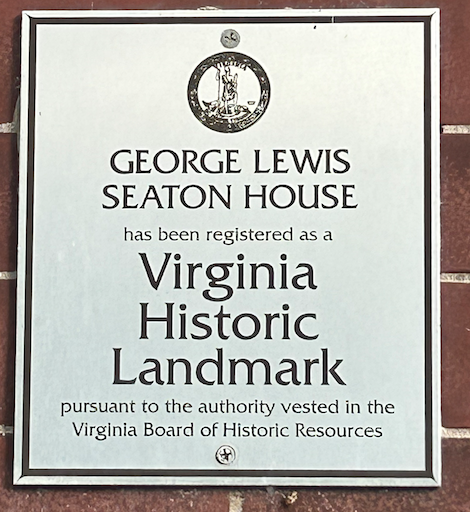
In recognition of its historical significance, the George Lewis Seaton House was proudly added to the Virginia Landmarks Register and the National Register of Historic Places in the early 2000s.
George Lewis Seaton’s Impact on Alexandria and Beyond
Seaton’s influence wasn’t confined to carpentry. He ventured into the political arena, attending Republican Party meetings, gracing conventions, and even winning a seat in the House of Delegates, where he represented Alexandria from 1869 to 1871. Seaton also served on the federal grand jury that took up the treason case against Jefferson Davis, adding another layer to his multifaceted contributions to history.

George Lewis Seaton’s Role in Building Alexandria’s Schools
But his heart was always with the community. He was instrumental in building schools for African Americans and proudly served as a trustee of the First Free School Society of Alexandria. His craftsmanship, a testament to his dedication, can be seen across Alexandria. Seaton’s touch is evident from municipal buildings to the Odd Fellows Hall, the latter of which is listed on the National Register of Historic Places. Throughout his life, he remained a fervent advocate for education, championing equal rights and opportunities for African Americans.
Where is George Lewis Seaton Buried? The Mystery of His Final Resting Place
For all his contributions to Alexandria, the final resting place of George Lewis Seaton remains a mystery. While many believe he is buried in Trinity United Methodist Cemetery, part of the Wilkes Street Complex, others speculate that he could be interred at Union Cemetery. However, no official records confirm his burial site.
Despite this uncertainty, George Lewis Seaton’s impact is deeply felt across Alexandria. George Lewis Seaton’s contributions to education, politics, and the Hayti Neighborhood continue to inspire future generations. Walking past 404 S. Royal Street, one can almost hear the echoes of the past—reminders of Seaton and the trailblazers who shaped the city’s future.
The Enduring Influence of George Lewis Seaton in Alexandria Today
George Lewis Seaton’s journey from a free Black child born in 1822 to a pillar of Alexandria’s community is a story of perseverance, education, and unwavering commitment to the betterment of society. His legacy in the Hayti Neighborhood and beyond serves as a beacon, inspiring future generations. His story is told in his own voice at Stop 10 of the From Enslavement to Justice walking tour, as guests pass Trinity Methodist Cemetery.
Updated October 2026 with family details from the Free Negro Registers and the Bernstein study, with T. B. McCord’s history of the 400 block of South Royal Street, and with links to the Seaton family trees.
Sources of Information
Alexandria Times. (2021, April 29). Hayti: One of Alexandria’s first African-American neighborhoods.
Bernstein, P., et al. (2001). The life and times of George Lewis Seaton. Alexandria Archaeology Publications (No. 121). (Printed 2003).
McCord, T. B., Jr. (1985). Across the fence, but a world apart: The Coleman site, 1796–1907. Alexandria Archaeology Publications (No. 126). (Reprinted 2006).
Pippenger, W. E. (1992). Tombstone inscriptions of Alexandria, Virginia: Volume 1. Family Line Publications.
Pippenger, W. E. (2014). Tombstone inscriptions of Alexandria, Virginia: Volume 5. Heritage Books.
Pro-vine, D. M. (1990). Alexandria County, Virginia, free Negro registers, 1797–1861. Heritage Books.
Virginia MLK Commission. (n.d.). Biography of George Lewis Seaton. Retrieved September 11, 2023.