The Fugitive Slave Act of 1850, authored by James Murray Mason, stands as one of the most contentious laws in American history. As a U.S. Senator from Virginia, Mason introduced this legislation as part of the Compromise of 1850, requiring the return of escaped slaves to their owners, even from free states. This act, formally known as the Fugitive Slave Act, significantly heightened tensions between North and South, setting the stage for the Civil War.

James Murray Mason is buried in Alexandria, in the Mason family plot in Christ Church Cemetery, part of the Wilkes Street Cemetery Complex, beside his father, General John Mason. The family’s graves are among the stories on our guided walk through the Wilkes Street Cemetery Complex.
Mason was born on November 3, 1798, on Analostan Island, also known as Mason’s Island and now called Theodore Roosevelt Island, in Arlington County, Virginia. He studied at the University of Pennsylvania and The College of William and Mary. He worked as a lawyer in Frederick County, Virginia. He served as a representative for that county multiple times in the Virginia House of Delegates from 1826 to 1832, except for 1827-1828.
He served as a representative for Virginia’s 15th Congressional District during the 25th Congress of the United States from March 4, 1837, to March 3, 1839.
In 1847, he was elected as a Democrat to the United States Senate to fill the vacancy left by the death of Isaac S. Pennybacker. He was reelected in 1850 and 1856 and served from January 21, 1847, until March 28, 1861, when he left the Senate after supporting Virginia’s decision to leave the Union.
Before he left, he worked privately, using his position as a United States Senator to obtain necessary information for the new Southern Confederacy. Soon after, he was chosen as one of Virginia’s delegates to the Provisional Confederate Congress, where he served in 1861 before the Confederacy sent him to Europe.
He and nine other Southern senators were formally expelled from the United States Senate on July 11, 1861, for supporting the rebellion against the United States.
James Murray Mason: A Fierce Advocate for Slavery
Mason was known as confident, bossy, and arrogant; he firmly believed that each state should have the power to make its own decisions. He firmly believed that slavery was an essential part of Southern society, and he was among the first to think Virginia should leave the United States, especially if it meant keeping slavery safe.
Unlike many of his friends, who were part of the American Colonization Society, he believed that the solution to the issue with “free blacks” was to send them back to slavery. He also believed that blacks were the “major problem of the country.”
When California asked Congress to join the United States in 1850 as a state without slavery, it caused more problems between the Southern and Northern states. Many people from the South believed California would be a good place for slavery, but the gold rush in 1849 brought in many people who preferred free work instead of using slaves. Senators like Mason and Jefferson Davis from Mississippi were very angry about this.
Mason and nine other Senators from the South disagreed with the California bill. They expressed their concerns in a letter to their colleagues.
“Because the right of the slaveholding States to a common and equal enjoyment of the territory of the Union has been defeated by a system of measures which, without the authority of precedent, of law, or of the Constitution, were manifestly contrived for that purpose, and which Congress must sanction and adopt, should this bill become a law.”
— James M. Mason, as quoted in The Public Life and Diplomatic Correspondence of James M. Mason (p. 79)
James Murray Mason and the Fugitive Slave Act of 1850
One of the things that bothered the South about the North was that the North was sheltering enslaved people who ran away from the South to be free. These escaped enslaved people were called “fugitive slaves,” and they were often protected by local communities in the North who mostly ignored the 1793 Fugitive Slave Act. This act permitted local governments to capture and send back escapees to their owners, and it also punished anyone who helped them escape.
Realizing that California would most likely join the United States, Mason wrote and introduced the Fugitive Slave Act: “I introduced the bill here to fulfill my duty to the people I represent and in obedience to the instructions of the General Assembly of Virginia. I must admit,” he continued, “that although the bill and the amendments have been carefully crafted and the amendments have received approval from the Committee on the Judiciary, I have little hope that it will provide the intended remedy. I’m afraid that even this law will have little effect in protecting the rights of those it’s supposed to benefit. However, if the proposed solutions could be enforced, they would be of great value and importance, not only to the people of the State I represent, but to all the Southern States currently holding the African race in slavery.”
After much discussion, the law was ultimately approved along with four other laws, collectively known as the Compromise of 1850. These other laws involved granting California the status of a non-slavery state, banning the trade of enslaved people in the District of Columbia, creating a government for the Utah Territory, determining the borders of Texas, and establishing the New Mexico Territory.
The Injustice of the Fugitive Slave Act
The Fugitive Slave Act of 1850 marked a dark chapter in American history, compelling federal officials across all states, including those where slavery was illegal, to assist in returning escaped enslaved individuals to their owners in the South.
The law imposed severe penalties on law enforcement officials, including Federal Marshals, who failed to arrest alleged runaway slaves. Non-compliance resulted in a $1,000 fine. These officials were required to detain suspected fugitive slaves based solely on a claimant’s affidavit.
The Act denied accused fugitive slaves the right to a jury trial and the opportunity to testify in their own defense. It also criminalized any assistance to these individuals, including providing food or shelter. Violators faced six months of imprisonment and a $1,000 fine. Officers who captured fugitive slaves were entitled to a fee, paid by the federal government.
This law significantly impacted Northern sentiment, galvanizing the abolitionist movement more than any prior event. Widespread opposition led to numerous violent confrontations, with free black communities and their allies actively resisting efforts to capture fugitive slaves. In a notable development, the Wisconsin Supreme Court declared the law unconstitutional in 1855.
Despite the law’s reach, only about 300 out of the thousands of self-emancipated individuals living in the North were forcibly returned to enslavement in the South. Many who had found refuge and built new lives in the North were compelled to flee again, seeking safety in Canada to evade pursuit by U.S. government agents.
Congress repealed the 1850 Fugitive Slave Act on June 28, 1864.
James Murray Mason and the Trent Affair
Mason is also famous for the Trent Affair, a diplomatic problem between the United States and Great Britain at the start of the American Civil War.
After leaving Washington for Richmond, he was chosen as Commissioner of the Confederacy to Great Britain and France and given the responsibility of persuading these two countries to acknowledge the new southern confederacy. While on the way to Great Britain, he and fellow commissioner John Slidell from Louisiana, who had managed to avoid the blockade and reach Havana, were forcibly removed on November 8, 1861, from the British mail steamer RMS Trent on the open sea by the USS San Jacinto, in violation of international law. Mason and Slidell were taken to Fort Warren in Boston, Massachusetts. 1

Ironically, the officer who led the boarding party that took Mason and Slidell off the Trent was Lieutenant Donald Fairfax, the San Jacinto’s executive officer. Donald was born at Mount Eagle, where the Montebello Condominiums are located, south of Alexandria. He was the only member of his family who supported the North during the Civil War. Fairfax County in Virginia is named after the Fairfax family.
The British were outraged and warned that they might go to war with the United States. Lincoln understood that he couldn’t fight two wars at the same time. Consequently, he chose to release Mason and Slidell, which occurred on January 1, 1862, permitting them to continue their diplomatic mission in Europe.
Mason’s strategy of using cotton as a diplomatic tool didn’t work, because British mills had stockpiled enough American cotton before the war to last about two years. They also believed that acknowledging Mason as a representative would anger the Union, and they wanted to retain access to essential ports like New York.
After the war, Mason escaped to Canada until President Johnson made a public announcement granting complete forgiveness and freedom from punishment for treason against the United States in 1868.
James Murray Mason’s Final Years at Clarens
Clarens Estate: A Historical Haven
After being pardoned, Mason returned to Alexandria and purchased the Clarens Estate, residing there until his death in 1871. Clarens, still standing today at 318 North Quaker Lane in Alexandria, VA, holds a significant place in history. Mason, however, famously refrained from using the house’s porches, as they offered a view of Washington D.C., the city he believed betrayed his Confederacy. He once remarked, “The feature that mars all is that we are but eight miles distant from Washington, that nest of serpents, which is in full view, but I have no communication with them.”
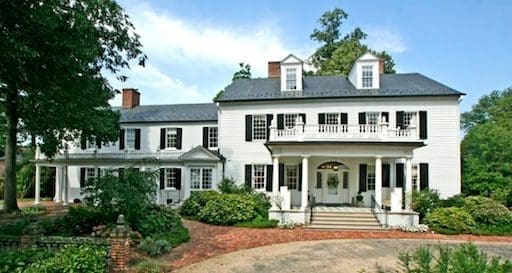
Clarens’ Role in Education and War
In the 1850s, Clarens was home to “The Fairfax School,” led by Reverend George Smith, educating notable students such as George Washington Custis Lee. During the Civil War, it served as a hospital, with Union troops building a fort on the estate. Post-war, Mason hosted notable figures at Clarens, including Jefferson Davis and Robert E. Lee. After Mason’s wife’s demise in 1874, Clarens evolved from a girls’ school to a private residence.
Family Life and Legacy
Eliza Margaretta Chew Mason
James Murray Mason’s life was deeply intertwined with that of his wife, Eliza Margaretta Chew, born at “Cliveden” in Germantown, Pennsylvania. Daughter of Benjamin Chew Jr. and Katherine Banning, she married Mason on July 25, 1822, and became Eliza Mason. The couple had eight children, and Eliza spent her final years at Clarens, passing away on February 14, 1874. She was buried in Christ Church Cemetery.
Mason’s Resting Place and Family Connections
James Murray Mason rests in the family plot beside his father, Brigadier General John Mason, who famously sent Francis Scott Key on his historic mission, indirectly leading to the creation of the National Anthem. Also in the family plot is his sister, Anna Maria Mason Lee, affectionately known as “Nannie,” who married Sydney Smith Lee, Robert E. Lee’s older brother. Mason’s grave is a site of historical significance, marking the legacy of a family deeply woven into the fabric of American history.
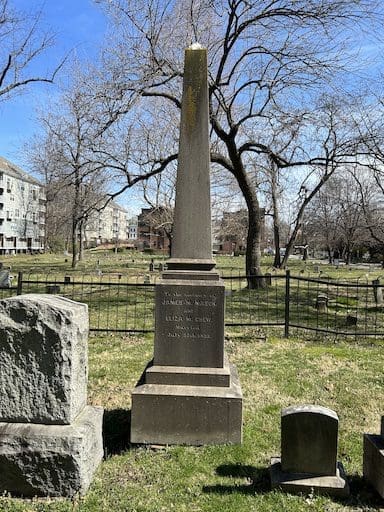
| JAMES MURRAY MASON of Selma, near Winchester. Va. Born November 3rd, 1798 Died at Clarens, Fairfax Co. Va. April 28th 1871 |
Visit James Murray Mason’s Grave
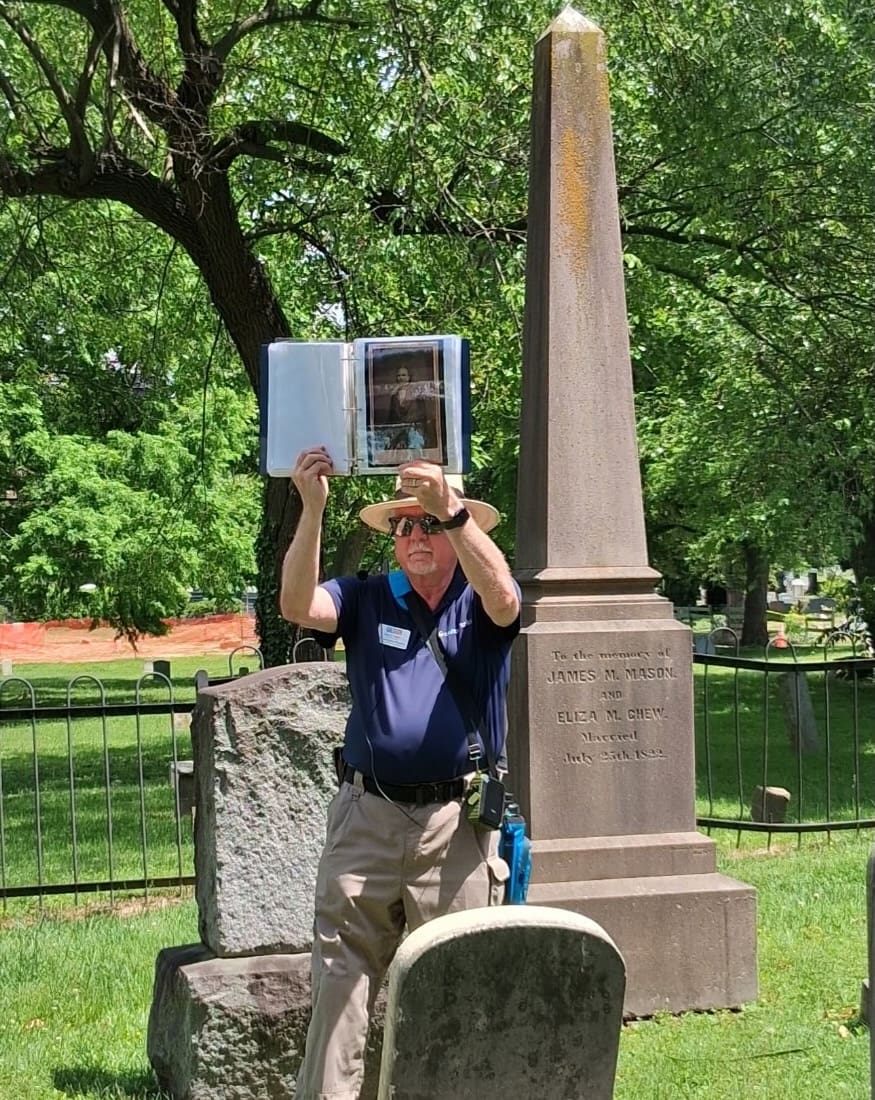
James Murray Mason, his father, and his sister rest within a few steps of one another in Christ Church Cemetery, and their stories are part of our 90-minute, historian-led Wilkes Street Cemetery Complex walking tour. You can also see all of our tour dates and options, or plan your own visit with the Christ Church Cemetery visitor information page.
Keep Reading
The story of James Murray Mason runs through several families buried in Alexandria. Read about his father, General John Mason, who sent Francis Scott Key on his 1814 mission; his brother-in-law General Samuel Cooper, the Confederacy’s highest-ranking general; the Mason family members buried in Christ Church Cemetery; and John Wilkes, the British radical whose great-nephew seized Mason in 1861. For the other side of the Fugitive Slave Act, the From Enslavement to Justice tour tells the story of slavery and freedom in Alexandria through voices connected to the Wilkes Street Cemetery Complex.
Sources of Information
Furgurson, E. B. (2004). Freedom Rising: Washington in the Civil War. Vintage Books.
Green, S. A. (1912). James Murray Mason and John Slidell in Fort Warren, Boston Harbor: With other matter relating to the War of the Rebellion. Cambridge, MA: John Wilson and Son, University Press.
Gunston Hall. (n.d.). George Mason’s descendants. Retrieved from https://web.archive.org/web/20090926055445/http://www.gunstonhall.org/library/masonweb/p6.htm#i256
Mason, V. (1906). The public life and diplomatic correspondence of James M. Mason: With some personal history. Washington & New York: The Neale Publishing Company.
Pippenger, W. E. (1992). Tombstone inscriptions of Alexandria, Virginia (Vol. 3). Westminster, MD: Family Line Publications.
Ricks, M. K. (2007). Escape on the Pearl: The heroic bid for freedom on the Underground Railroad. HarperCollins.
Thomas, W. G. III. (2022). Senator James Murray Mason, Black labor, and the aftermath of the Civil War [Blog post]. Retrieved from https://www.williamgthomas.com
City of Alexandria. (2023, June 12). Douglass Cemetery drainage and preservation update [Presentation]. Lee Center, Alexandria, VA
- Also removed from the Trent were James E. MacFarland, Mason’s private secretary, who is buried in Rock Creek Cemetery in Washington, D.C., and George Eustis Jr., a former U.S. Congressman and Confederate military aide to Senator John Slidell. Eustis remained in Paris until the end of the Civil War and was later commissioned by Elihu B. Washburne, U.S. Minister to France, to negotiate a postal treaty with the French government. He died in Cannes, France, on March 15, 1872, and is buried in Oak Hill Cemetery in Washington, D.C. Eustis was married to Louise Morris Corcoran, daughter of William Wilson Corcoran, a prominent financier, philanthropist, and art collector. After retiring from banking in 1854, Corcoran devoted himself to charitable works, including founding the Louise Home for Women and the Corcoran Gallery of Art in Washington, D.C. Louise died in Cannes in 1867 at the age of 29. ↩︎