Inside the base of the bell tower of the Old Presbyterian Meeting House, in a storage area most visitors never see, the church’s records place a small gravestone carved with two initials: “I. Y.” Donald C. Dahmann, the Meeting House archivist, has seen it there, and his roster of the historic congregation records the marker in the tower base as of 2009. The stone is all that Alexandria keeps of the John Yost gunsmith shop, which sold George Washington a rifle and armed Maryland’s soldiers.
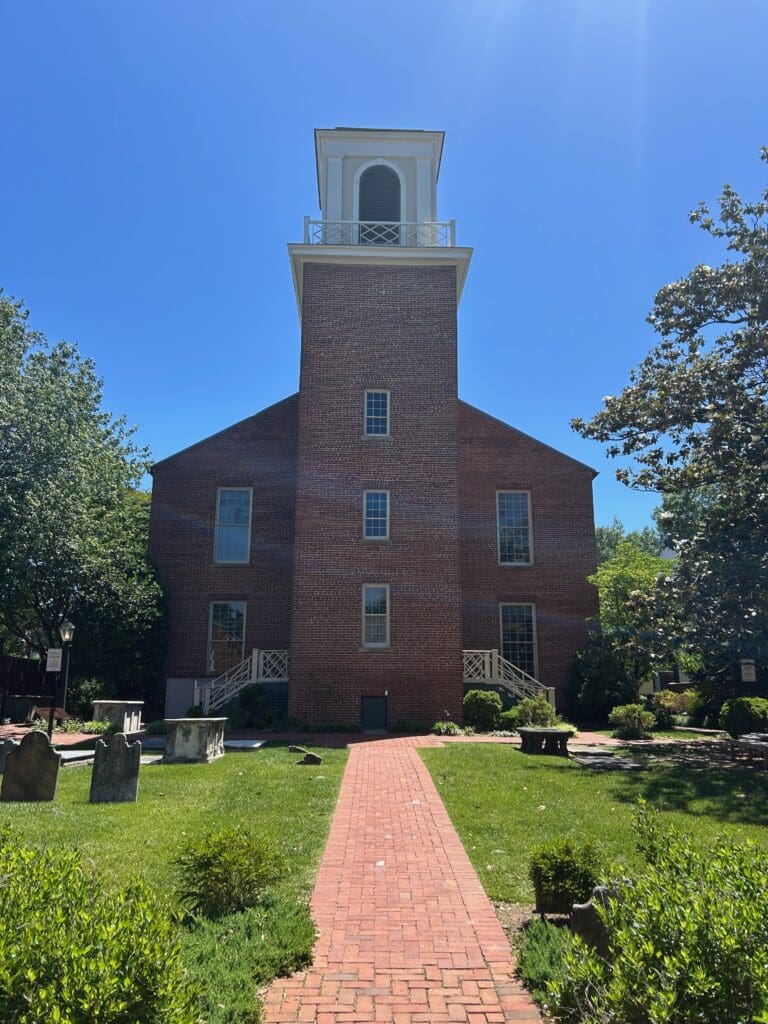
Yost was a gunsmith, blacksmith, and keeper of Alexandria’s town powder house. Plenty of patriots in this churchyard knew George Washington as a neighbor, a patient, a customer, or a friend. Yost’s connection is different. Washington carried his work.
Who Was John Yost? A Lancaster Gunsmith on the Potomac
John Yost was born in Lancaster, Pennsylvania, around 1743, at least by family reckoning. The Rev. James Muir, who recorded his funeral in 1806, put his age at seventy, which would push the birth back several years. Either way, the clerks of the day never settled on how to spell him: Yost, Youst, Yoast, Yoest, and, in Washington’s own account book, Jost.
In 1767 he married Rebecca Waggoner, daughter of Henry and Rebekah Waggoner of Lancaster. By 1770 the couple had moved to Georgetown, Maryland, where John and his brother Henry (later a gunsmith in Hagerstown) went into business together. The John Yost gunsmith shop, at First and High Streets, became one of the busiest on the Potomac.
George Washington and John Yost
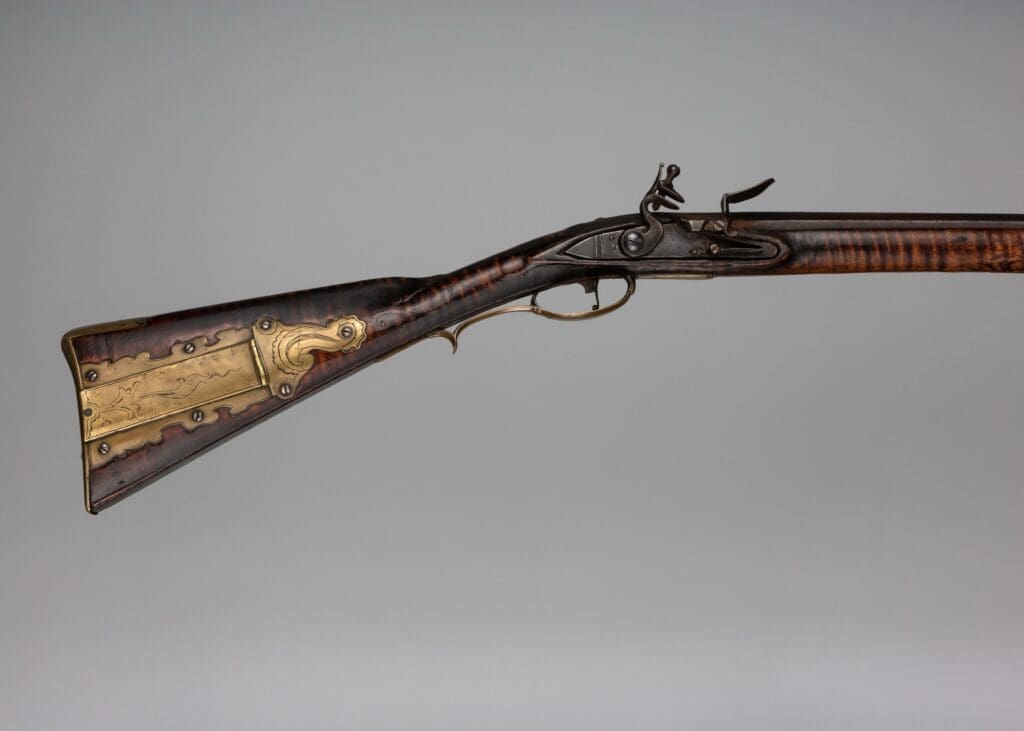
On March 5, 1770, Washington was hunting with his friend Robert Alexander. His diary notes that he rode over to Georgetown and returned that night. His ledger explains the side trip. He paid “John Jost” six pounds ten shillings in Maryland currency for a rifle.
For the John Yost gunsmith shop, that was custom work at a custom price, roughly a third more than the four pounds fifteen shillings Yost would later charge the state of Maryland per rifle during the war. Washington was a rifleman by long preference. He paid a premium for quality, and he paid it to a man who almost certainly lies somewhere in the Meeting House churchyard.
Arming the Revolution: Muskets and Rifles for Maryland
When the war came, the John Yost gunsmith shop became an arsenal.
As early as October 1775 John and Henry contracted with Maryland’s Committee of Safety to make muskets and bayonets exclusively for the Continental Congress: seventy-five stands to Annapolis by May 1776, and twenty-five more every month after that. On July 7, 1776, John signed on for 300 muskets and 100 rifles, and by late summer he had built a horse-powered mill in Georgetown to bore gun barrels.
The record follows him through the whole war. Maryland paid him for gun repairs in March 1776, shipped his muskets to the company at Port Tobacco in May, and advanced him money in August so he could keep producing “good substantial Musquets.” He swore the Maryland patriot oath in 1778 in Montgomery County.
As late as July 1781, a county official reported to the governor that Yost had repaired a batch of public arms and was working on the latest shipment, then warned that unless the state paid what it owed, its gunsmith would stop. Like many who armed the Revolution, Yost spent much of it asking his government to pay for what it had already fired.
John Yost in Alexandria and the Old Presbyterian Meeting House
Early in 1783, John and Rebecca moved their family to Alexandria. The household had numbered ten in the 1782 census. The John Yost gunsmith shop reopened on Lot No. 146, at the northwest corner of Wilkes and Fairfax Streets, two blocks from the Meeting House burial ground.
He worked there as gunsmith and blacksmith, kept the town’s powder house, and sold a little of everything, especially spirits. The man who had armed the Maryland Line spent his last twenty-odd years as a fixture of the port’s working streets.
He died in 1806 without a will. Muir conducted his funeral on March 8 of that year, and he was almost certainly laid to rest in the Meeting House churchyard. Rebecca outlived him into the following decade.
Where exactly he lies is no longer known. Muir’s register names no burial place, and the grave the stone once marked cannot be located. The stone itself was moved indoors at some point; when, and from where in the yard, no record survives. A family account places his burial instead at Christ Church, in the lot of Jacob Wess, but Muir’s funeral record and the surviving marker both point to this ground.
The initials on that stone are easy to overlook. The John Yost gunsmith story behind them, that of a Lancaster German craftsman whose rifles reached the Maryland militia, the Continental Line, and George Washington himself, has waited two hundred years to be told.
John Yost is one of the 162 documented Revolutionary War patriots buried in Alexandria. You can find his full entry, and the others, in the Alexandria Revolutionary War Patriots registry at gravestonestories.com, and hear his story on the Rebellious Scoundrels tour of the Old Presbyterian Meeting House.
Sources
Samuel Preston Adams III, “Henry and John Yost, Gunsmiths,” Sons of the American Revolution, Saramana Chapter. Reproduced in Yaacov Apelbaum, “Washington’s Mystery Firearm,” Revolutionary War Journal, May 4, 2020. https://revolutionarywarjournal.com/washingtons-mystery-firearm/
Archives of Maryland, vol. 11, Journal and Correspondence of the Maryland Council of Safety, 1775–1776, p. 214 (entry of 8 March 1776, payment to “John Youst” for repairing guns, near the foot of the page). Maryland State Archives. https://msa.maryland.gov/megafile/msa/speccol/sc2900/sc2908/000001/000011/html/am11–214.html
Archives of Maryland, vol. 47, pp. 351–352 (John Murdock to the Governor, July 1781). Maryland State Archives. https://msa.maryland.gov/megafile/msa/speccol/sc2900/sc2908/000001/000047/html/am47–351.html
Donald C. Dahmann, Roster of Historic Congregation Members of the Old Presbyterian Meeting House (unpublished manuscript), Alexandria, Va.
Peter Force, ed., American Archives, 4th ser., vol. 5, and 5th ser., vol. 1 (Washington, 1837–1853).
Donald Jackson, ed., The Diaries of George Washington, vol. 2 (University Press of Virginia, 1976), entry of 5 March 1770 and editorial note. Founders Online, National Archives. https://founders.archives.gov/documents/Washington/01-02-02-0005-0006
T. Michael Miller, Artisans and Merchants of Alexandria, Virginia, 1780–1820, vol. 2 (Heritage Books, 1991–92).
George Washington, General Ledger A, folio 302. George Washington Papers, Series 5, Financial Papers, Library of Congress. https://www.loc.gov/collections/george-washington-papers/
F. Edward Wright and Wesley E. Pippenger, Early Church Records of Alexandria City and Fairfax County, Virginia (Heritage Books, 2012), p. 152.
Yost family genealogy appendix (Rachel A. Yost correspondence), as cited in Dahmann.
Image sources
Bell tower of the Old Presbyterian Meeting House, Alexandria, Virginia. Photograph by David Heiby, Gravestone Stories.
Flintlock Longrifle, possibly by George Schreyer Sr., York County, Pennsylvania, ca. 1770. The Metropolitan Museum of Art, 2018.568. Public domain. https://www.metmuseum.org/art/collection/search/811888