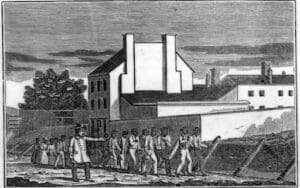
In May 1828, shortly after formalizing their partnership, the slave-trading firm of Franklin and Armfield rented the large brick house at 1315 Duke Street in Alexandria, Virginia. Originally constructed by General Robert Young—a militia commander, merchant, and civic leader buried in the Presbyterian Cemetery—the property was transformed into the headquarters of what would become the largest and most infamous domestic slave trading firm in American history.
By May 15, 1828, newspaper advertisements confirmed their relocation to 1315 Duke Street. City tax records and a federal census from 1830 show that they held up to 145 enslaved individuals on-site at one time, many of whom were chained and confined in basements, yards, or outbuildings modified specifically for human imprisonment. A city tax official chillingly referred to the property in 1829 as “Franklin’s blackhole.”
This site—once a private residence—became the physical and symbolic epicenter of the brutal expansion of slavery across the American South. Today, it is home to the Freedom House Museum, preserving the stories of those who passed through its walls.
Sources of Information
Bancroft, F. (1996). Slave trading in the Old South (with a new introduction by M. Tadman). University of South Carolina Press.
Rothman, J. D. (2021). The ledger and the chain: How domestic slave traders shaped America. Basic Books.
Skolnik, B. A. (2021). Building and property history: 1315 Duke Street, Alexandria, Virginia. Alexandria Archaeology, City of Alexandria. Retrieved from https://media.alexandriava.gov/docs-archives/historic/info/archaeology/1315dukestbuildinghistoryskolnik2021.pdf