Historic Context
Bethel Cemetery in Alexandria, VA, now occupies what was once part of Spring Garden Farm. In December of 1885, the land transitioned into the possession of the Bethel Cemetery Company’s stockholders. This incorporation had been sanctioned by the Virginia Assembly on December 15, 1885. The purchase price for the property amounted to $4350.00.
In a bygone era, an emerald-hued chapel graced the northwest corner of Section F. However, during the mid-1970s, it fell victim to a destructive fire.
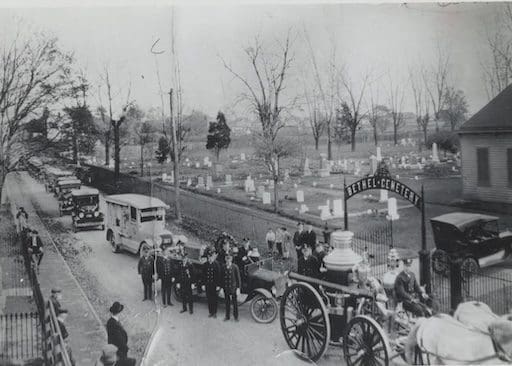
One of the earliest known photographs of Bethel was taken during the funeral of Alexandria firefighter Frank Entwisle. He was born in 1856 and died October 29, 1924. Entwisle is buried in plot A125 at Bethel Cemetery. In the photograph, a portion of the chapel can be seen. Interestingly, the image also captures a historic firefighting steam engine brought to Alexandria by the New York Zouaves during the Civil War. These engines, known as Amoskeags, were manufactured by the Amoskeag Manufacturing Company and were renowned for their reliability and efficiency. The chapel later fell into disrepair and was used as a tool and equipment storage area. It was destroyed when someone set it on fire in the mid-1970s.
Currently, the custodianship of the cemetery rests in the capable hands of Mr. James Click. A noteworthy detail is that Mr. Click represents the third consecutive generation of his family to take charge of this sacred site’s administration.
The tally of interments within the cemetery surpasses 12,000, rendering it the most expansive burial ground within the Wilkes Street Complex.
C
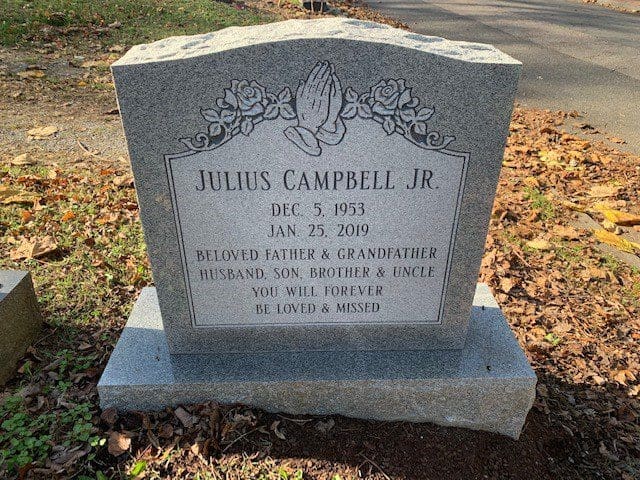
Julius Campbell, Jr. (December 5, 1953 – January 25, 2019), a Former high school football star portrayed in the 2000 Disney film “Remember the Titans“
Julius Campbell was a key figure in American high school football history. He was a leader on the football team at a newly integrated school in Alexandria, Virginia, in the early 1970s. He played a pivotal role in the team’s state championship win during a season filled with racial tensions. Campbell’s story and that of his teammates were immortalized in the 2000 film “Remember the Titans,” where actor Wood Harris portrayed him. The movie focuses on the integration of Alexandria’s high schools and the undefeated season that led to the Virginia AAA state championship. After graduating from T.C. Williams in 1973, Campbell attended Ferrum Junior College. He had a successful career with the Prince George County, Maryland, Department of Animal Services. Sadly, he died on January 25, 2019, at 65, due to organ failure. His legacy remains a symbol of unity and triumph over adversity.

Fields Cook (1820 – January 20, 1897) Notable Baptist minister, Republican Party leader, educator, and advocate for the rights of African Americans
Fields Cook (1820 – January 20, 1897) was a notable Baptist minister, Republican Party leader, educator, and advocate for the rights of African Americans during the 19th century. Born into slavery in King William County, Virginia, he purchased his freedom by 1850. He became an influential figure in Richmond, where he prospered as a businessman, teacher, and bank cashier for the Freedman’s Savings Bank. As a minister and political organizer, Cook actively fought for the rights of freedpeople, representing Richmond City at the Convention of the Colored People of Virginia in 1865, where he stood firm against racist threats.
Read more about him at this blog: Preserving History and Heritage: the Story of Douglass Memorial Cemetery and Fields Cook’s Enduring Legacy.
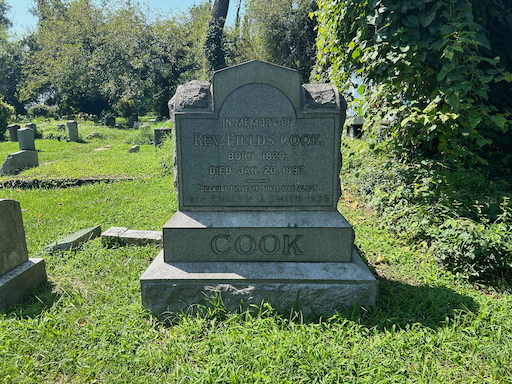
| In memory of Rev. FIELDS COOK born 1820 died Jan 20, 1897 Because I live, ye shall live also. |
P
George W. Petty: Proprietor, Foreman, and Chief
George W. Petty (c. 1851–1911) was a lifelong Alexandrian whose legacy is deeply tied to both the city’s business life and its firefighting history. Though early records of his childhood remain elusive, Petty first appears in Alexandria’s City Directory in 1876 as the proprietor of a saloon at the fish wharf. Over the decades, he operated several businesses—relocating from Union Street to Fairfax and eventually to Royal Street, where he lived and worked across from City Hall. By 1910, he was listed as the proprietor of a restaurant. He was married twice and had three children with his first wife, Margaret Ennis, who died in 1887 and is buried beside him.
Petty’s firefighting career began with the Sun Fire Company, though the exact date of his enrollment is unknown. When Sun went defunct after the Civil War, he joined the Hydraulion Fire Company and rose to become its foreman by 1876. Renowned for his bravery and leadership, Petty’s heroism was on full display during a major fire in 1896. Reports praised how he charged into the flames, directing his crew with tireless energy. At one point, he called for an axe to cut through a flooded floor so water could drain, then asked to move to where the fire was still burning—declaring he wanted “more to do.”
In 1897, Petty succeeded Edgar Warfield as Chief Engineer of the Alexandria Fire Department. His tenure was marked by professional excellence and public gratitude, with residents frequently publishing letters of thanks in the Alexandria Gazette. Petty often replied with humility and appreciation, reinforcing his reputation as both capable and compassionate.
On April 15, 1911, Chief Petty collapsed from a heart attack while responding to a fire on South Henry Street. He was rushed to the Alexandria Hospital but could not be revived, becoming the first firefighter to die in the line of duty since the catastrophic fire of 1855 that claimed seven lives. His funeral drew more than 200 Alexandria firefighters and dozens from Washington, D.C. His casket was borne on a hose reel, followed by his horse-drawn carriage draped in mourning and bearing his helmet, coat, and boots.
Though long buried in an unmarked grave at Bethel Cemetery, George W. Petty’s final resting place was recently rediscovered, and a gravestone now honors his legacy. He is remembered as a devoted public servant, respected businessman, and one of Alexandria’s most distinguished firemen.
Story based on research provided by Catherine Weinraub, Alexandria’s leading firefighting historian.
W
George Washington Whalen (1908–1925): Alexandria’s Boy Fireman
At just 15, George Whalen lied about his age to join the fire department—only to suffer fatal injuries battling his very first blaze. His six-month fight for life and the citywide outpouring of support that followed left a legacy of courage and community.
👉 Read the full story of the “Boy Fireman.”
This story was researched and provided by Catherine Weinraub, Alexandria’s leading firefighting historian.
Sources of Information
Pippenger, W. E. (1993). Tombstone Inscriptions of Alexandria, Virginia (Volume 4). Family Line Publications. Westminister, MD 21157.
Heiby, D. (2023, August 10). I want to thank Mr. Jim Holloway, Interpretive Program Coordinator, City of Alexandria, VA, at The Lyceum – Alexandria’s History Museum, for providing most of the source of information used to write the biography on the Reverend Fields Cook.