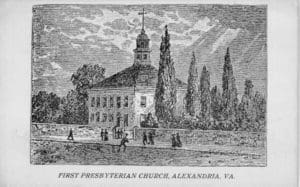
In 1775, Alexandria’s Presbyterian congregation completed its new sanctuary and burial ground on South Fairfax Street, establishing what would become one of the city’s most significant historic churches. The pulpit was originally positioned along the north wall, and worshippers were seated in simple benches—one surviving black bench remains in use today at the west end of the southern gallery.
Over the years, the sanctuary endured both natural and human-made damage. During the July 1786 hurricane, the roof was torn off and a wall and gallery collapsed. A violent hailstorm on June 7, 1811, shattered windows across the city—destroying some 300 panes of glass in the Meeting House alone.
A pipe organ built by Jacob Hilbus was installed in the south gallery in 1817, serving the congregation until it was destroyed in the 1835 fire. The original structure had no steeple or bell tower, but a cupola on the roof enclosed Alexandria’s first bell, cast by Morton and Foster of Loudoun County. This bell served not only to summon worshippers but also to alert townspeople to fires.
Despite multiple disasters—including the hurricane, hailstorm, and eventually the 1835 fire that gutted the sanctuary—the Meeting House and its burial ground remained central to Alexandria’s spiritual and civic life.