By the final days of 1862, the toll of war was becoming unmistakably visible in Alexandria’s burial grounds. A brief but telling local notice in the Alexandria Gazette reported that 197 Union soldiers had been buried at Penny Hill Cemetery since January 8, with another 724 interred in the city’s Union Cemetery.
These stark numbers offer a rare, contemporary glimpse of Alexandria’s role as a major wartime hospital center. Penny Hill, one of the earliest burial grounds in the Wilkes Street Cemetery Complex, was a large municipal field established in 1796. By the Civil War, it had become a common resting place for soldiers who died in the city’s overflowing military hospitals.
Today, Penny Hill remains an open grassy expanse, with few—if any—visible gravestones marking its thousands of burials. The exact fate of the Union dead once recorded there is uncertain. Many were likely reinterred at Alexandria National Cemetery, established in 1862 specifically to serve as a permanent military burial ground. No known roster survives confirming individual transfers, leaving the story of these soldiers partially untold.
Still, the December 1862 newspaper record preserves a poignant truth: nearly 200 soldiers had already been laid to rest at Penny Hill by year’s end, silently testifying to the immense human cost of war in this once-quiet Virginia town.
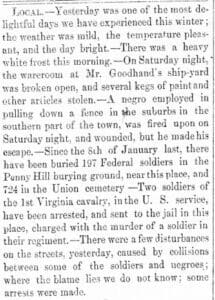
Image Description:
A black-and-white newspaper clipping from the Alexandria Gazette, dated December 29, 1862, under the section titled “Local.” The column contains brief local reports, including pleasant winter weather, a theft at Mr. Goodhand’s shipyard, a shooting incident involving an enslaved man attempting escape, and several Civil War-related notes. Most notably, it reports:
“Since the 8th of January last, there have been buried 197 Federal soldiers in the Penny Hill burying ground, near this place, and 724 in the Union cemetery.”
It also mentions the arrest of two soldiers from the 1st Virginia Cavalry, in the U.S. service, charged with the murder of another soldier in their regiment.
Clarification: While many readers may associate the 1st Virginia Cavalry with the Confederate unit famously commanded by J.E.B. Stuart, the newspaper here refers to the 1st Virginia Cavalry Regiment (Union) — a completely separate unit in U.S. service. This Union regiment was organized in Winchester, Virginia, in July 1861, and uniquely included twelve companies. Its men hailed from a range of counties in what is now Virginia and West Virginia, including Frederick, Berkeley, Rockbridge, Clarke, Washington, Augusta, Jefferson, Amelia, Loudoun, Rockingham, and Gloucester.
The column also briefly references street unrest involving soldiers and African Americans, noting arrests but offering no attribution of blame. The clipping is printed in small serif type typical of the 19th century and shows signs of aging such as mild ink fading and paper wear.