Philip Richard Fendall, Sr. first entered public life well before the American Revolution moved onto the international stage. On June 14, 1774, he was appointed by Charles County as one of its delegates to the Provincial Convention in Annapolis, placing him among the early colonial leaders responding to Britain’s escalating political crisis.
Fendall’s role would soon expand beyond colonial resistance to international diplomacy. In early 1778, he was in Paris, serving as secretary to his cousin Arthur Lee, one of the American commissioners negotiating an alliance with France alongside Benjamin Franklin and Silas Deane. Signed on February 6, the Treaty of Alliance secured crucial French military and financial support—aid that would prove decisive at Yorktown in 1781.
Fendall’s presence within this diplomatic circle is confirmed by John Adams, who recorded the following in his diary while in France:
“Dined at Mrs. Chaumont’s with a great deal of company. After dinner took a walk to Chaillot to see Mr. Lee, who had a large company of Americans to dine with him, among them Mr. Fendell (sic) of Maryland.”
— Diary and Autobiography of John Adams, ed. L. H. Butterfield, vol. 2, p. 312.
This brief but telling entry places Fendall squarely within the social and political orbit of the American commissioners abroad, offering a contemporaneous glimpse of the networks that helped carry the Revolution to its successful conclusion.
After the war, Fendall settled in Alexandria. In 1785, he built what is now the Lee-Fendall House, a residence that would become deeply intertwined with both local heritage and national history.
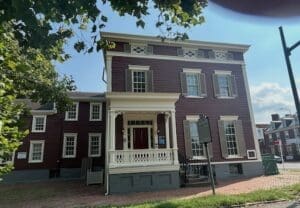
When Fendall died in 1805, he was buried on his 15-acre farm near today’s Slaters Lane and Route 1. During the early 20th century—when this area was radically transformed by the construction of Potomac Yard, one of the largest railroad classification yards on the East Coast—it appears likely that Fendall and the remains of two of his wives were disinterred and reburied at Ivy Hill Cemetery.
While no surviving record documents the precise date of removal, the timing aligns closely with the clearance and grading of former farmland between 1903 and 1908 for railroad infrastructure, a process that displaced numerous earlier burial sites in this corridor.
This rediscovery and reconstruction of Fendall’s burial history is documented in Gravestone Stories: Unraveling the Mystery: The Burial Place of Philip Richard Fendall Revealed
A fun aside: The high-stakes world of Franklin’s French diplomacy has been vividly dramatized in the 2024 Apple TV+ miniseries Franklin, starring Michael Douglas—a reminder that the individuals Adams mentioned almost casually in his diary were shaping the outcome of the war.