Interactive Map of Fallen Firefighters in Alexandria, VA
Historic Cemetery Locations
Honoring the brave firefighters and leaders who served Alexandria from 1774 to today
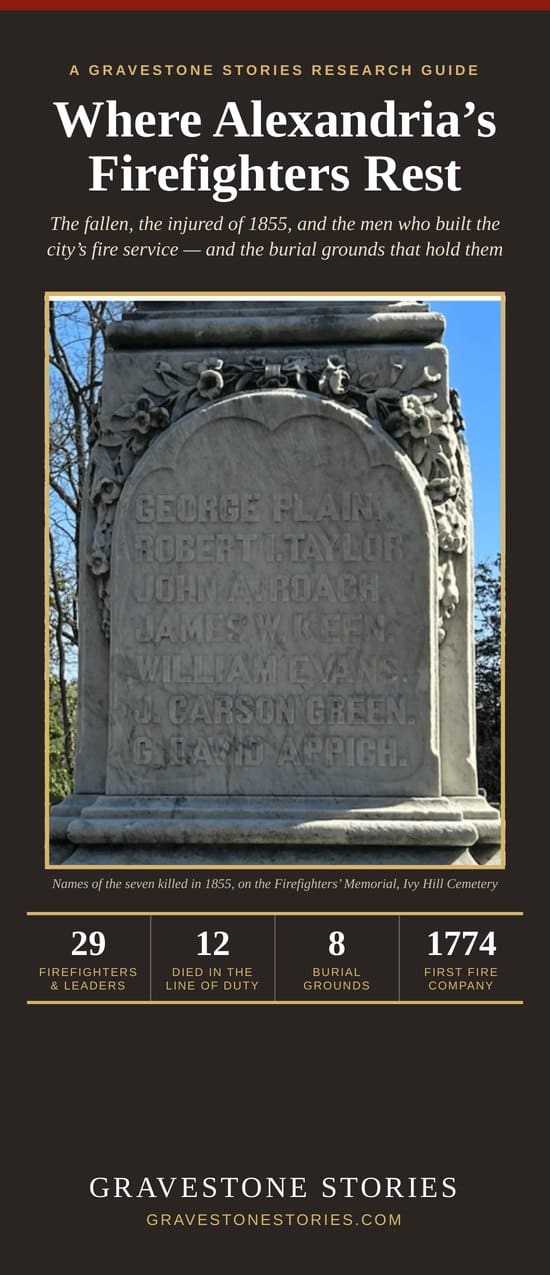
Prefer It in Print?
Every grave on this map is also in our free tri-fold guide, Where Alexandria’s Firefighters Rest: twenty-nine firefighters and fire company leaders grouped by burial ground with plot references, the story of the 1855 Dowell China Shop Fire and where each of the seven rests, and the Firefighters’ Memorial at Ivy Hill Cemetery. Print it or save it to your phone before you visit.
Download the Brochure More Free GuidesAbout Alexandria’s Fire Department History
Alexandria’s fire service began in 1774 with the establishment of the Friendship Fire Company, the first volunteer firefighting organization in the city. This interactive map honors the fallen firefighters Alexandria has lost over nearly 250 years of service, along with injured heroes and fire service leaders buried throughout the city’s historic cemeteries. Special focus is given to the tragic 1855 Dowell China Shop Fire that claimed seven brave firefighters in a single night.
Major Fire Companies: Friendship (1774), Sun (1775), Relief (1788), Star (1799), Hydraulion (1827)
Transition to Professional Service: 1866 – First paid firefighter Joseph H. Young hired as engineer to maintain the city’s horse-drawn steam engine left by Union troops.
Four Major Fires That Shaped Alexandria
The Waterfront Fire of 1810: On September 24, 1810, an unattended candle in Lawrence Hill’s cooper shop ignited Alexandria’s waterfront. Fire companies battled through the night with hand-pumped engines and bucket brigades, with critical assistance from “persons of color” who worked the fire engines. Three days later, the Sun Fire Company formally appropriated Twenty Dollars to reward these Black firefighters—one of the earliest documented instances of African Americans serving in Alexandria’s fire protection efforts.
The Great Fire of 1827: Started in James Green’s cabinet shop at King and Royal Streets on January 18, 1827. Visible from Washington D.C., it consumed dozens of buildings in bitter 13°F cold, demonstrating the importance of mutual aid between fire departments.
The Dowell China Shop Fire of 1855: A deliberately set arson fire on November 16-17, 1855, that claimed seven firefighters when a warehouse wall collapsed at 4:00 a.m. This tragedy led to improved firefighting procedures and the memorial at Ivy Hill Cemetery.
The City Hall Fire of 1871: On May 19, 1871, fire destroyed City Hall including Benjamin Latrobe’s historic 1817 steeple design, representing a major loss of early American architecture.
Alexandria’s Early Fire Companies
The Colonial Era Foundations of Modern Fire Protection
Market Square: The Heart of Fire Protection
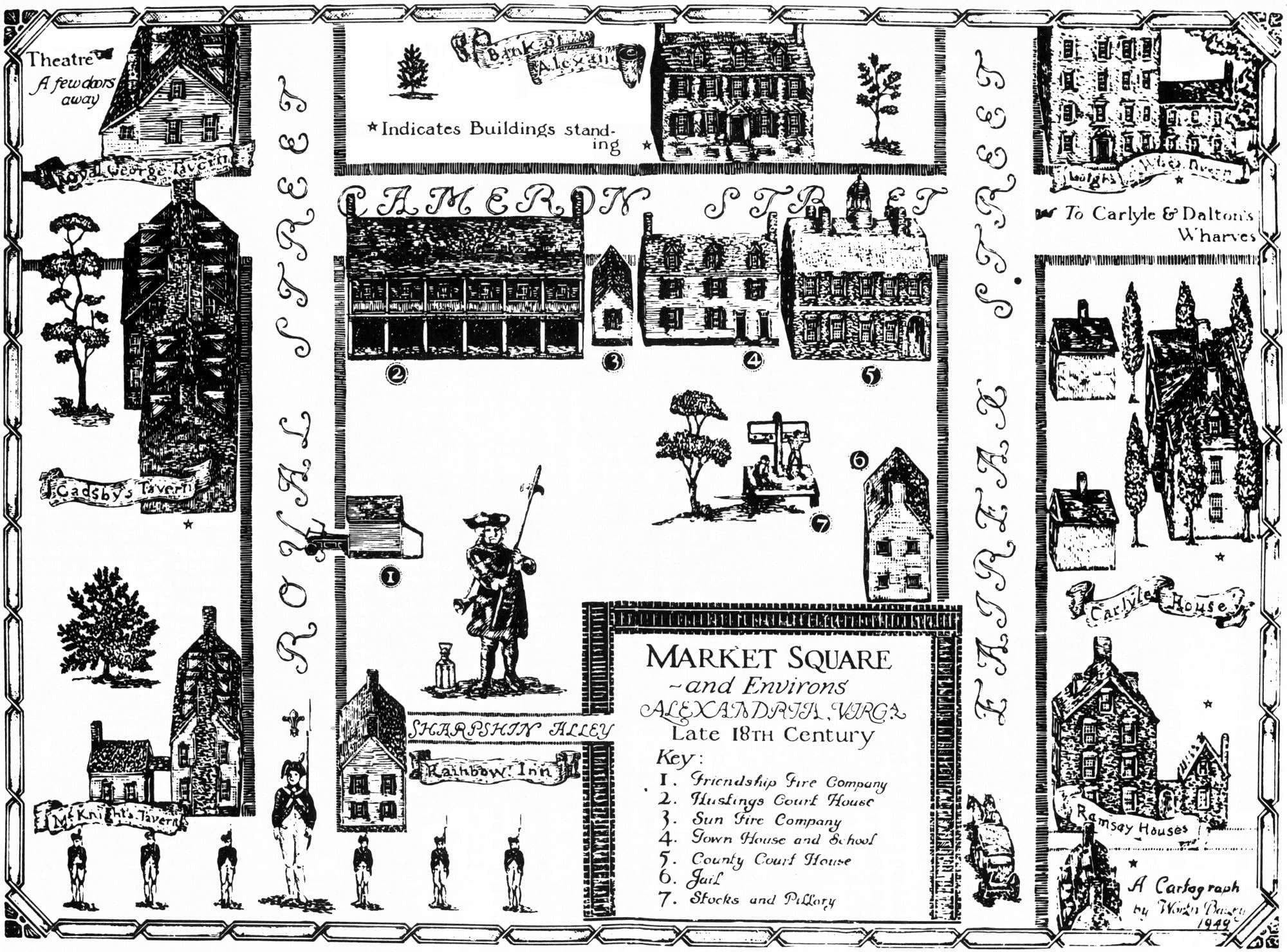
Cartograph of the Market Square and Fairfax County Courthouse in Alexandria, as they might have appeared in the eighteenth century. Drawn by Worth Bailey, 1949.
In colonial Alexandria, Market Square served as the focal point of the city’s earliest fire protection efforts. Two pioneering fire companies established their presence here in the 1770s, marking the beginning of organized firefighting in the growing port city.
The location was strategically chosen for its central position in the city, allowing quick access to both the waterfront commercial district and the residential areas spreading inland. Market Square’s prominence as a gathering place also ensured that volunteers could be quickly assembled when the call came.
A colonial fire engine, similar to those housed by Alexandria’s early fire companies. From “Seaport in Virginia: George Washington’s Alexandria” by Gay Montague Moore, 1949, page 147.
The Presbyterian Meeting House: Strategic Fire Protection
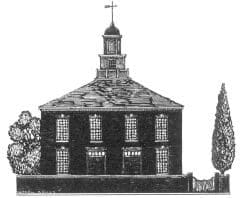
The Old Presbyterian Meeting House before the 1835 fire that gutted the building. From “Seaport in Virginia: George Washington’s Alexandria” by Gay Montague Moore, 1949, page 139.
Beginning in 1794, the Relief Fire Company established their headquarters at the northeast corner of the Presbyterian Meeting House churchyard, where they would remain for four decades.
Perhaps most importantly, the Meeting House housed the town’s only bell from 1790 to 1817. This bell served as Alexandria’s primary communication system, alerting citizens to fires and other emergencies throughout the community.
The Relief Fire Company’s engines were positioned to primarily serve the southside of Alexandria, complementing the Market Square companies’ coverage of the northern districts and waterfront areas.
Legacy Continues: From Relief to Station 1
The tradition of fire protection that began with Relief Fire Company at the Presbyterian Meeting House continues today. The company that once operated from the churchyard evolved into what is now Alexandria Fire Engine Station Number 1, located at 317 Prince Street.
Then and Now
From hand-pumped engines and volunteer bucket brigades to modern apparatus and professional firefighters, Alexandria’s commitment to protecting its citizens spans over 250 years.
Firefighter Memorials
Sources & Attribution
Primary Sources:
- Alexandria Gazette (Alexandria, Virginia). (1810, September 29). At a Meeting of the Sun Fire Company of Alexandria, Sept. 27, 1810. Page 3. newspapers.com
- Dahmann, D. C. (2002). The Roster of Historic Congregational Members of the Old Presbyterian Meeting House.
- Moore, G. M. (1949). Seaport in Virginia: George Washington’s Alexandria. The University Press of Virginia.
- Office of Historic Alexandria. (n.d.). Historic Waterfront Plan: Chapter 5. City of Alexandria. alexandriava.gov
- Official website of the Old Presbyterian Meeting House. opmh.org/history
- Official archives website of The Washington Post. Washington Post Archives
- Official website of the Friendship Firehouse Museum. friendshipfirehouse.net
- Reber, P. B. (2010). Jamieson Bakery, Alexandria Va.
- Weinraub, C. (2017). The Firefighter’s Memorial in Ivy Hill Cemetery. The Alexandria Chronicle, Fall 2017.
- Weinraub, C. (2023). Friendship Fire Company 250th Anniversary 1774-2024. Friendship Veterans Fire Engine Association.
- Weinraub, C. Alexandria Fire of 1855: A Night of Tragedy & Heroism. Gravestone Stories.
- Weinraub, C. History of Firefighting in Alexandria. Friendship Fire Company.
Additional Sources:
- City of Alexandria Fire Department records and Roll Call of the Fallen
- Alexandria Historical Society archives
- Cemetery historical records and burial documentation
- Various Alexandria historical publications and newspaper archives