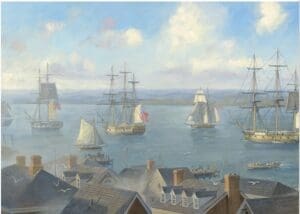
In the aftermath of the British burning of Washington in August 1814, Commodore James Gordon’s Potomac Squadron advanced up the river and demanded the surrender of Alexandria. On August 28, town leaders—including Mayor Charles Simms and Edmund Jennings Lee Sr.—negotiated terms to prevent the city from being shelled.
To avoid destruction, Alexandria agreed to surrender supplies. Over the course of a five-day occupation, British forces seized large quantities of flour, tobacco, cotton, and 21 merchant ships—stripping the port of valuable goods but sparing the town’s buildings.
Among the British warships anchored during the occupation was the H.M.S. Terror, a powerful bomb ship designed to launch explosive shells. Three decades later, the Terror would be refitted for polar service and sent on the 1845 Franklin Expedition, a doomed voyage to find the Northwest Passage. Commanded by Sir John Franklin, the expedition ended in catastrophe—both ships vanished, and all 129 crew members perished, their fate remaining one of the greatest maritime mysteries in history.
Thus, one of the ships that once loomed over Alexandria’s harbor would later disappear into the Arctic ice, linking this quiet Virginia port to a global tale of exploration and tragedy.