When President George Washington laid the first cornerstone of the U.S. Capitol on September 18, 1793, the occasion was marked by a grand Masonic ceremony, parade, and feast. Among those who took part was Reverend James Muir, D.D., pastor of Alexandria’s Presbyterian Meeting House. His presence, captured in a mural that today is in the Cox Corridors of the Capitol, symbolized Alexandria’s deep connection to the new nation’s founding moments.
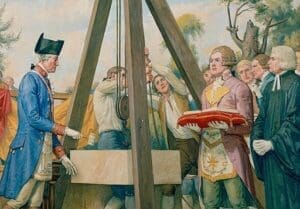
Muir was a respected scholar and preacher who guided his congregation through the early years of the republic. In the Cox mural, he stands on the far right, his identity confirmed decades later when the artist, Allyn Cox, wrote to church historian Mary Lloyd Fawcett verifying the likeness.
Though the original Meeting House sanctuary burned in 1835, Muir remains interred within its walls. He lies 13 feet beneath the north aisle floorboards of the rebuilt 1837 sanctuary, near where the first pulpit once stood.
Reverend James Muir’s legacy endures not only in the Capitol he helped dedicate but also in the sanctuary that still holds his remains—linking Alexandria’s sacred ground to the nation’s civic heart. And thanks to Mary Lloyd Fawcett’s mid-20th-century research, which confirmed his role at the Capitol ceremony, the story continues forward: she herself now rests in St. Paul’s Cemetery within the Wilkes Street Cemetery Complex, a reminder of how Alexandrians across generations have preserved their city’s place in America’s story.